Module Overview
SE5100 covers the principles, methodologies, and tools for rapid application development — approaches that prioritise speed of delivery, iterative development, and stakeholder collaboration over rigid upfront planning.
High-Yield Topic Clusters
| Topic Cluster | Key Exam Patterns |
|---|
| Process Model Selection | Waterfall vs Spiral (drivers/flaws), Prototyping (not standalone), Incremental Development, 5 core attributes, exponential cost, safety-critical vs consumer tech scenarios |
| RAD vs. Agile | 7-dimension comparison; RAD timeboxing; Agile umbrella; 4 Pillars; 4 Phases; RAD Design Model; 4 Issues |
| Scrum | Roles (ScrumMaster vs PO), ceremonies (Review=product vs Retrospective=process), DoD 5 criteria, Burndown Chart, user story format |
| XP | TDD, Refactoring, Pair Programming — Scrum teaches management, XP teaches code quality |
| DevOps and CI/CD | CI vs CD; 8-stage lifecycle; 6-stage pipeline + 4 properties; Docker vs Kubernetes; IaC 5 properties; 4 trade-offs; stats: 10x/30%/60% |
| Observability | Three Pillars: Logs (what?), Metrics (how?), Traces (where?); USE + RED methods; Observability vs Monitoring |
| Release Strategies | Blue-Green (instant swap, double infra), Canary (gradual %), Feature Flags (decouple deploy/release); comparison table |
| DDD | Ubiquitous Language (same terminology), Bounded Contexts (prevent model corruption) |
| Kanban | WIP Limits, Pull System, "Stop Starting Start Finishing", continuous delivery; Kanban vs Scrum 6-dimension comparison |
| RAD Teams | 6 roles; servant leadership; 4 sourcing strategies; T-shaped professional; 4-stage onboarding; 6 knowledge transfer practices; 4 tracking metrics; UCD Cycle; JRP/JAD |
| CASE Tools | Unified analysis-to-code pipeline; Visual Modeling; 4GL; Component Repositories (84% cost); RepoGuard |
| Low-Code / No-Code | "Prototype IS the Product"; Quickbase/Caspio; Prototype Fidelity (Lo-fi vs Hi-fi); Ajax; JRP & JAD |
| Product Management | PM definition; "Fall in love with the problem"; User Persona 6 components; PM vs PM vs PO; PLC 5 stages (Nokia); Product Dev 6 stages; MVP |
| SE Ethics & Legal | ACM/IEEE Code; ISO 27000 series; Legal attack surface; Geographical compliance; BA case study (£20M) |
| SOLID | 5 principles; Code Viability Matrix; CI/CD Guardrail Funnel; Knight Capital case study ($460M) |
| Professional Practices | Dynamic Tension Web; Complete Engineer; SRE + SLOs + Error Budgets; Green SE Carbon Stack; Groupthink Decay Curve; Sociotechnical Ecosystem |
| Lean | Origins (Toyota TPS → Poppendiecks 2003); 7 Principles; 7 Wastes; Kaizen/PDCA; 4 Anti-Patterns; 24→11 day worked example |
| VSM | VSM definition; 21-day pipeline example (31% value-adding, 69% waste); 6-step workshop; 6 Lean Metrics incl. Little's Law and DORA |
| GenAI in RAD | GenAI Development Loop (6 stages); Traditional vs GenAI RAD comparison; Role transformations; 4 Risks; Strategic Methodology Mapping |
| Revenue Models & Licensing | 4 revenue models; 5 transaction sub-types; 5 license categories ordered by restrictiveness; Copyleft vs Proprietary distinction |
Study Gaps (Not Yet in Notes)
Note: DSDM — named in lectures but not covered in depth. Design Patterns — named only in L1. "4 golden signals" (Latency/Traffic/Errors/Saturation) — mentioned in assignment, not covered in lecture body. No past papers ingested.
1 — Process Model Selection
Method Selection Principles
| Principle | Detail |
|---|
| No "Best" Methodology | Every project is different. The best method is the one that fits your context — not the newest or most popular |
| Context Determines Choice | Requirements clarity, timeline, team size, and risk tolerance all influence the decision |
| Predictability vs Adaptability | This is the fundamental trade-off. Know which one your project needs most — it drives all other choices |
Important: "Success is not about choosing the newest method, but matching the process to specific constraints."
What is Software Engineering?
| Perspective | Detail |
|---|
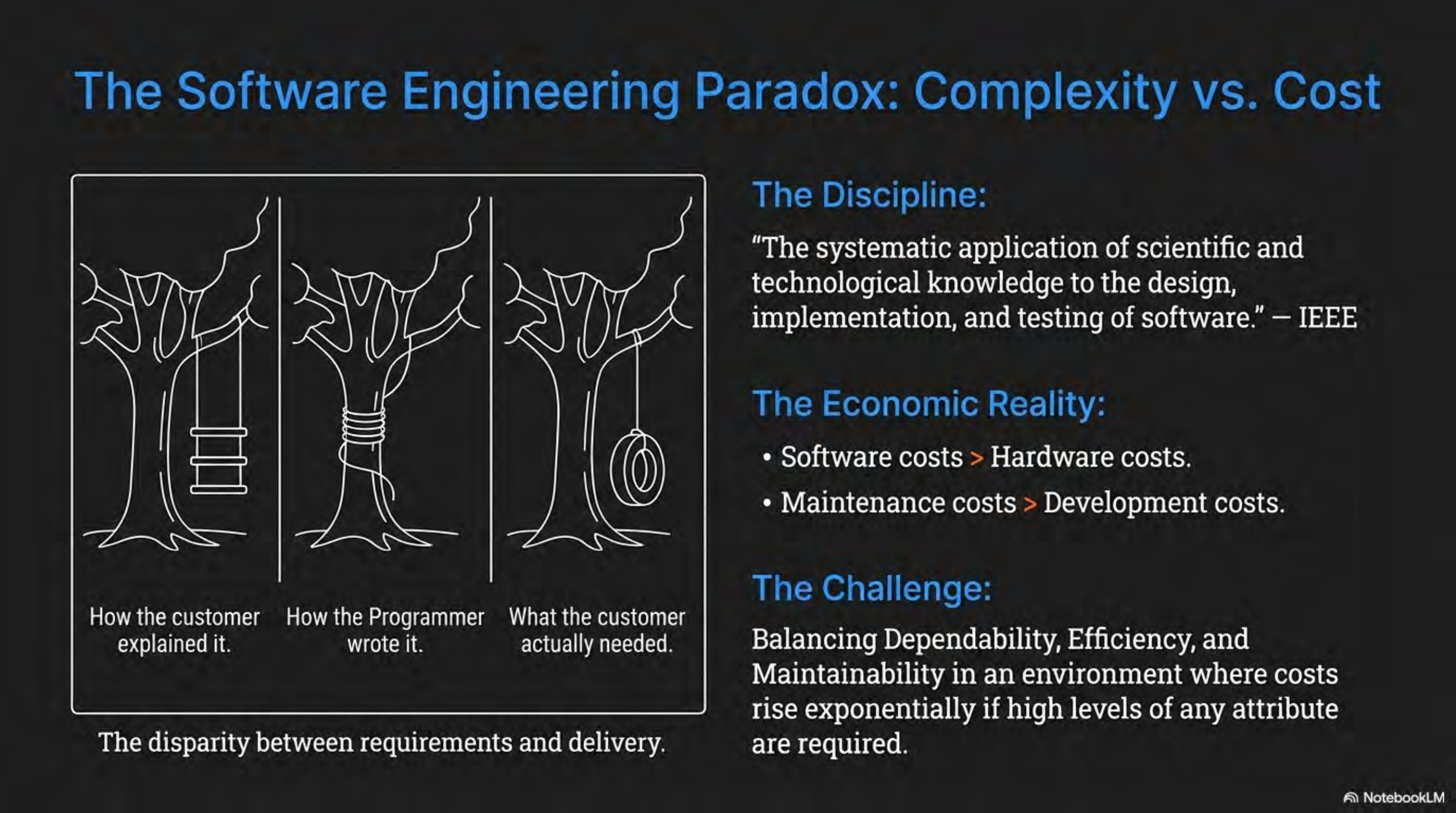
| IEEE Definition | "The systematic application of scientific and technological knowledge to the design, implementation, and testing of software." |
| Google's Perspective | "Programming integrated over time" |
| Economic Reality | Software costs > Hardware costs; Maintenance costs > Development costs |
Five Core Product Attributes
| Attribute | Role |
|---|
| Performance | Speed and responsiveness of the system |
| Maintainability | Ease of modifying and extending the system over time |
| Dependability | Reliability, safety, and security |
| Efficiency | Resource utilisation (CPU, memory, energy) |
| Usability | Ease of use for end users |
Important: Costs rise exponentially when very high levels of a specific attribute are required.
Process Structure
Every process model — regardless of type — must address all four stages:
| Stage | Description |
|---|
| Specification | Define what the system should do |
| Design | Define the system's structure and architecture |
| Validation | Verify the system meets requirements |
| Evolution | Adapt the system to changing needs over time |
Foundational Process Models
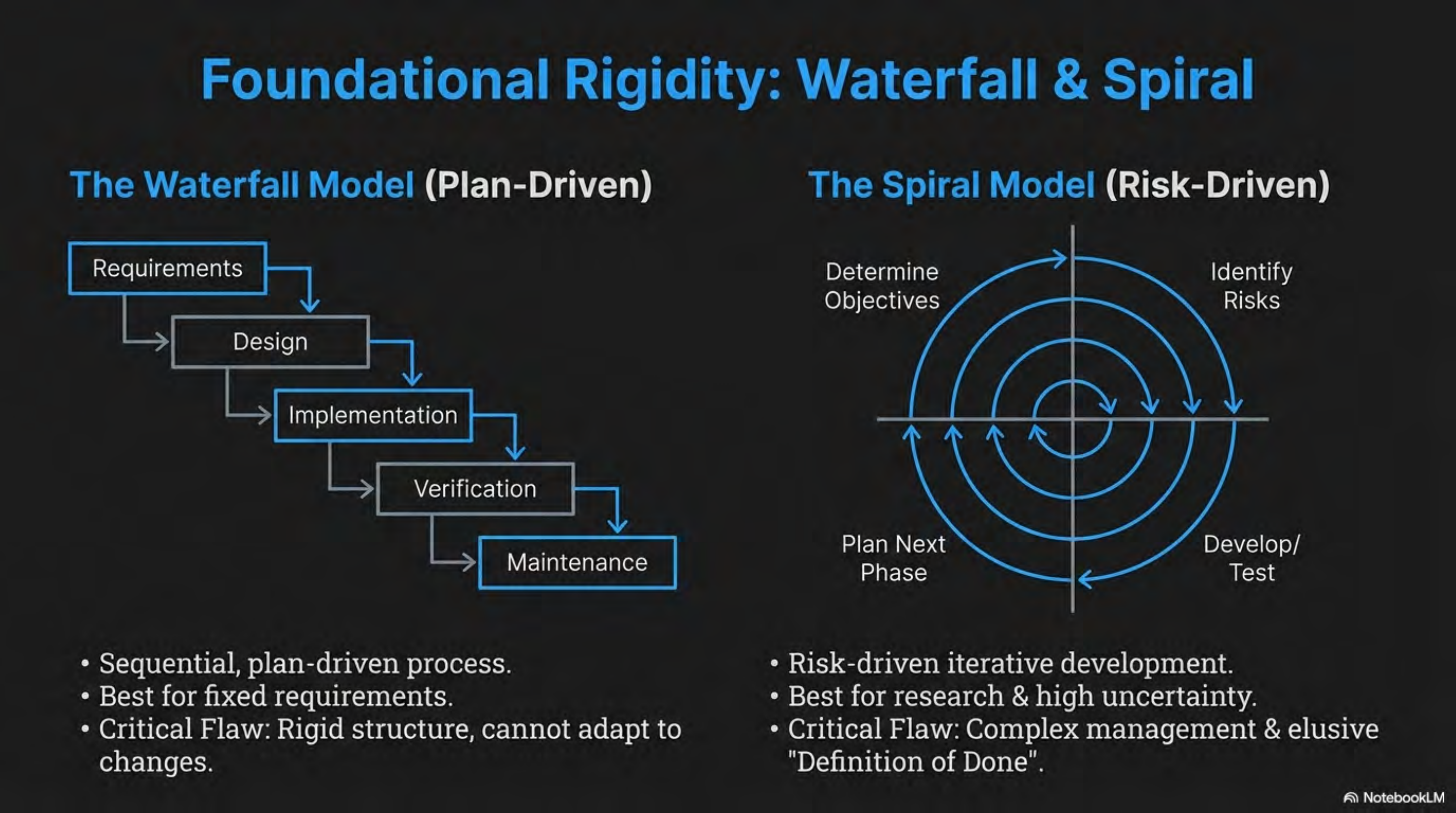
Waterfall Model (Plan-Driven)
| Property | Detail |
|---|
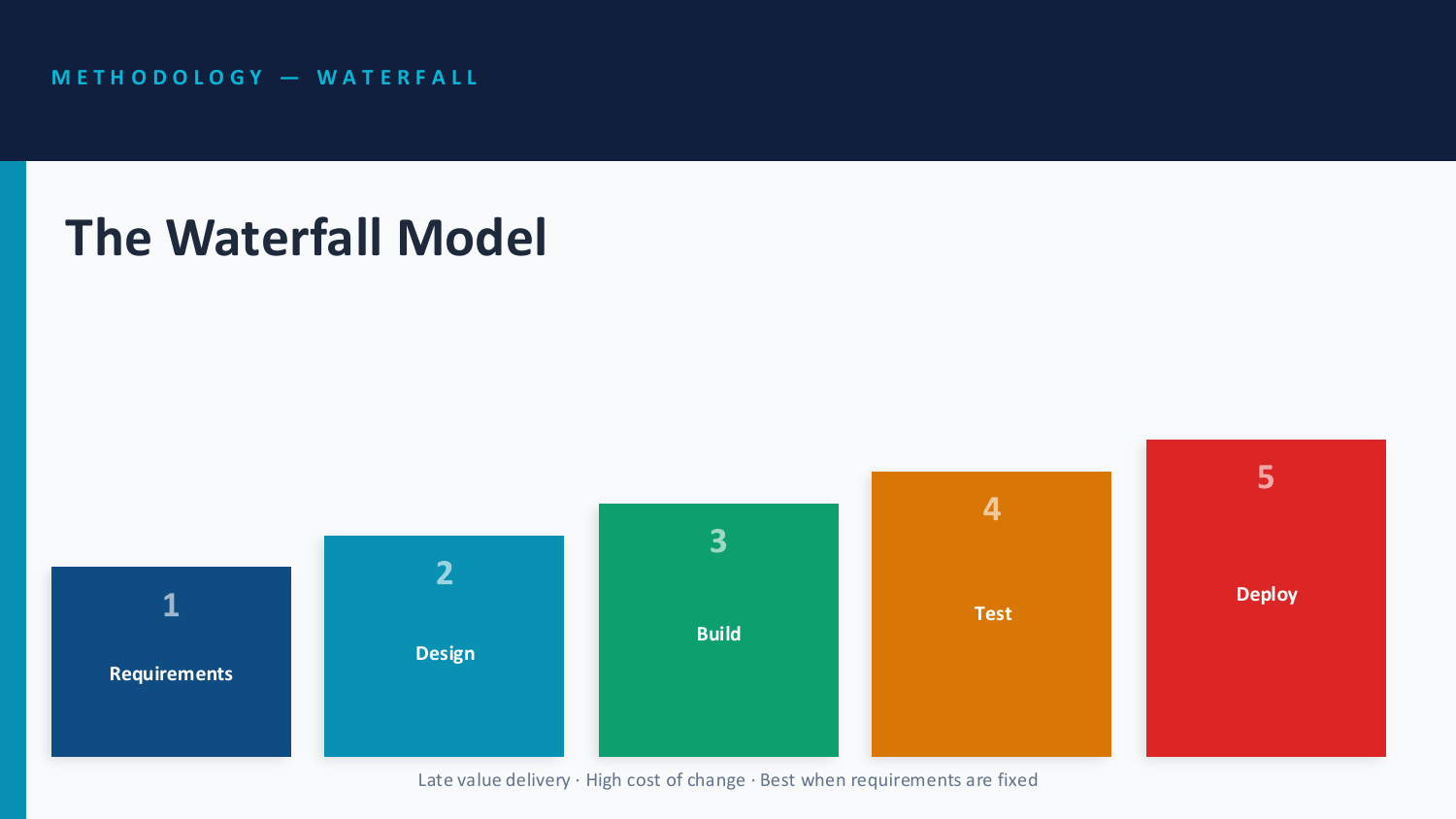
| Structure | Sequential: Requirements → Design → Build → Test → Deploy |
| Driven by | Plan |
| Best for | Fixed requirements + Low technical risk + Strict compliance |
| Critical Flaw | Late value delivery; high cost of change; if market changes mid-project, plan becomes obsolete |
| Metaphor | Waterfall = Orchestra — everyone follows the score exactly; predictable only when the score is perfect |
Contrast: Agile = Jazz — a structured framework for improvisation; adapts to what the audience needs; thrives when requirements evolve.
V-Model (Verification & Validation)
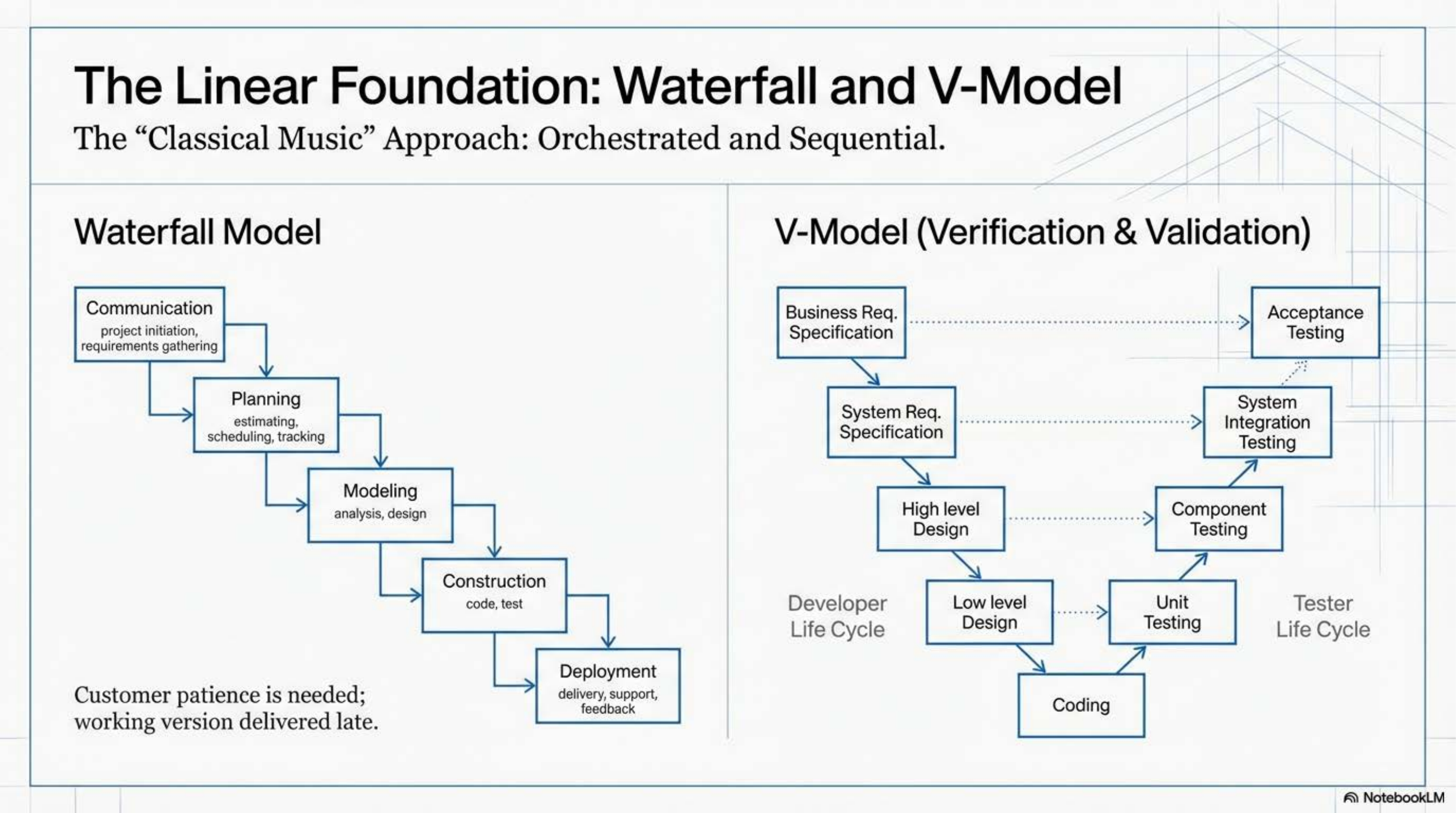
Extension of Waterfall that maps each development stage to a corresponding testing stage:
| Developer Life Cycle (left) | Tester Life Cycle (right) |
|---|
| Business Requirements Specification | Acceptance Testing |
| System Requirements Specification | System Integration Testing |
| High Level Design | Component Testing |
| Low Level Design | Unit Testing |
| Coding (bottom) | |
Important: The V-Model's key differentiator: every design step has a corresponding testing step defined upfront. Use case: Fixed Requirements + Strict Compliance.
Spiral Model (Risk-Driven)
Origin: Barry Boehm. Differentiator: Explicit Risk Analysis phase in every iteration.
| Property | Detail |
|---|
| Structure | Repeating cycles through 4 quadrants: Planning → Risk Analysis → Engineering → Customer Evaluation |
| Driven by | Risk |
| Best for | Mission-critical, complex systems where failure is not an option |
| Critical Flaw | Complex management; elusive "Definition of Done" |
Waterfall vs V-Model vs Spiral
| Dimension | Waterfall | V-Model | Spiral |
|---|
| Approach | Sequential | Sequential + Verification | Iterative |
| Driver | Plan | Plan + Validation | Risk |
| Requirements | Fixed upfront | Fixed upfront | Can evolve |
| Testing | At end | Mapped to each design stage | Per cycle |
| Management complexity | Low | Medium | High |
| Best for | Known, stable requirements | Compliance-critical systems | High-stakes, uncertain projects |
Prototyping and Incremental Development
| Model | Key Property |
|---|
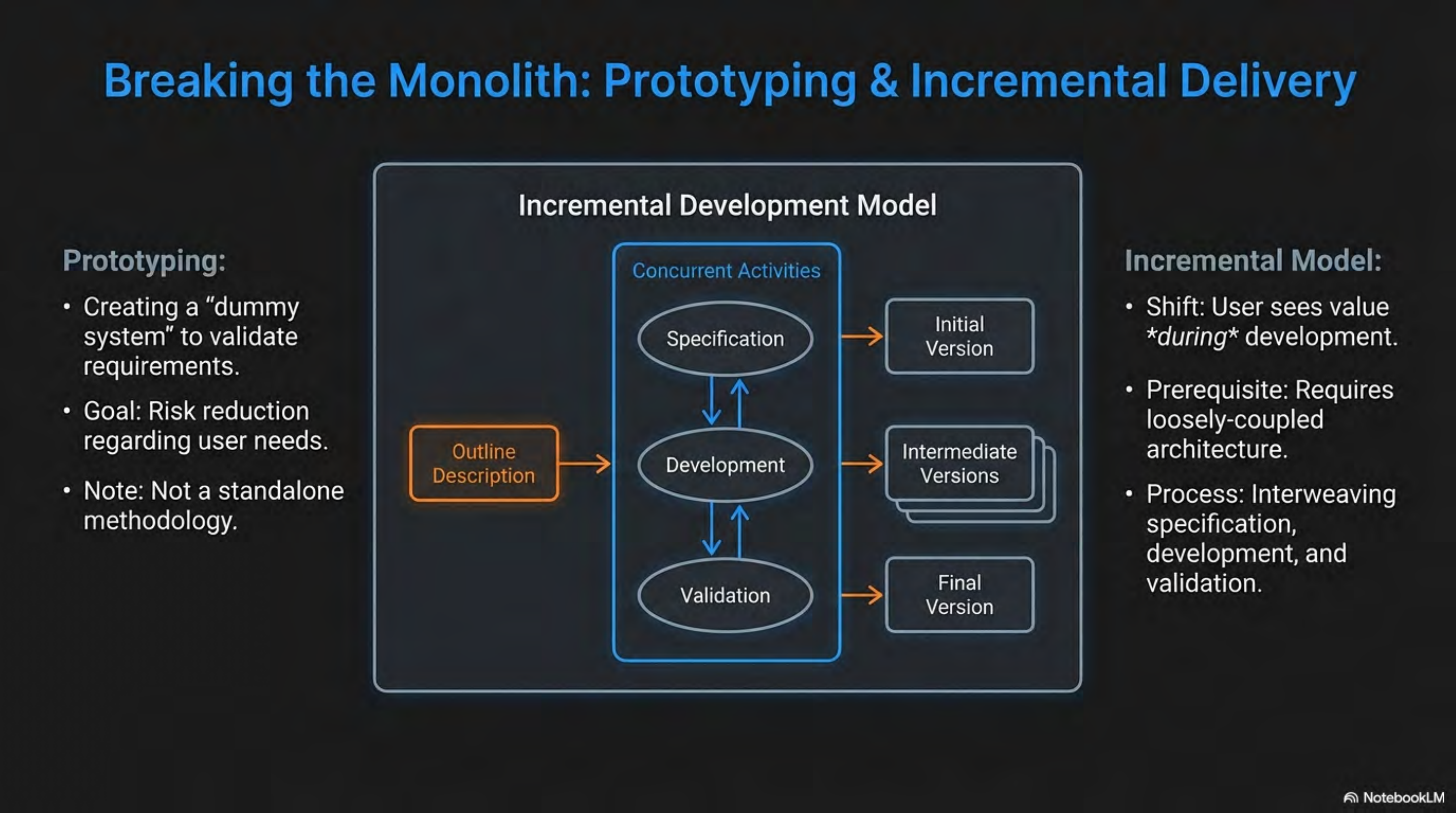
| Prototyping | Creating a "dummy system" to validate requirements. NOT a standalone methodology — always used within another model |
| Incremental Development | User sees value during development. Requires loosely-coupled architecture. Concurrent Spec/Dev/Val producing Initial → Intermediate → Final versions |
The Methodology Spectrum
| Zone | Methodologies | Characteristic |
|---|
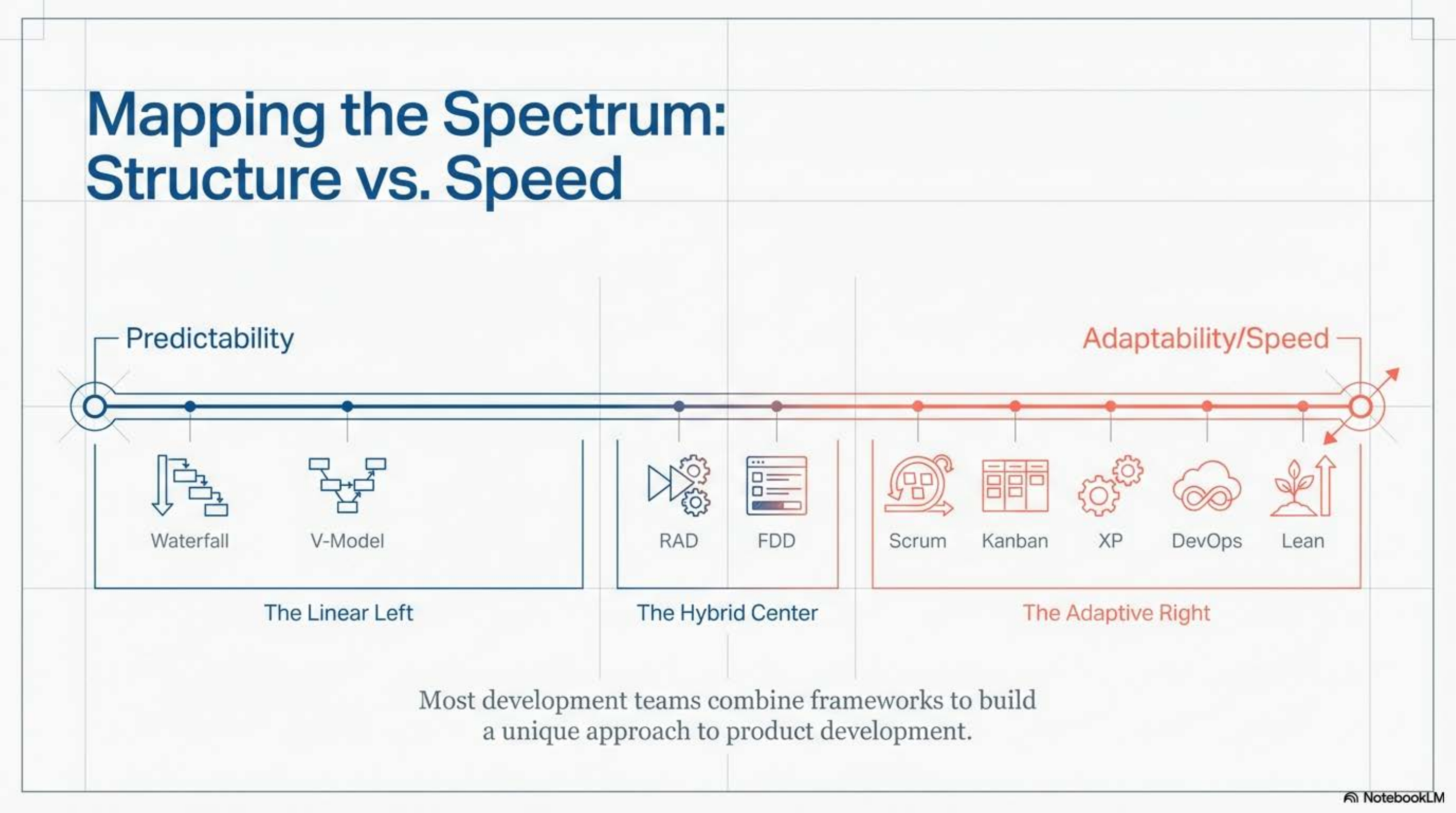
| Linear Left | Waterfall, V-Model | Maximum predictability; plan-driven; fixed requirements |
| Hybrid Center | RAD, FDD | Balance speed with structure; prototype-centric |
| Adaptive Right | Scrum, Kanban, XP, DevOps, Lean | Maximum adaptability; people-driven; changing requirements |
Strategic Model Selection
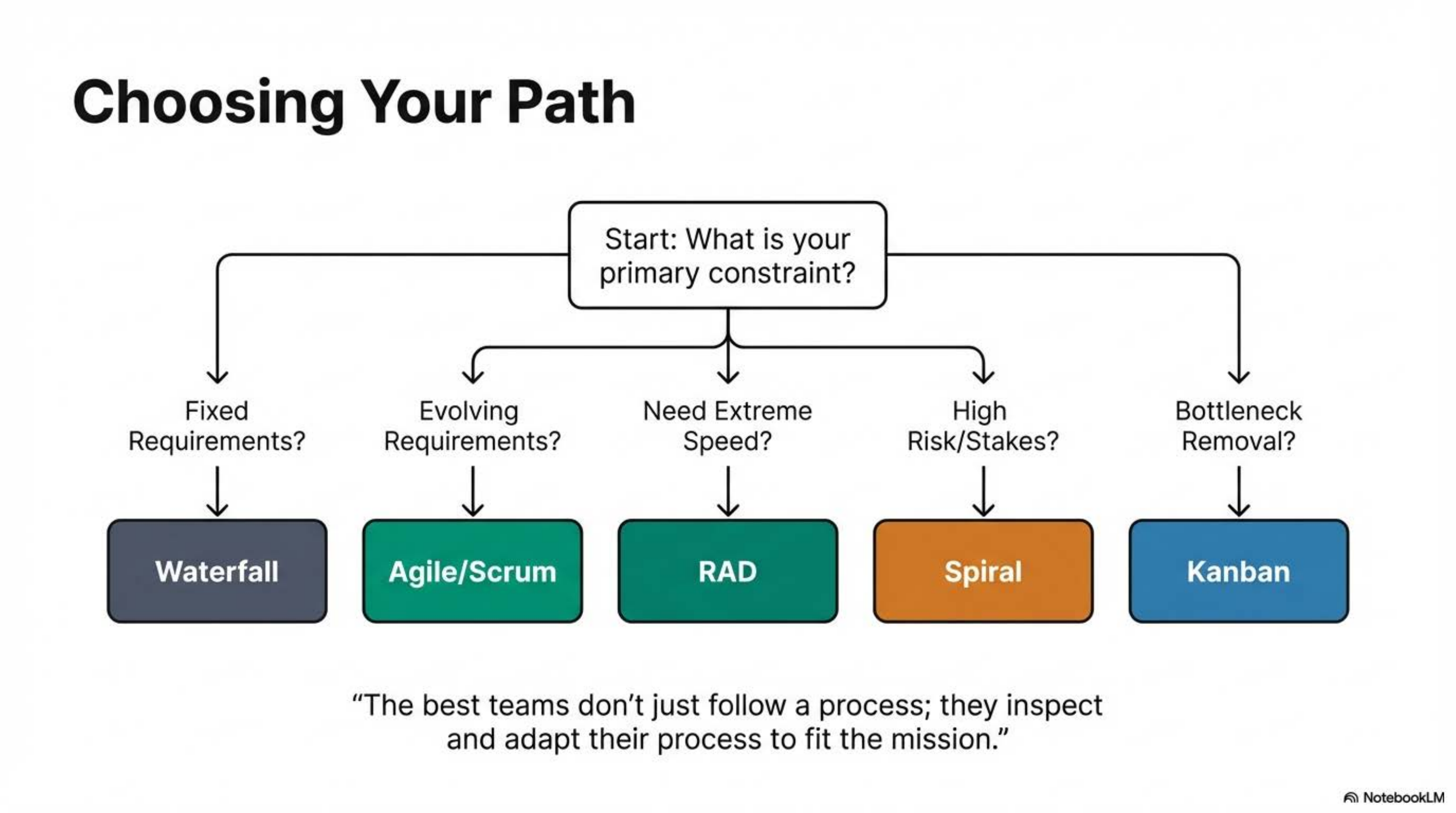
| Primary Constraint | Recommended Model |
|---|
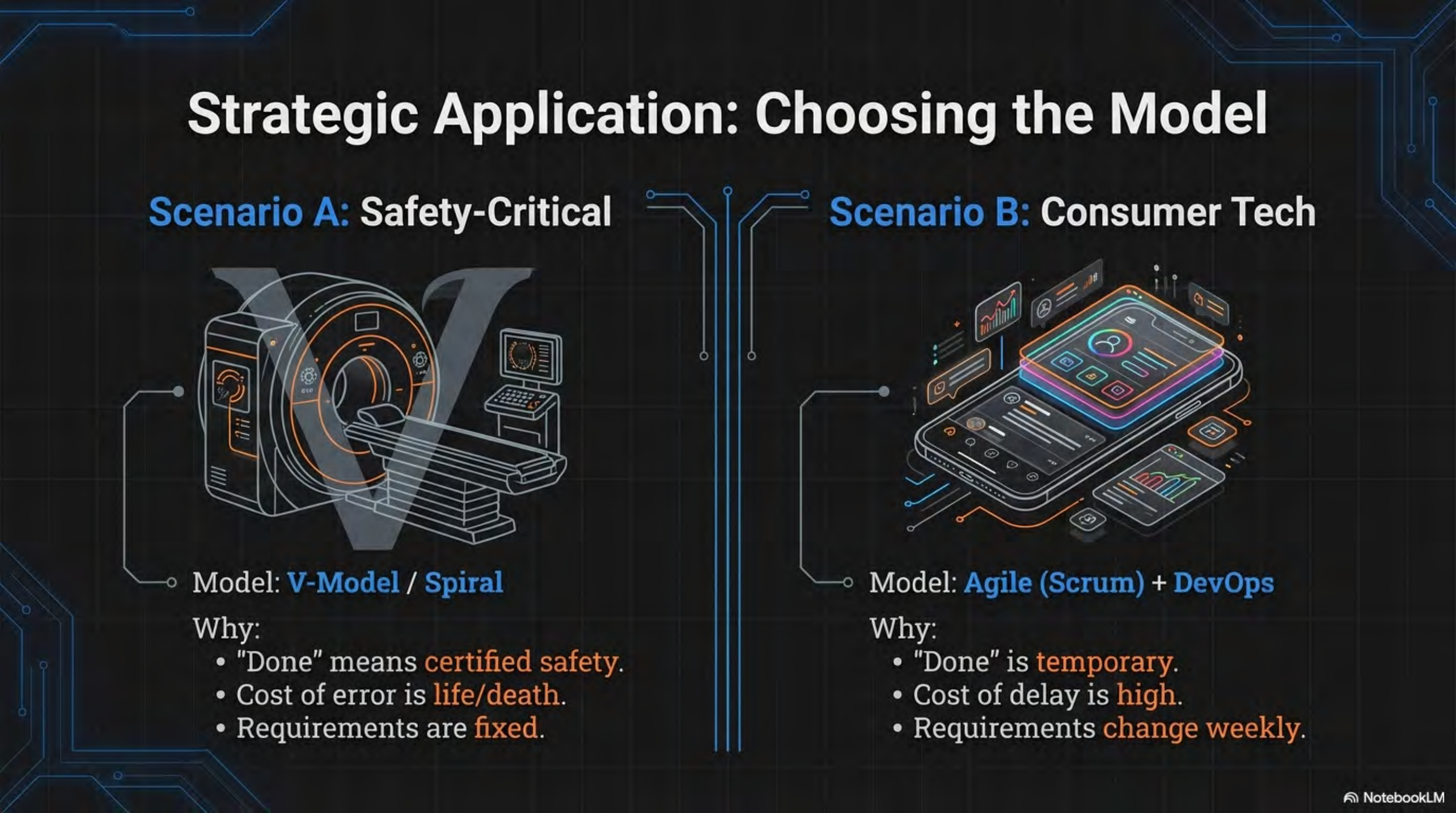
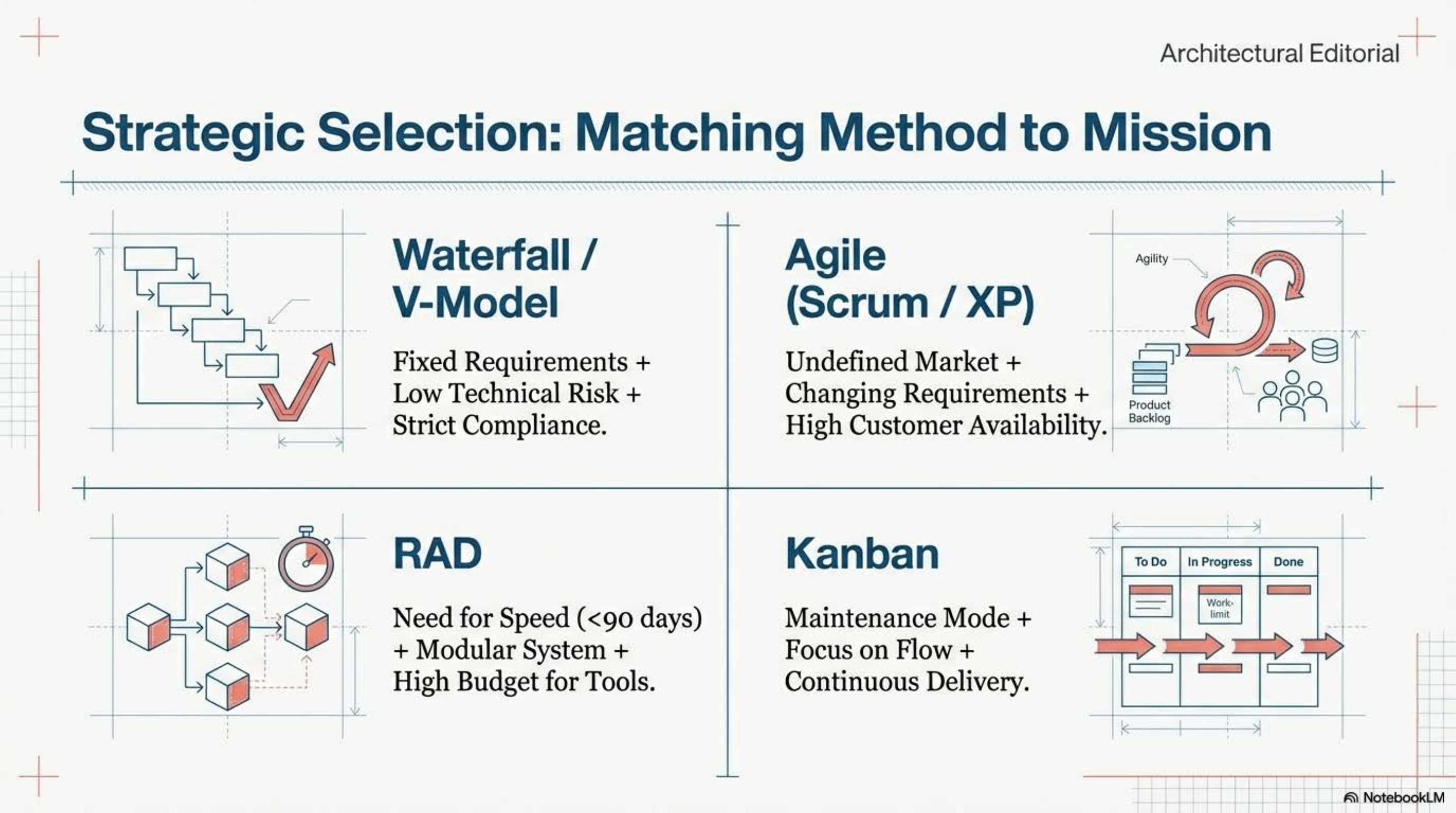
| Fixed Requirements + Low Risk + Strict Compliance | Waterfall / V-Model |
| Evolving Requirements + High Customer Availability | Agile (Scrum / XP) |
| Need Extreme Speed (<90 days) + Modular System | RAD |
| High Risk / Stakes — mission-critical | Spiral |
| Maintenance Mode + Bottleneck Removal | Kanban |
2 — RAD and Agile
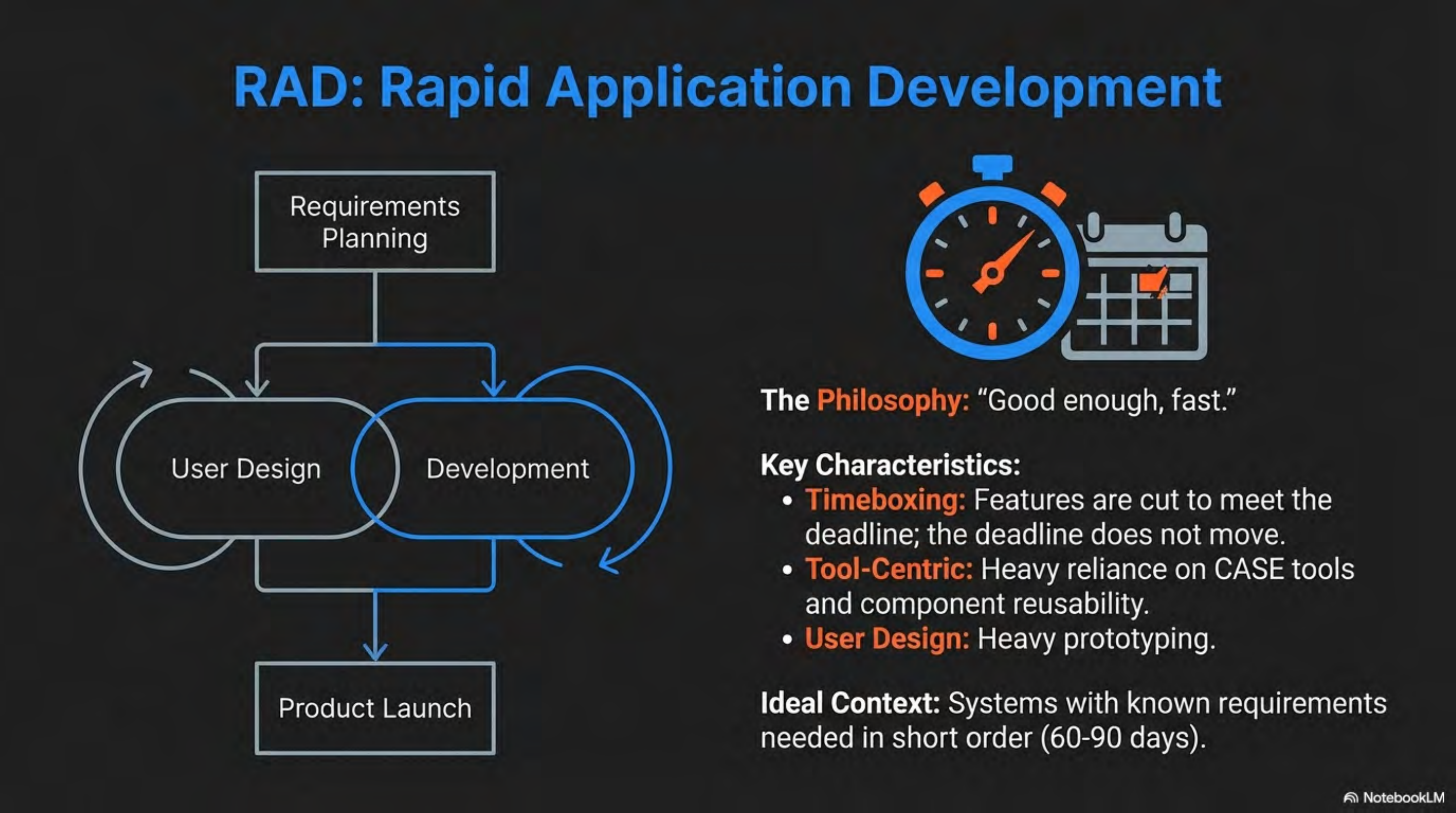
Rapid Application Development (RAD)
| Property | Detail |
|---|
| Definition | Incremental model (IBM, 1980s) compressing analysis, design, build, and test into short, iterative cycles |
| Philosophy | "Good enough, fast." Time-boxed cycles (60–90 days) |
| Timeboxing | Features are cut to meet the deadline — the deadline does not move. Scope is flexible |
| Tool-Centric | Heavy reliance on CASE tools and component reusability |
| User Design | Heavy prototyping with active user involvement throughout |
Important: Timeboxing is the defining RAD characteristic: scope is flexible, the deadline is not.
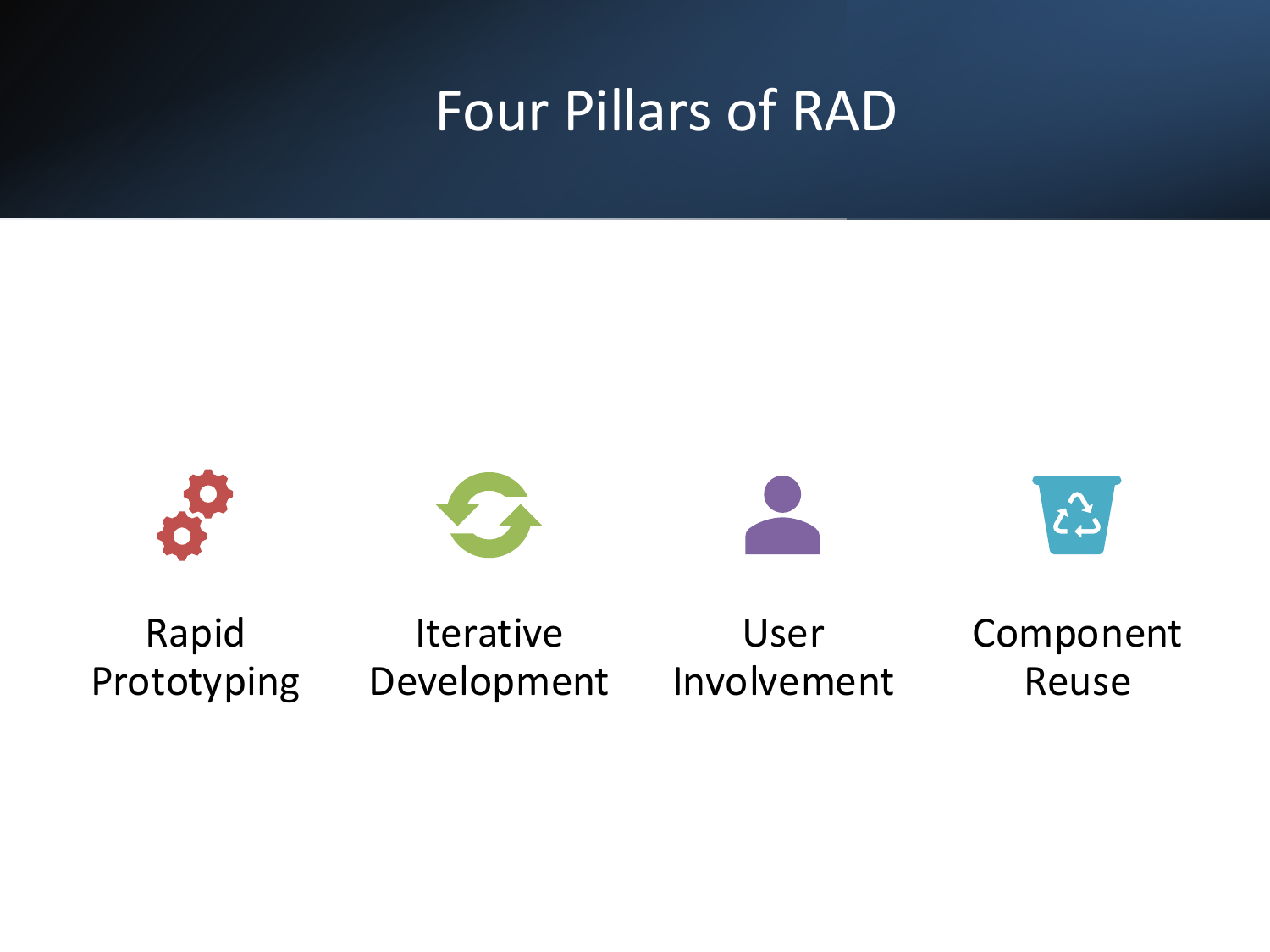
Four Pillars of RAD
| Pillar | Description |
|---|
| Rapid Prototyping | Build working models quickly to validate requirements |
| Iterative Development | Repeated cycles of build-feedback-refine |
| User Involvement | Active stakeholder participation throughout — not just at start/end |
| Component Reuse | Leverage existing libraries, frameworks, and CASE tools to accelerate delivery |
Estimation in RAD
| Principle | Detail |
|---|
| Timeboxed Planning | Deadline is fixed; scope is cut to fit |
| Scope Flexibility | Features are deprioritised or dropped when time is tight |
| Feature-Based Estimation | Estimate by feature value, not raw effort |
| Velocity-Informed Adjustments | Use team velocity from prior iterations to calibrate future estimates |
RAD Phases
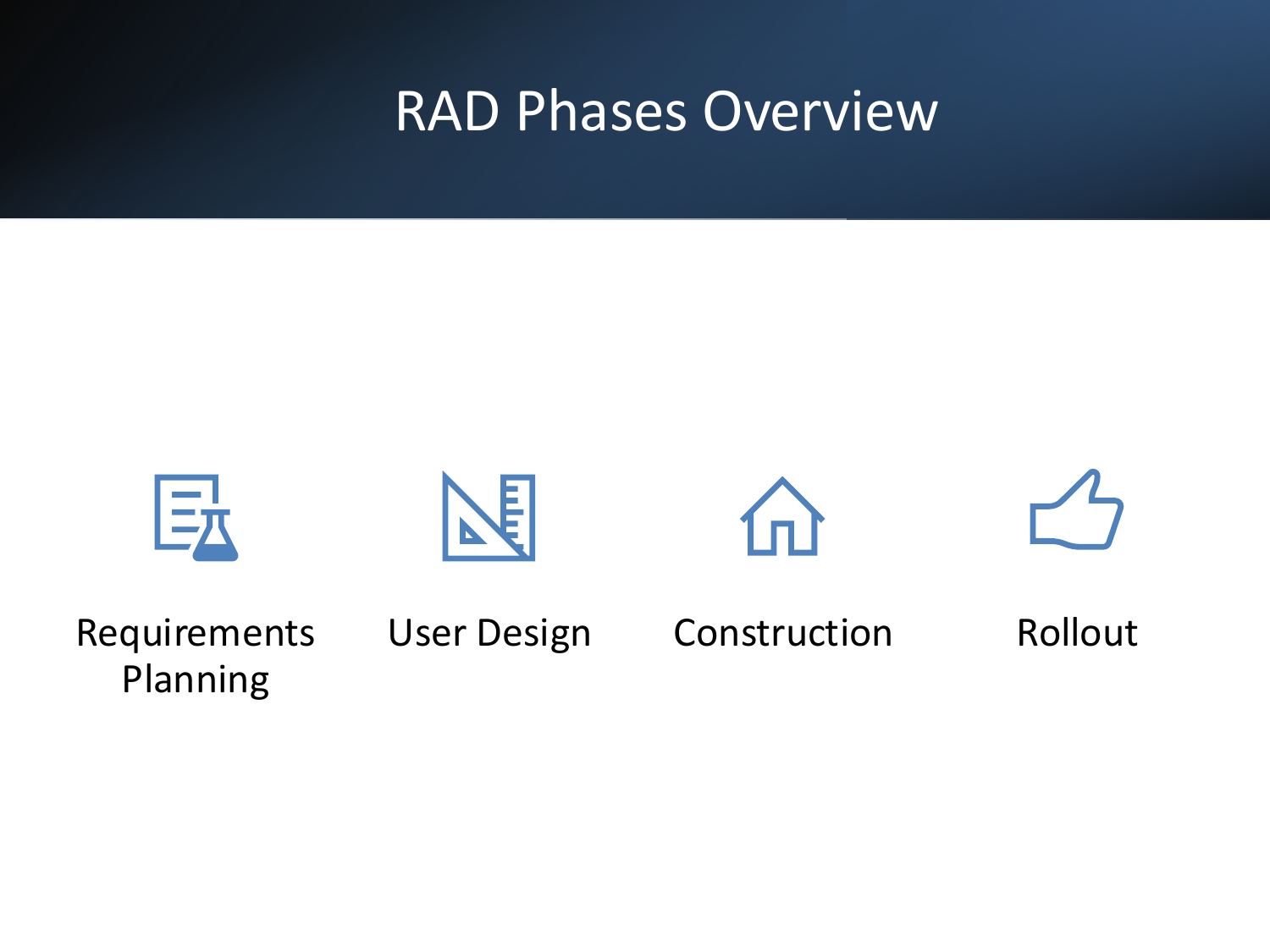
Note: The final phase is variously called "Rollout" or "Cutover" — both refer to the same phase. "Cutover" is the original IBM RAD terminology.
| Phase | Activities |
|---|
| Requirements Planning | Agree on scope, constraints, and business goals; identify stakeholders |
| User Design | Prototype development; users test, developers refine; real-time feedback |
| Construction | Rapid coding; feature improvement; component integration |
| Cutover / Rollout | Testing; data conversion; training; deployment |
The User Design ↔ Construction loop iterates until quality is achieved, then Cutover completes the delivery.
RAD Design Model (parallel)
| Model | Activity |
|---|
| Business Modelling | Workflow identification; information flow mapping |
| Data Modelling | Entity definition; relationship mapping |
| Process Modelling | Logic definition; transformation mapping |
| Application Generation | Automated tools; visual development environments; framework reuse |
| Testing | Continuous validation; user acceptance; integration checks |
| Turnover | Deployment completion; documentation; knowledge transfer |
RAD Ingredients for Success
| Ingredient | Detail |
|---|
| SWAT Team | Small, multi-disciplinary group of highly skilled experts; experts in tools |
| Decisive Management | Willingness to cut bureaucracy; quick decision-making |
| The Toolset | Heavy reliance on CASE tools, automated code generators, reusable component libraries |
RAD Success Factors
| Factor | Detail |
|---|
| Small Expert Teams | Fewer handoffs, faster decisions. Quality over quantity — 6–10 people max (2–4 in GenAI RAD) |
| Strong Decision-Making | Someone with authority must be in the room. Delays kill momentum in a timebox |
| Automation Tools | Manual processes negate RAD's speed advantage. CASE tools, CI/CD, now AI copilots |
RAD Pros and Cons
| Pros | Cons |
|---|
| ~70% reduction in development cycle time | High cost (tools and skilled talent) |
| High flexibility for changing requirements | High user commitment required — fails without active users |
| High user satisfaction via active involvement | Scalability issues — system must be modular |
| Early customer feedback via prototypes | Not suitable for high technical risk |
| High reusability of components | Role confusion (developers bypass analysts) |
Important: RAD is NOT suitable for: safety-critical systems, systems that cannot be modularised, or projects where users cannot commit significant time.
RAD Trade-offs
Important: The considerations below are not flaws — they are precondition failures. RAD works when skilled teams, committed users, and adequate budget are all present. When any of the three is absent, the corresponding disadvantage materialises.
| Advantages | Considerations (precondition failures) |
|---|
| Faster time-to-market | Requires highly skilled talent |
| High user satisfaction | Users must commit significant time |
| Early and continuous feedback | Can be expensive to sustain |
| Reduced overall project risk | Scope creep risk is real |
RAD Issues
| Issue | Impact |
|---|
| Requires skilled teams | RAD collapses without developers experienced in rapid prototyping |
| High user availability dependency | Continuous user feedback is essential — unavailable users stall iterations |
| Integration complexity | Component reuse and parallel development create integration risk |
| Limited suitability for safety-critical systems | Speed and scope-cutting are incompatible with rigorous safety certification |
Specialized RAD Architectures
| Architecture | Key Metric | Detail |
|---|
| Component-Based Development (CBD) | 70% cycle time reduction; 84% cost reduction | Reuse of COTS components rather than building from scratch |
| Aspect-Oriented Software Development (AOSD) | — | Cross-cutting concerns (security, logging) managed as separate "aspects" woven across all modules |
Feature Driven Development (FDD)
| Property | Detail |
|---|
| Focus | Client-valued features; building by feature, not by phase |
| Approach | Highly structured and design-oriented |
| Spectrum position | Hybrid Center — more structured than pure Agile, faster than Waterfall |
Agile Software Development
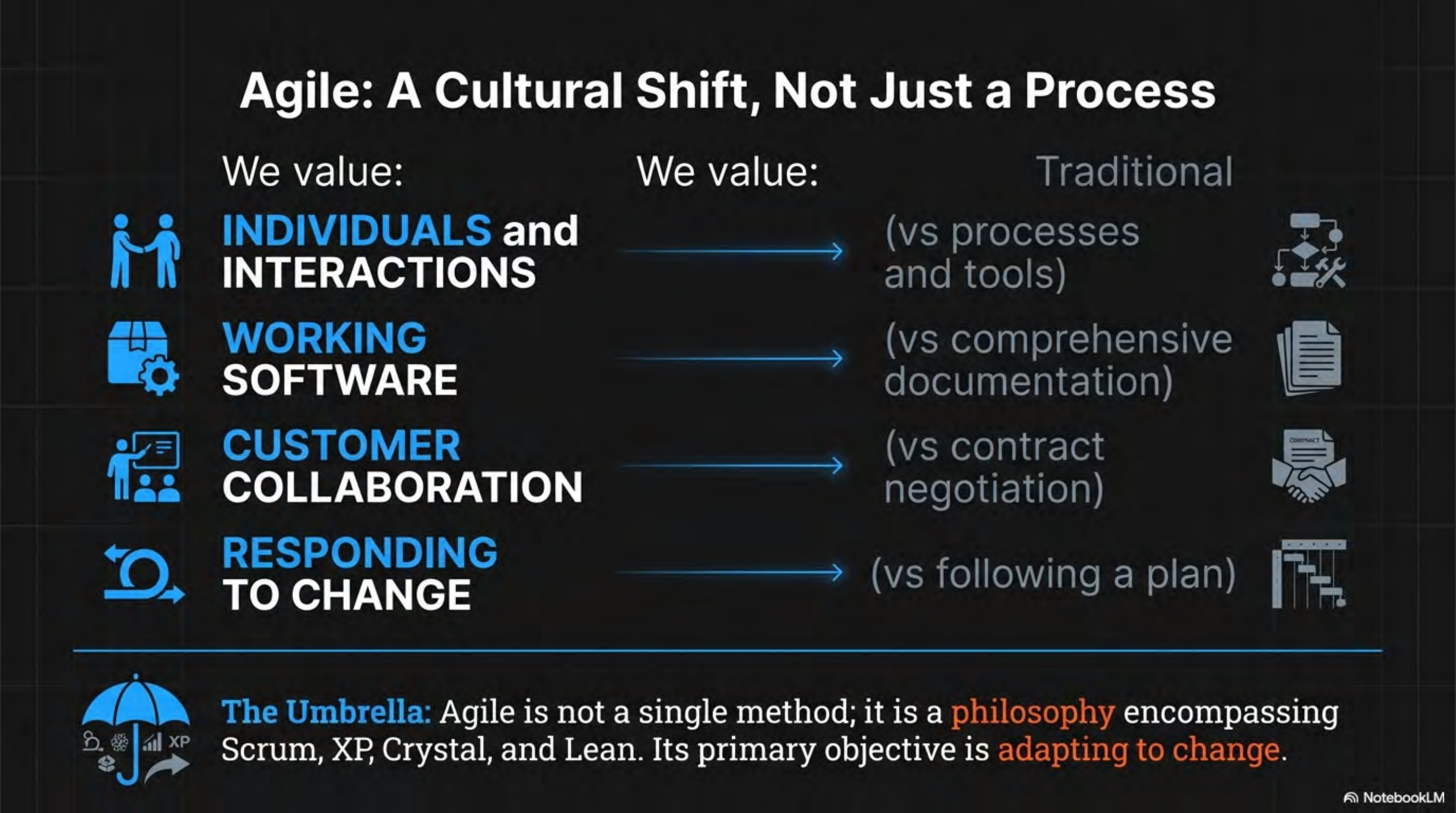
The Umbrella: Agile is not a single method — it is a philosophy encompassing Scrum, XP, Crystal, and Lean.
Agile Manifesto — Four Core Values
| Value (prioritised) | Over |
|---|
| Individuals & Interactions | Processes & Tools |
| Working Software | Comprehensive Documentation |
| Customer Collaboration | Contract Negotiation |
| Responding to Change | Following a Plan |
Important: The Manifesto says "the items on the right have value, but we value the items on the left more." It is not a rejection of process or documentation — it is a priority ordering.
RAD vs. Agile: 7-Dimension Comparison
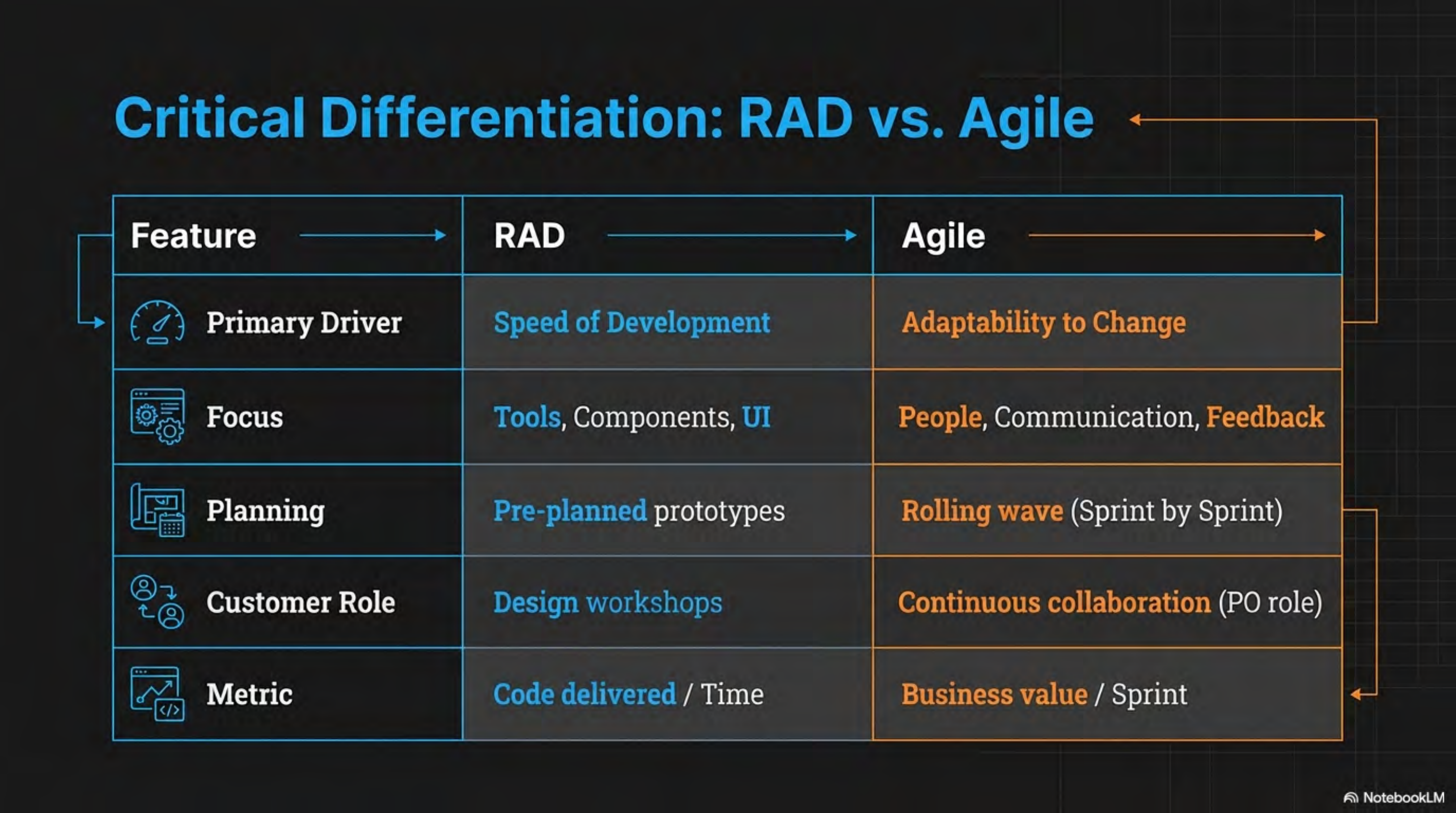
| Feature | RAD | Agile |
|---|
| Primary Driver | Speed of Development | Adaptability to Change |
| Focus | Tools, Components, UI | People, Communication, Feedback |
| Planning | Pre-planned prototypes | Rolling wave (Sprint by Sprint) |
| Customer Role | Design workshops | Continuous collaboration (PO role) |
| Metric | Code delivered / Time | Business value / Sprint |
| Requirement Type | Known requirements | Rapidly changing |
| Complexity | Complex to manage | Self-organizing teams |
Important: Core distinction: RAD primary driver = Speed; Agile primary driver = Adaptability.
3 — Scrum
Scrum structures work into Sprints — fixed timeboxes of 1–4 weeks — each producing a "Done" increment. Its essence is Empirical Process Control: Plan → Produce → Inspect/Adapt.
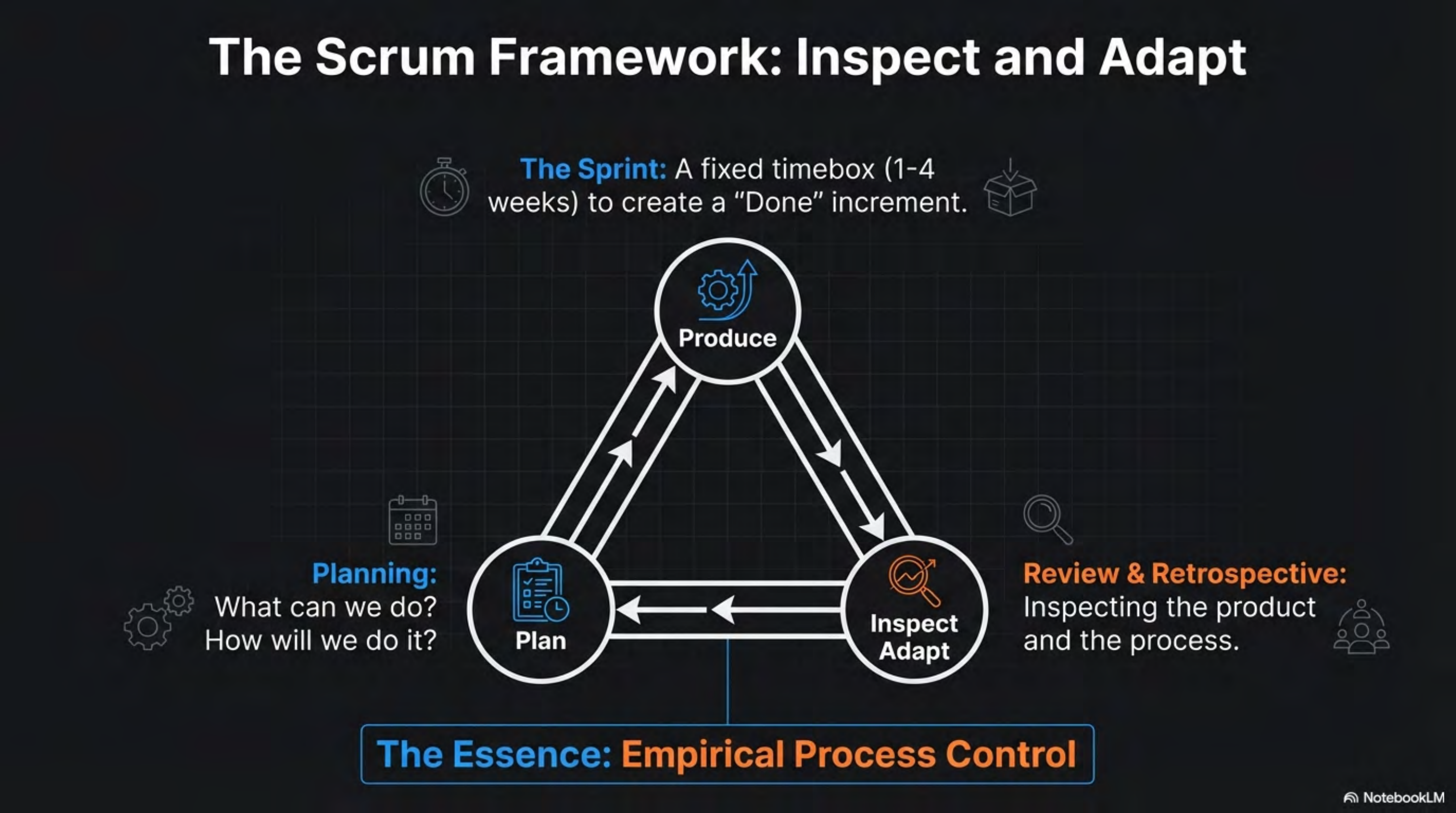
Three Roles
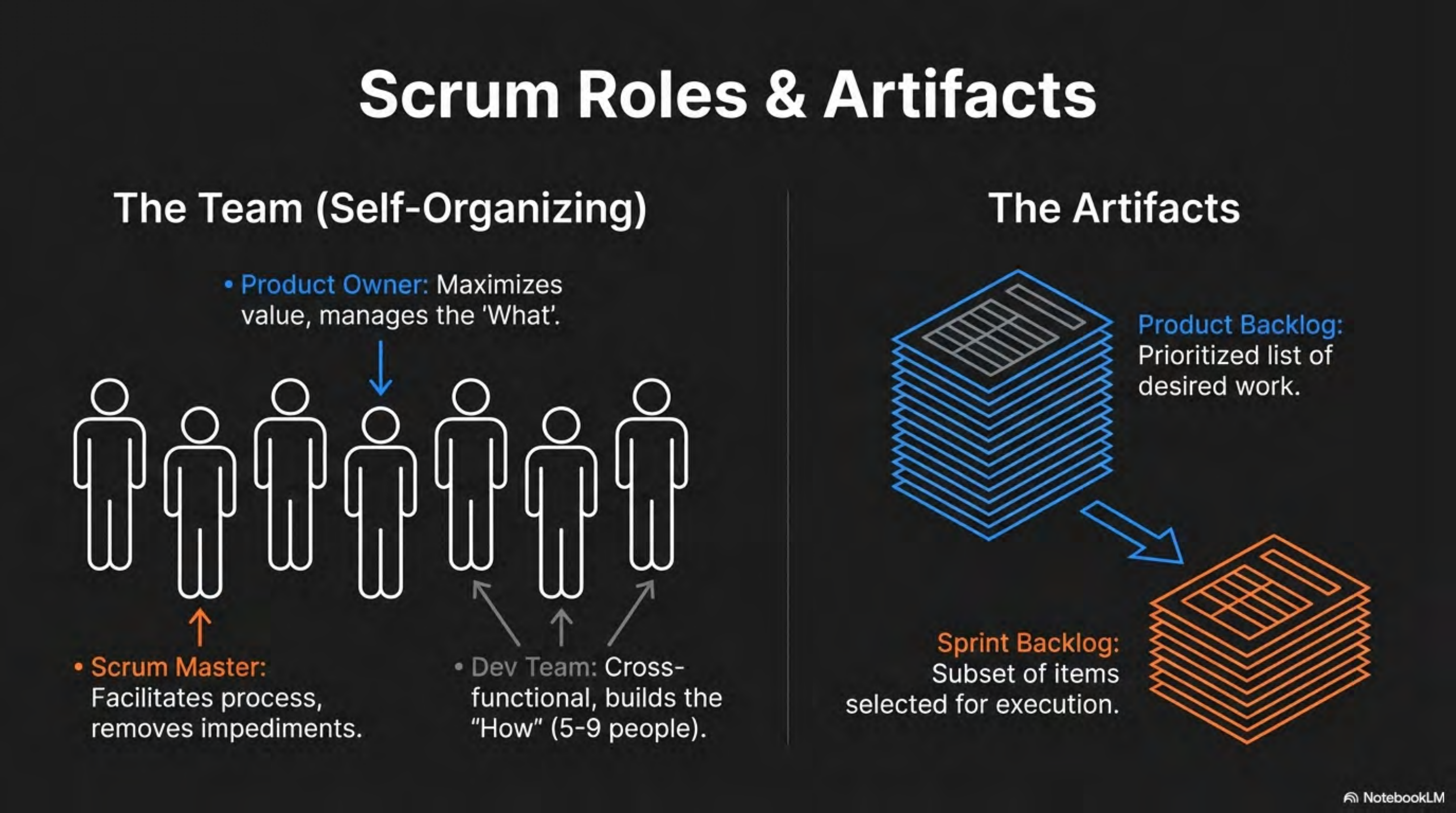
| Role | Description |
|---|
| Product Owner (PO) | Single person; maximises business value; manages the "What"; owns the Product Backlog |
| Development Team | All skills needed; recommended size 5–9 people; builds the "How" |
| ScrumMaster | Facilitates process, removes impediments; is not the team's boss; NOT the project manager |
Important: The ScrumMaster facilitates and removes impediments — not a project manager, not the boss. This distinction is commonly tested.
Four Ceremonies
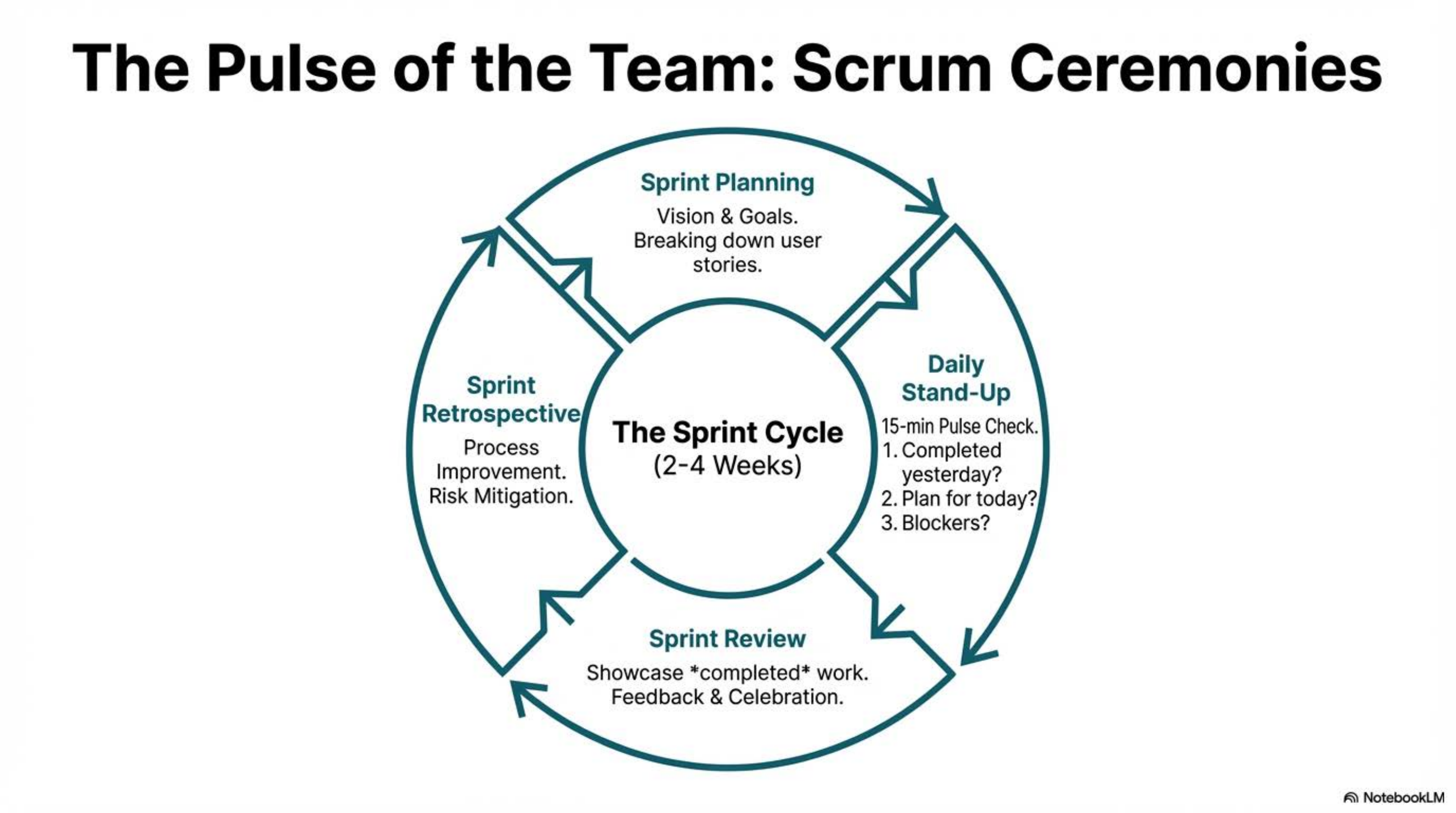
| Ceremony | Purpose | Key Detail |
|---|
| Sprint Planning | Define "what" (PO) and "how" (Dev Team); break user stories into tasks | Sets the Sprint Goal |
| Daily Stand-Up | 15-minute pulse check; surface blockers | 3 Questions: (1) What did I do yesterday? (2) What will I do today? (3) Am I blocked? |
| Sprint Review | Showcase completed work to stakeholders; inspect the product | "Celebration of the increment" |
| Sprint Retrospective | Honest look at the workflow; identify friction; create action plan for next Sprint | Process Improvement + Risk Mitigation |
Important: Sprint Review = inspect the product (showcase to stakeholders). Sprint Retrospective = inspect the process (team workflow improvement). A common exam distinction.
Artifacts
| Artifact | Description |
|---|
| Product Backlog | Prioritized list of all desired work — owned by the Product Owner |
| Sprint Backlog | Subset of Product Backlog items selected for execution in the current Sprint |
| Sprint Goal | The overarching objective for the Sprint, set during Sprint Planning |
| Burndown Chart | Tracks remaining effort — ideal line slopes from total story points → zero at Sprint end |
Definition of Done (DoD)
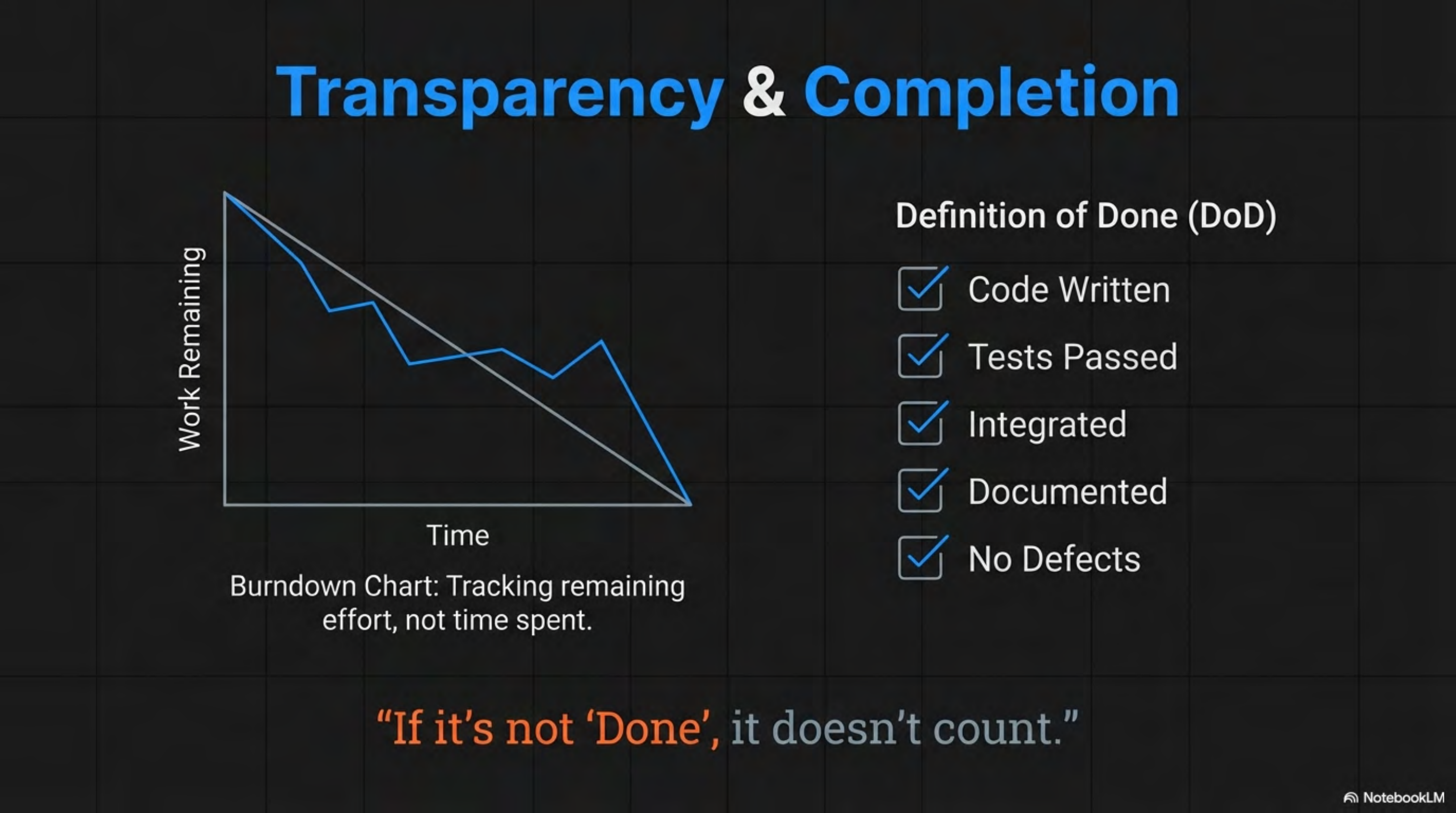
A "Done" increment must satisfy all five criteria:
| Criterion | Meaning |
|---|
| Code Written | Feature is fully implemented |
| Tests Passed | Automated tests pass |
| Integrated | Merged into the main codebase without conflicts |
| Documented | Code and feature are documented |
| No Defects | No known bugs in the increment |
Important: "If it's not 'Done', it doesn't count." Partial work has zero value in Scrum.
User Stories and Estimation
User Story: "As a <type of user>, I want <some goal> so that <some reason>"
Example: "As an Administrator, I want to modify employee personal details so that I can keep information up-to-date."

Sizing Formula: Size = Effort + Complexity + Uncertainty

The "1-2-3-4" Rule: Top backlog items should be small enough that 1–2 people can finish them in 3–4 days.
Agile Culture
| Property | Detail |
|---|
| Psychological Safety | People speak up about problems without fear of blame — essential for honest retrospectives |
| Active Listening | Team members genuinely hear each other; understanding before responding |
| Collaboration | Work is shared, not siloed — collective ownership of the increment |
| Clear Communication | Expectations and progress are transparent — visible backlogs, open impediment logs |
Important: Psychological Safety is the prerequisite for every other property — without it, retrospectives become performances rather than improvements.
Related Engineering Practices
Scrum provides process management but not technical guidance. These practices fill the gap:
| Concern | Framework | Key Practices |
|---|
| How to write code well | Extreme Programming (XP) | TDD, Refactoring, Pair Programming, Coding Standards |
| How to ship continuously | DevOps and CI/CD | CI, CD, Infrastructure as Code |
| How to align code with business | Domain Driven Design (DDD) | Ubiquitous Language, Bounded Contexts |
4 — Extreme Programming (XP)
Scrum teaches management — how to organise and track work. It does not teach how to write code. XP fills this gap by adding technical engineering discipline inside each Sprint.
Five Core XP Values
| Value | Meaning |
|---|
| Communication | Keep information flowing between all team members and stakeholders |
| Simplicity | Do the simplest thing that could possibly work — avoid over-engineering |
| Feedback | Short cycles expose problems early; use feedback from tests, customers, and team |
| Courage | Refactor fearlessly, raise problems honestly, discard code that doesn't work |
| Respect | Team members respect each other's effort and contributions |
Four XP Practices
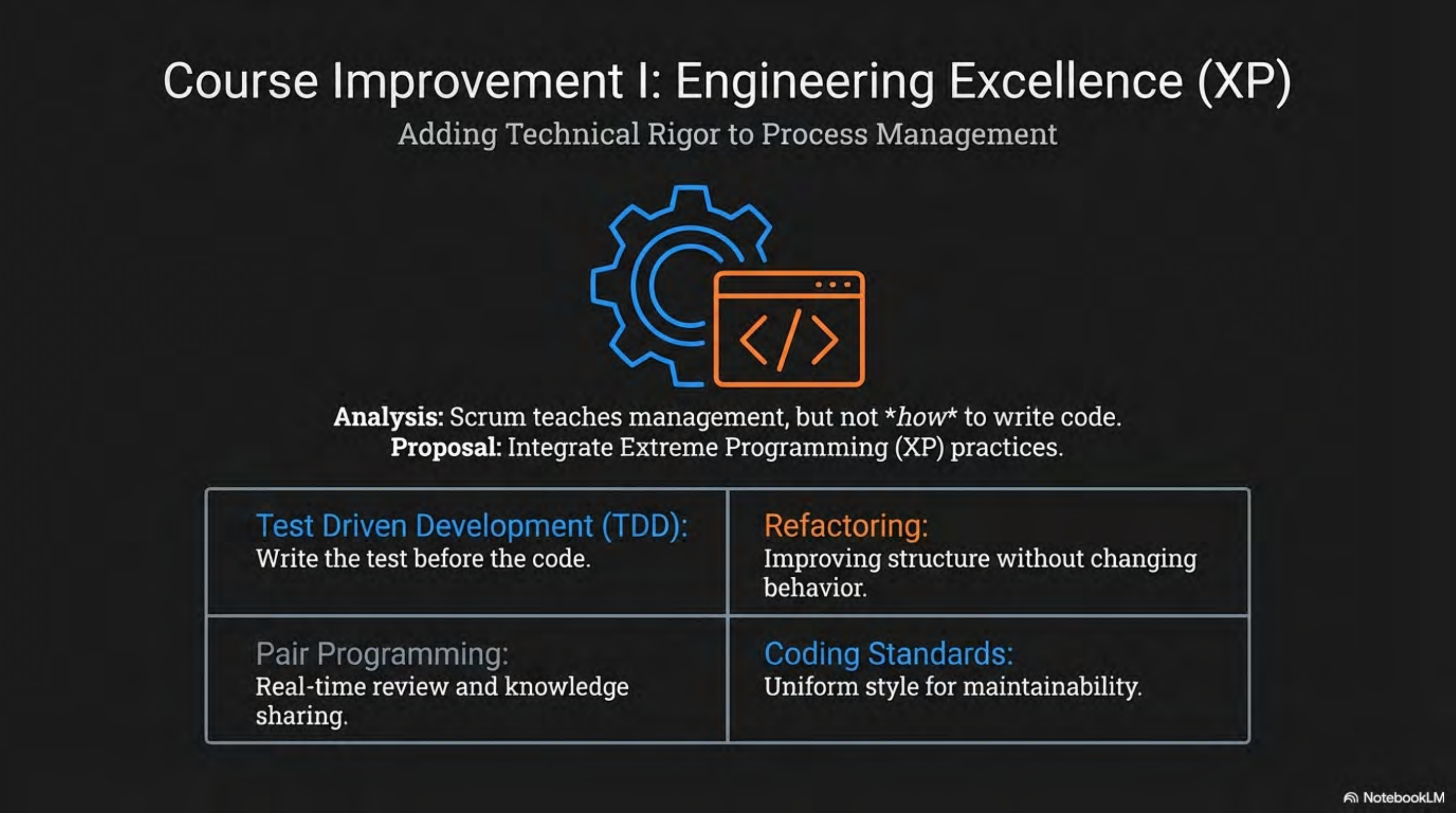
| Practice | Description |
|---|
| Test Driven Development (TDD) | Write the test before writing the code. Forces clear requirement thinking and produces a comprehensive test suite by default |
| Refactoring | Improve the internal structure of existing code without changing its external behaviour. Keeps the codebase clean and maintainable over time |
| Pair Programming | Two developers at one machine — Driver writes code (focused on immediate); Navigator reviews in real time (big picture, guides, catches bugs). Roles switch every 25–30 min. Benefits: fewer defects, knowledge spread, better design, mentorship |
| Coding Standards | Uniform style and conventions across the team. Ensures any team member can read, understand, and modify any part of the codebase |
Important: TDD = test first, code second; Refactoring = structure changes, behaviour does not. Know these definitions precisely.
Relationship to Scrum
| Scrum provides | XP provides |
|---|
| Process management (roles, ceremonies, artifacts) | Engineering practices (how to write production-quality code) |
| Sprint cadence and transparency | TDD, Refactoring, Pair Programming, Coding Standards |
| "What to build and when" | "How to build it well" |
RAD vs XP
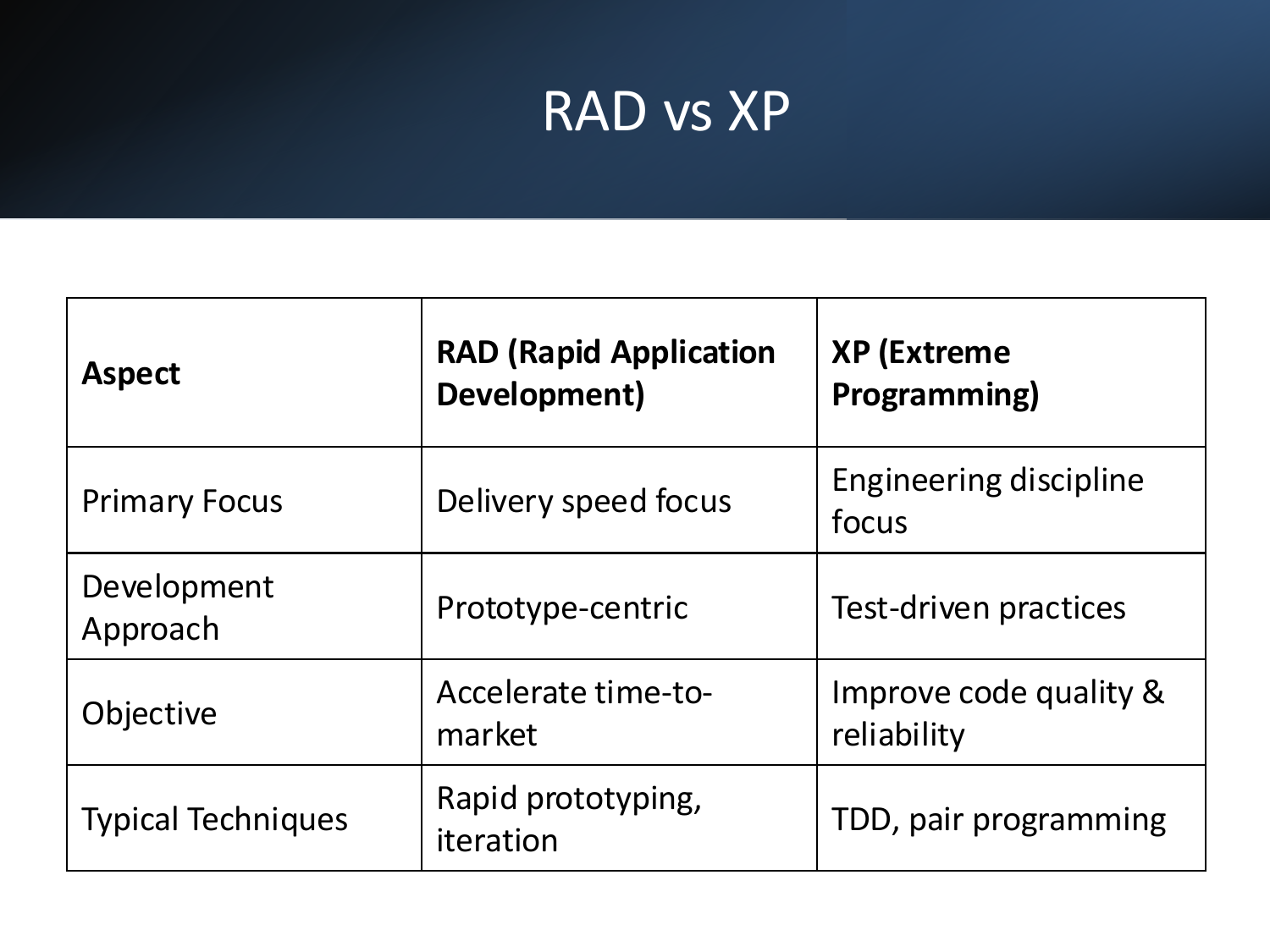
| Aspect | RAD | XP |
|---|
| Primary Focus | Delivery speed | Engineering discipline |
| Development Approach | Prototype-centric | Test-driven practices |
| Objective | Accelerate time-to-market | Improve code quality and reliability |
| Typical Techniques | Rapid prototyping, iteration | TDD, Pair programming |
Important: RAD and XP are not mutually exclusive — RAD defines how fast to build; XP defines how to build it well. A team can apply XP practices within a RAD timebox.
5 — DevOps and CI/CD
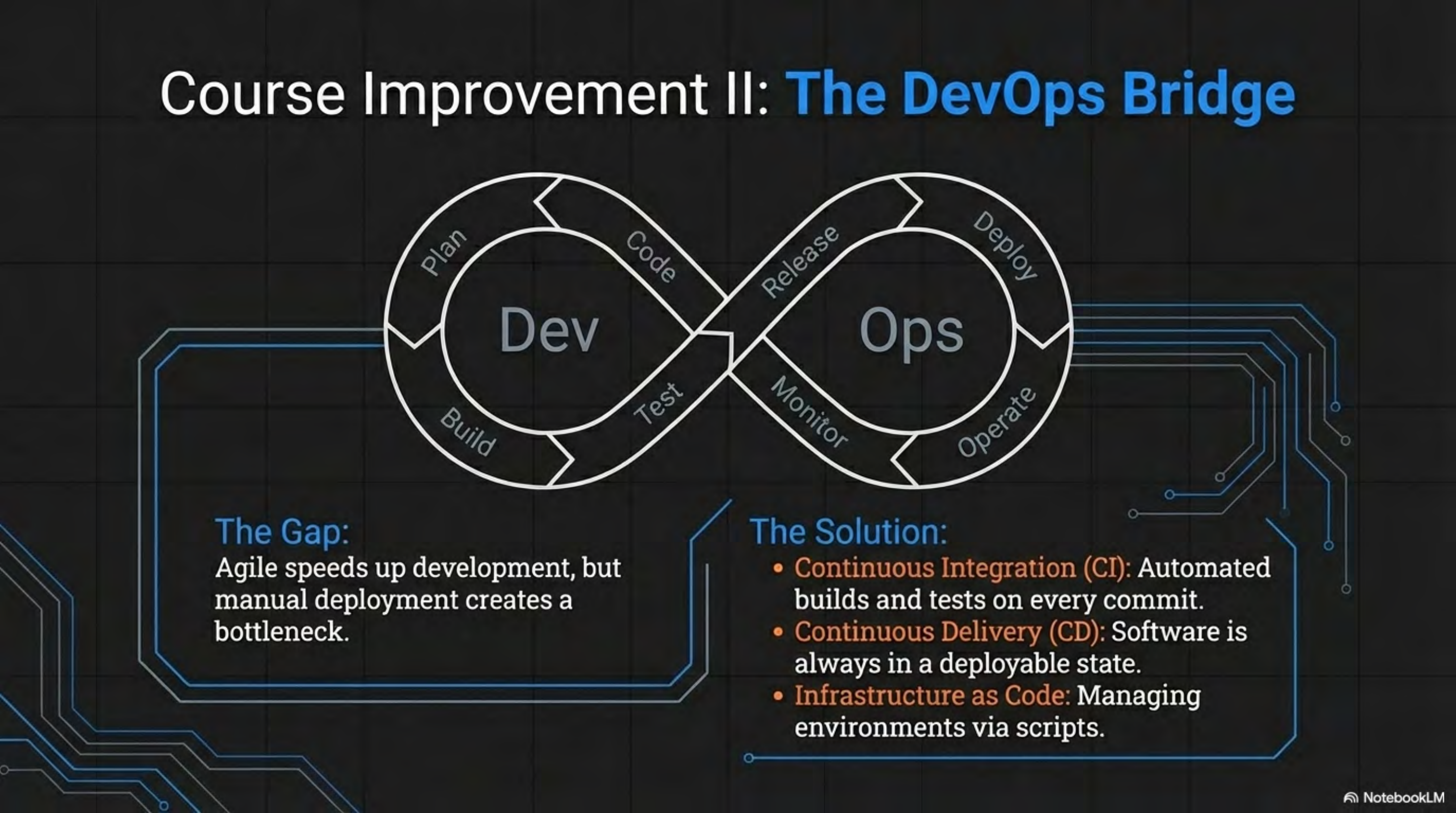
The Gap: Agile speeds up development, but manual deployment creates a bottleneck. Fast sprints mean nothing if releasing to production takes weeks.
DevOps bridges Development (building software) and Operations (running software).
DevOps Stats
| Stat | What it means |
|---|
| 10× faster deployment | Speed of release vs non-DevOps teams |
| 30% reduction in change failure rate | Fewer broken releases reaching production |
| 60% less time on unplanned work | Fewer incidents, faster recovery |
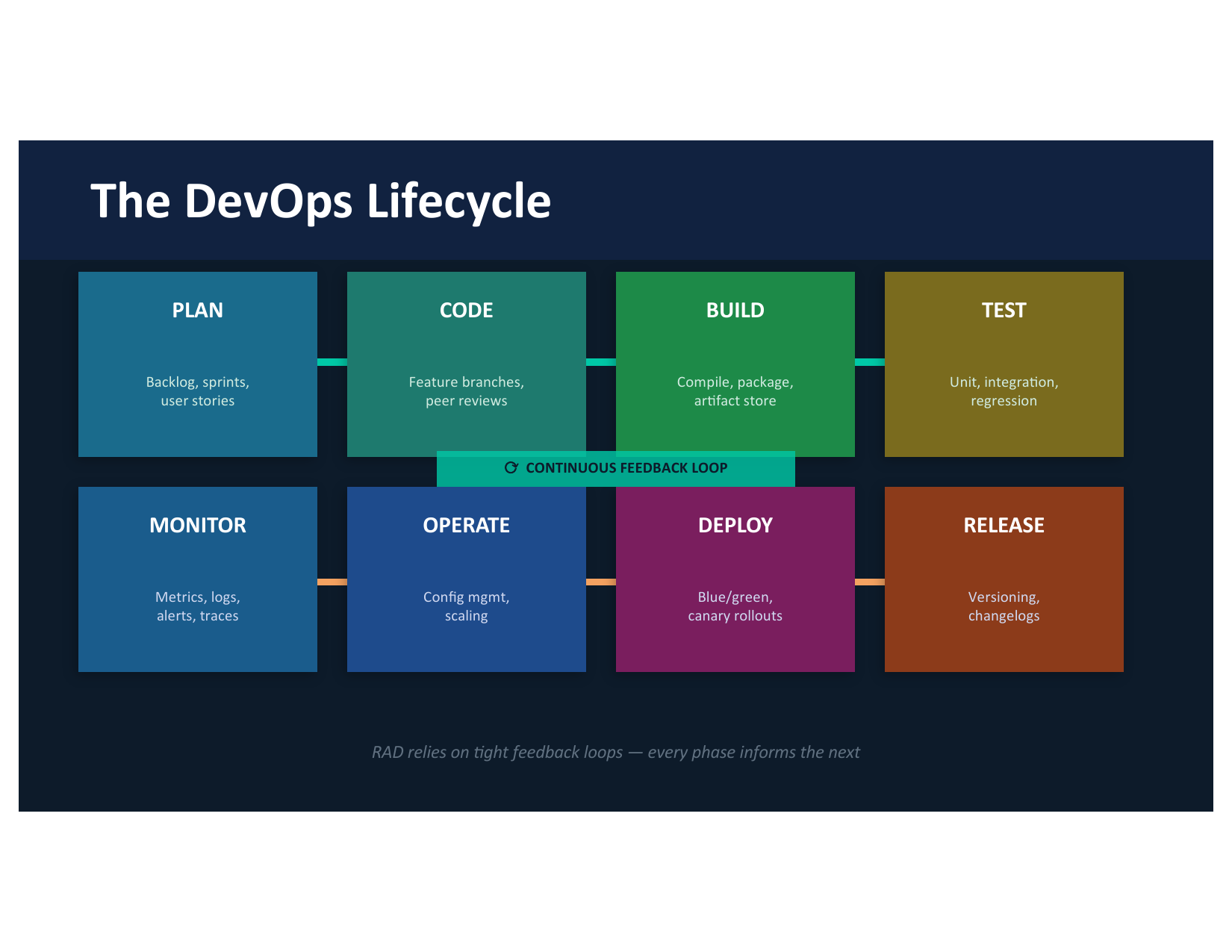
The 8-Stage DevOps Lifecycle
| Stage | Activities |
|---|
| Plan | Backlog, sprints, user stories |
| Code | Feature branches, peer reviews |
| Build | Compile, package, artifact store |
| Test | Unit, integration, regression |
| Release | Versioning, changelogs |
| Deploy | Blue/green, canary rollouts |
| Operate | Config management, scaling |
| Monitor | Metrics, logs, alerts, traces |
CI vs CD
Important: CI = automated build+test on every commit; CD Delivery = human gate before prod; CD Deployment = fully automatic. These are commonly confused in exam questions.
| Continuous Integration (CI) | Continuous Delivery | Continuous Deployment |
|---|
| What | Automated build + test on every push | Code always ready to deploy | Every passing build auto-deploys to prod |
| Gate | Fast test suite; broken builds block team | Human approval gate before prod | No human gate |
| Goal | Always have a shippable codebase | Reduce time from commit to customer value | Continuous release |
| Tools | Git, Jenkins, GitHub Actions, CircleCI | Argo CD, Spinnaker, Flux | AWS CodePipeline |
Typical DevOps Pipeline
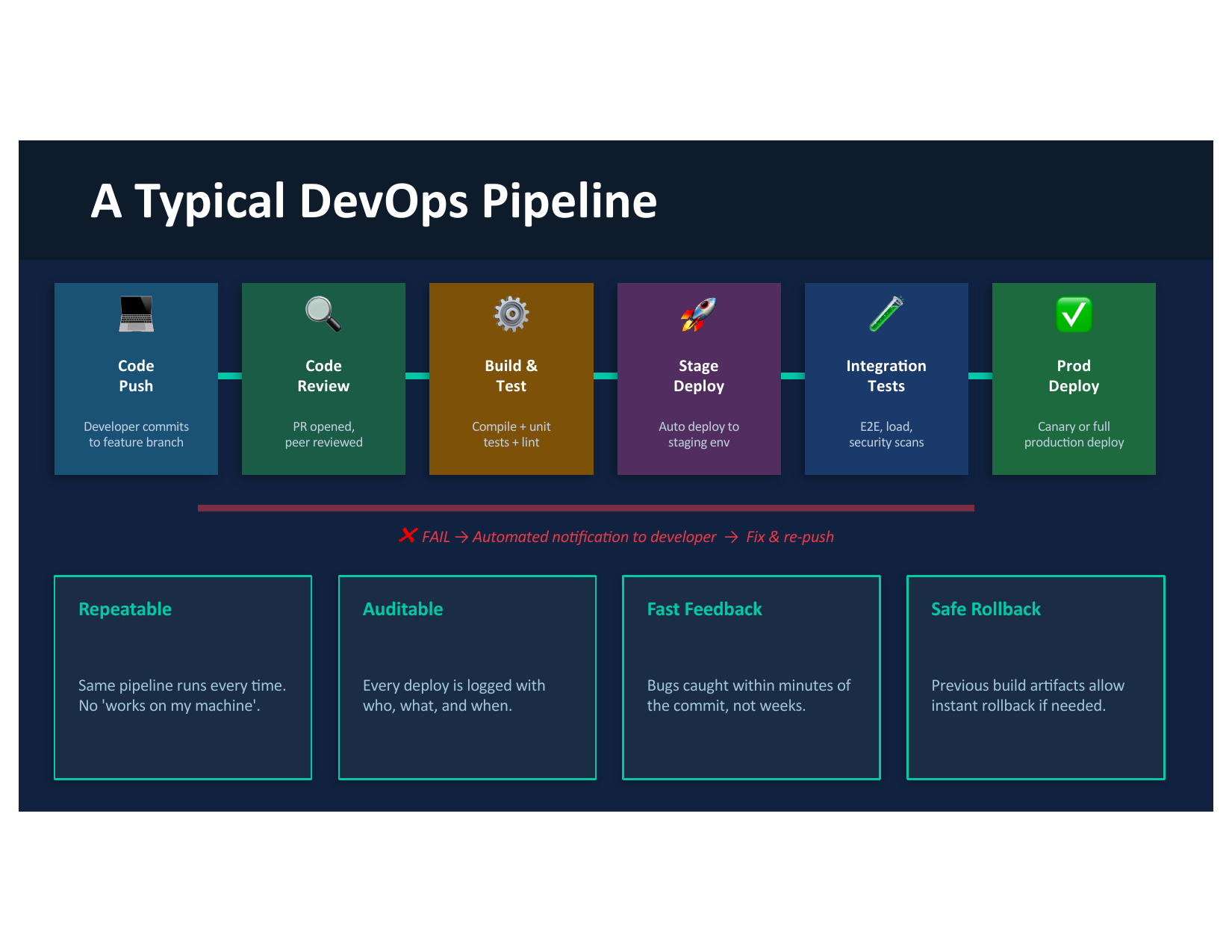
Stages: Code Push → Code Review → Build & Test → Stage Deploy → Integration Tests → Prod Deploy
| Pipeline Property | Detail |
|---|
| Repeatable | Same pipeline runs every time — no "works on my machine" |
| Auditable | Every deploy logged with who, what, and when |
| Fast Feedback | Bugs caught within minutes of the commit, not weeks |
| Safe Rollback | Previous build artifacts allow instant rollback if needed |
Containers & Orchestration
| Concern | Docker | Kubernetes (K8s) |
|---|
| Scope | Single container packaging and running | Multi-container orchestration at scale |
| Problem solved | Environment consistency; "works on my machine" | Scaling, self-healing, service discovery |
| Key capabilities | Portable images; Dockerfile defines env declaratively; Container ≠ VM | Auto-scaling; self-healing restarts; rolling updates; zero-downtime deploys; load balancing |
| When you need it | Every deployment | When running many containers in production |
Infrastructure as Code (IaC)
| Property | Detail |
|---|
| Reproducible | Spin up identical environments in minutes |
| Version controlled | Every change tracked in Git |
| Auditable | Who changed what, when, and why |
| Cost-controlled | Destroy dev environments overnight |
| Self-documenting | Code IS the documentation |
Tools: Terraform · Pulumi · Ansible · AWS CDK · Helm
DevOps Trade-offs
| Trade-off | Resolution |
|---|
| Speed vs Stability | Deploying 10× daily increases incident risk — invest in automated testing and observability |
| Automation vs Control | Fully automated pipelines reduce human error but reduce oversight — define clear approval gates for production |
| Cost vs Scalability | Kubernetes, multi-region, and redundancy cost money — size for P99 usage, use auto-scaling and spot instances |
| Monolith vs Microservices | Monoliths simpler to develop; microservices scale independently but add complexity — start monolith, split when needed |
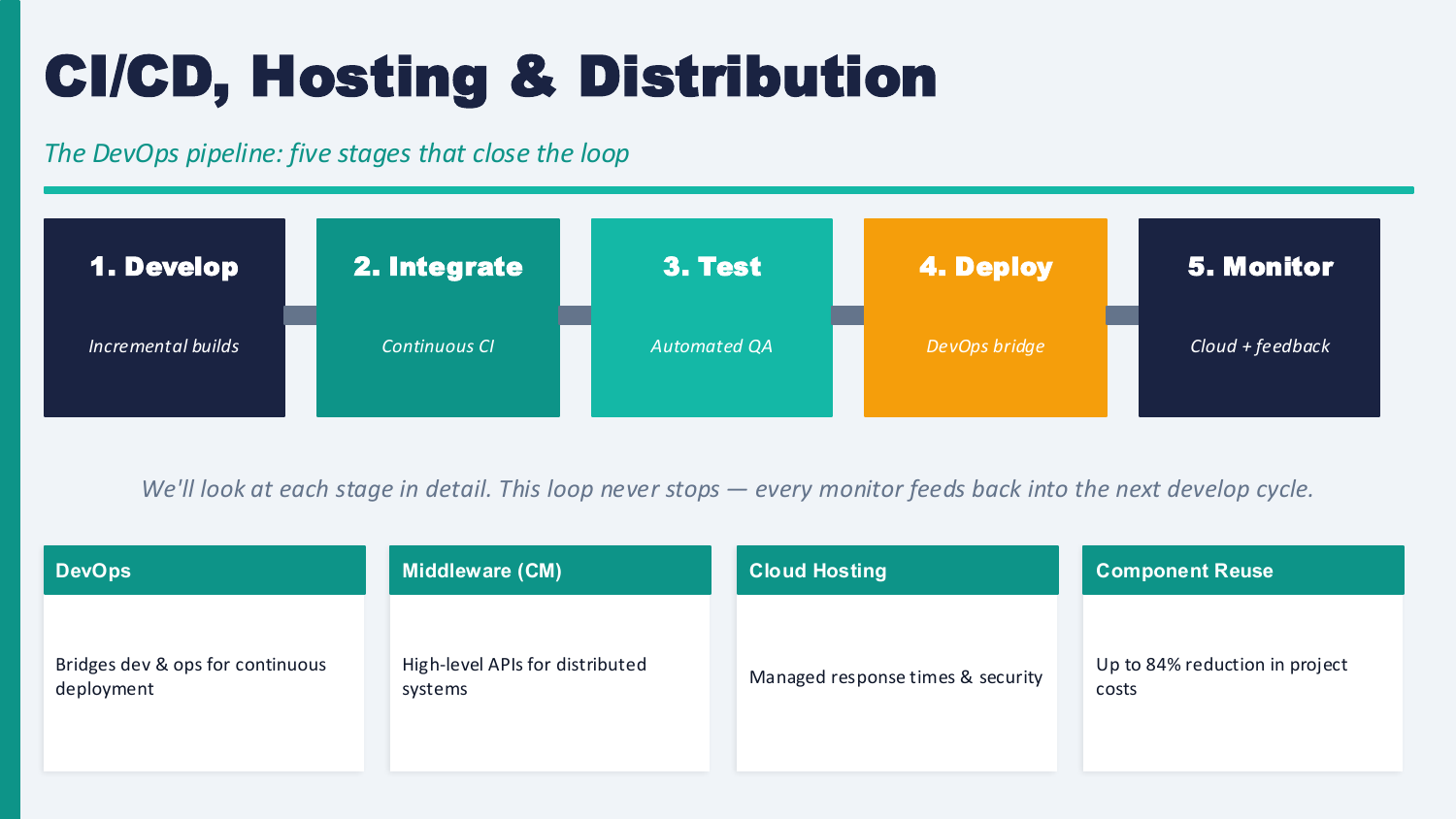
RAD 5-Stage Delivery Pipeline
| Stage | Subtitle | What happens |
|---|
| 1. Develop | Incremental builds | CASE tools, 4GL, and component repositories accelerate output. Each increment adds real value |
| 2. Integrate | Continuous CI | Multiple merges per day. Every merge triggers automated build check. RepoGuard validates and links commits to bug tracking |
| 3. Test | Automated QA | FitNesse, Selenium, V-Model approach run in parallel with development. Failures block the pipeline immediately |
| 4. Deploy | DevOps bridge | Tested code deployed automatically. Rollback mechanisms included. Communication Middleware enables scalable multi-user deployment |
| 5. Monitor | Cloud + feedback | Response times, resource scaling, security tracked. Performance data feeds back into the development backlog — the loop never stops |
Testing Tools in RAD
| Tool | What it does | RAD role |
|---|
| FitNesse | Business-readable acceptance tests — stakeholders write and verify criteria without touching code | Bridges business and technical; acceptance criteria become executable tests |
| Selenium | Automated browser testing for web apps — every UI interaction verified on every build | Catches regression in the UI layer before users do |
Relationship to Agile and RAD
| Agile (Scrum) | DevOps |
|---|
| Speeds up the development cycle | Speeds up the delivery and deployment cycle |
| Produces working software every Sprint | Ensures that software can be released continuously |
| Sprint Review shows working software | CD pipeline actually ships working software |
CI/CD as a Code Quality Guardrail
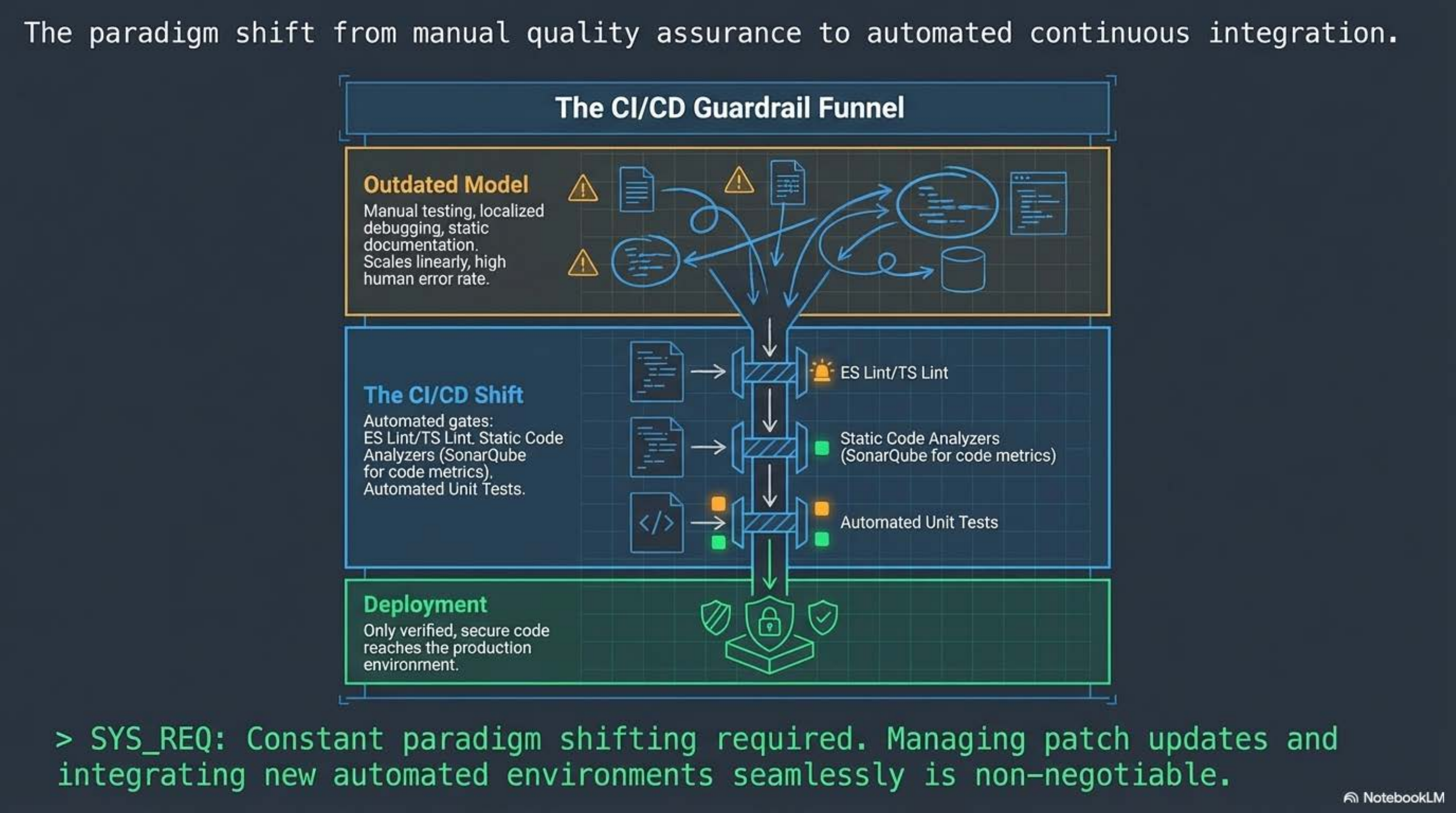
| Gate | Tool Examples | What it catches |
|---|
| Linting | ES Lint, TS Lint | Syntax errors, style violations, potential runtime errors before execution |
| Static Code Analysis | SonarQube | Code complexity, duplication, test coverage gaps, security hotspots |
| Automated Unit Tests | Jest, JUnit, PyTest | Regression — verifies existing behaviour is not broken by new changes |
6 — Observability
Observability is how you maintain quality as you move fast. The Monitor stage of the DevOps lifecycle feeds back into the next Plan cycle — observability makes that feedback actionable.
Important: Three Pillars: Logs (what happened?), Metrics (how is it performing?), Traces (where is it slow?). Know all three definitions and their tools.
The Three Pillars
| Pillar | Question Answered | Data Type | Key Practices | Tools |
|---|
| Logs | What happened? | Timestamped event records | Structured JSON preferred; centralise in ELK/Loki; add correlation IDs for cross-service tracing | ELK Stack, Loki, Papertrail |
| Metrics | How is it performing? | Numeric time series | USE method: Utilisation, Saturation, Errors (for infrastructure); RED method: Rate, Errors, Duration (for services). Alert on anomalies, not fixed thresholds | Prometheus, Grafana, Datadog |
| Traces | Where is it slow? | Distributed request journeys | Trace ID follows a request across all services; sample 1–10% of requests (cost vs coverage trade-off) | Jaeger, Zipkin, AWS X-Ray |
Important: Traces are critical for microservices architectures — a single user request may touch 10+ services. Without traces you cannot pinpoint where latency is introduced.
Observability vs Monitoring
| Monitoring | Observability |
|---|
| Tells you when something is wrong | Tells you why something is wrong |
| Tracks known failure modes | Explores unknown failure modes |
| Dashboards and alerts | Logs + metrics + traces combined |
7 — Release Strategies
Release strategies decouple deployment frequency from deployment risk — the goal is to ship to production safely and often.
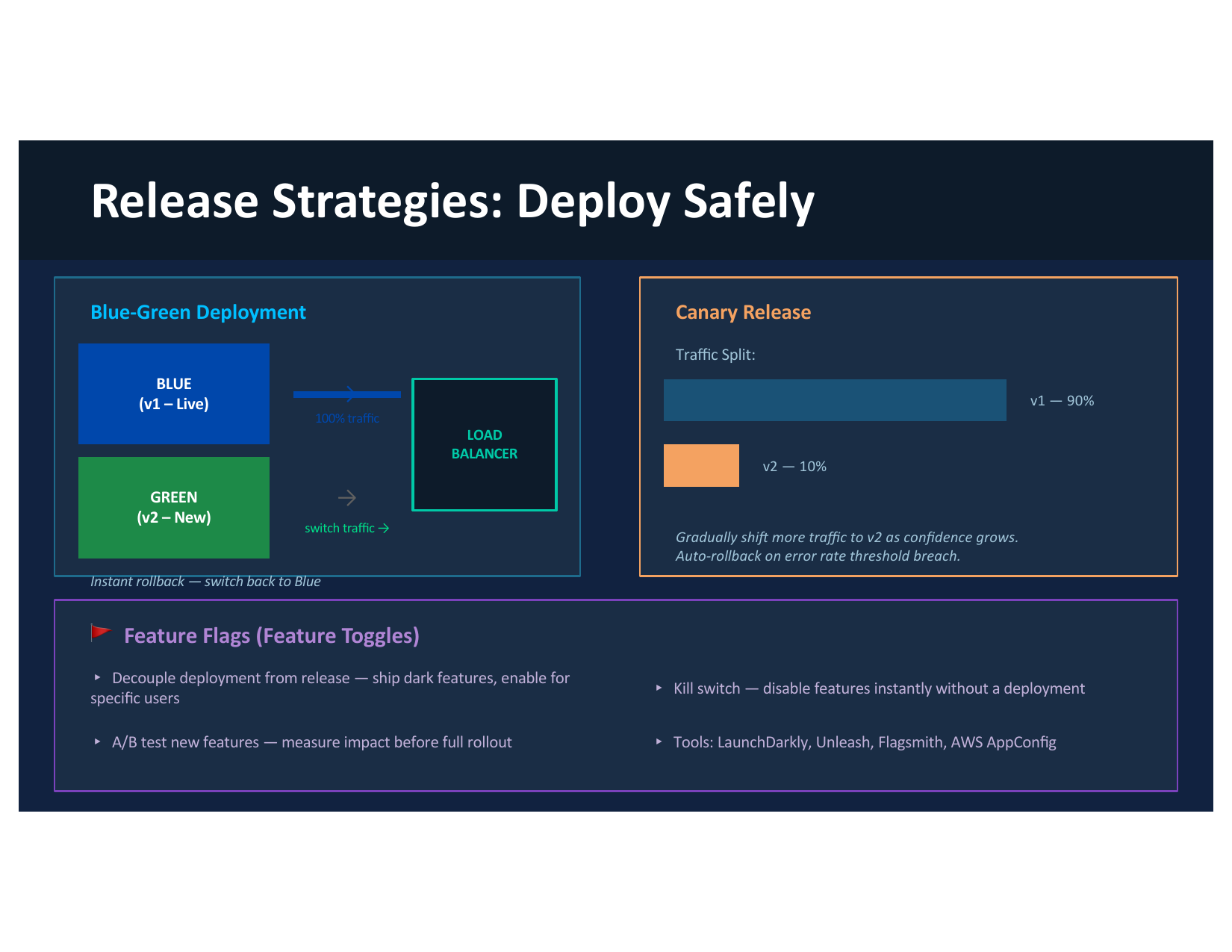
Important: Blue-green = instant all-or-nothing swap; Canary = gradual shift; Feature Flags = decouple code deploy from feature activation.
Blue-Green Deployment
| Element | Detail |
|---|
| BLUE | v1 — currently live, receives 100% of traffic |
| GREEN | v2 — new version deployed and tested in parallel |
| Switch | Traffic redirected Blue → Green when Green is ready |
| Rollback | Instant — switch traffic back to Blue |
| Cost | Requires double the infrastructure during transition |
Canary Release
| Element | Detail |
|---|
| Traffic split | Start small — e.g., v1: 90%, v2: 10% |
| Progression | Gradually shift more traffic to v2 as confidence grows |
| Auto-rollback | Triggered automatically on error rate threshold breach |
| Risk | Only a small percentage of users see potential issues |
Feature Flags (Feature Toggles)
| Property | Detail |
|---|
| Core idea | Ship "dark" features in deployed code, enable for specific users via config |
| A/B testing | Test new features on subsets of users, measure impact before full rollout |
| Kill switch | Disable a feature instantly without a new deployment |
| Tools | LaunchDarkly · Unleash · Flagsmith · AWS AppConfig |
Comparison
| Strategy | Traffic Control | Rollback Speed | Infrastructure Cost | Best For |
|---|
| Blue-Green | Instant all-or-nothing switch | Instant | High (2× environments) | Guaranteed rollback in seconds |
| Canary | Gradual percentage shift | Fast (reduce %) | Low (same infrastructure) | Validating with real traffic |
| Feature Flags | Per-user / per-segment | Instant (toggle off) | None | Decoupling deploy from release |
8 — Domain Driven Design (DDD)
Complex software fails when code drifts away from the business reality it is meant to model. DDD keeps code aligned with the business domain throughout development.
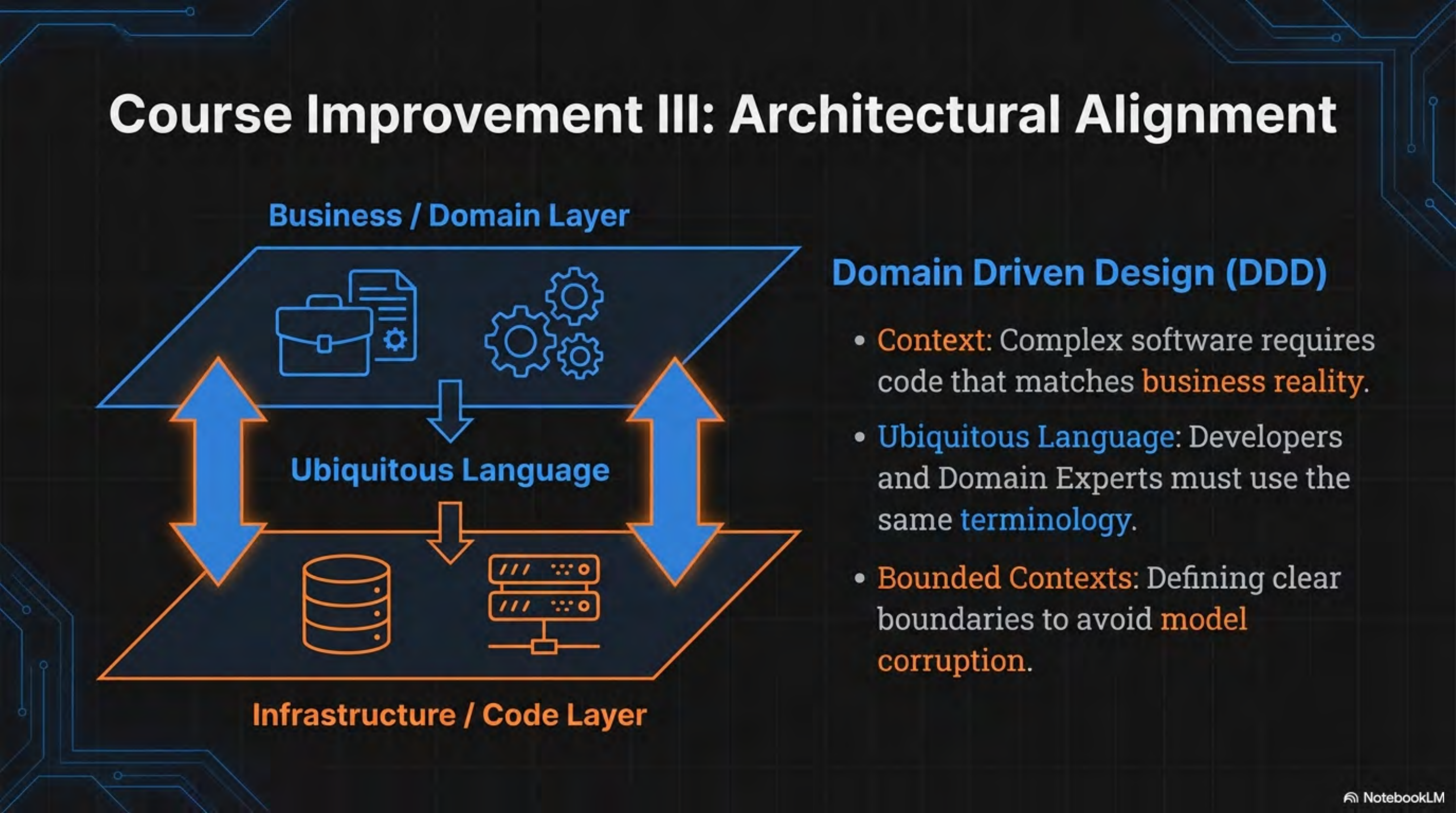
Core Concepts
| Concept | Definition |
|---|
| Ubiquitous Language | Developers and Domain Experts must use the same terminology throughout code, documentation, and conversation. Eliminates translation errors between business intent and technical implementation |
| Bounded Contexts | Clear boundaries around each part of the domain model prevent model corruption — the risk that terms mean different things in different parts of the system |
Architecture
Business / Domain Layer
        ↕
  Ubiquitous Language   ← the shared vocabulary
        ↕
Infrastructure / Code Layer
Important: Know the two key terms: Ubiquitous Language (same terminology across business and code) and Bounded Contexts (clear domain boundaries to avoid model corruption).
In fast-moving Agile environments, without explicit domain boundaries and shared language, the codebase rapidly diverges from business intent. DDD provides the architectural discipline to prevent this even under rapid development cycles.
9 — Kanban
Kanban is positioned in the Adaptive Right of the methodology spectrum. Core focus: Continuous Flow and Bottleneck Identification through visualising work and limiting WIP.
Core Concept: "Stop starting, start finishing."
The Kanban Board
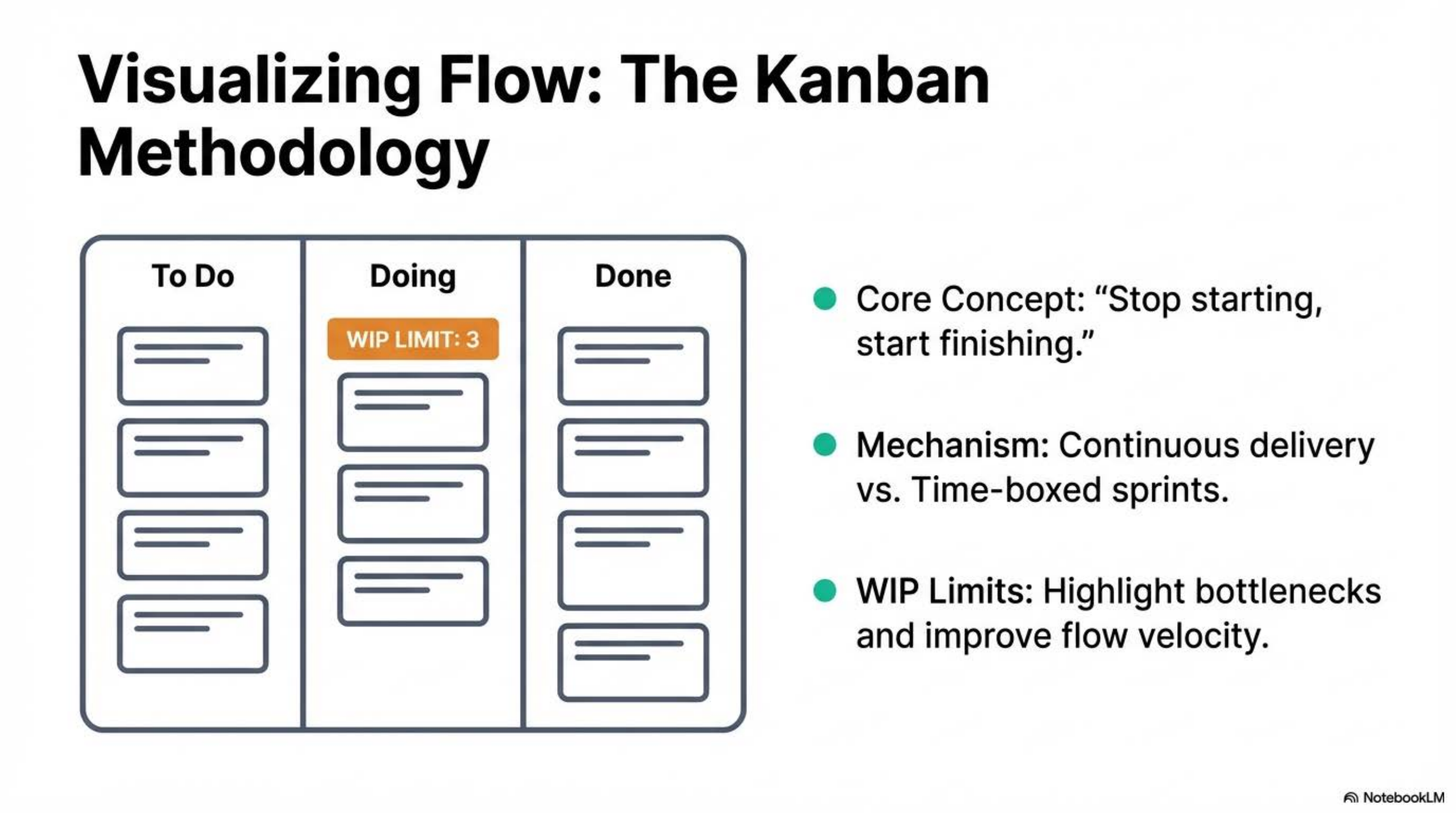
| To Do          | Doing (WIP: 3) | Done           |
|----------------|----------------|----------------|
| [task]         | [task]         | [task ✓]       |
| [task]         | [task]         | [task ✓]       |
| [task]         | [task]         |                |
| [task]         |                |                |
When the "Doing" column is full, no new work can be pulled — teams must finish before they start.
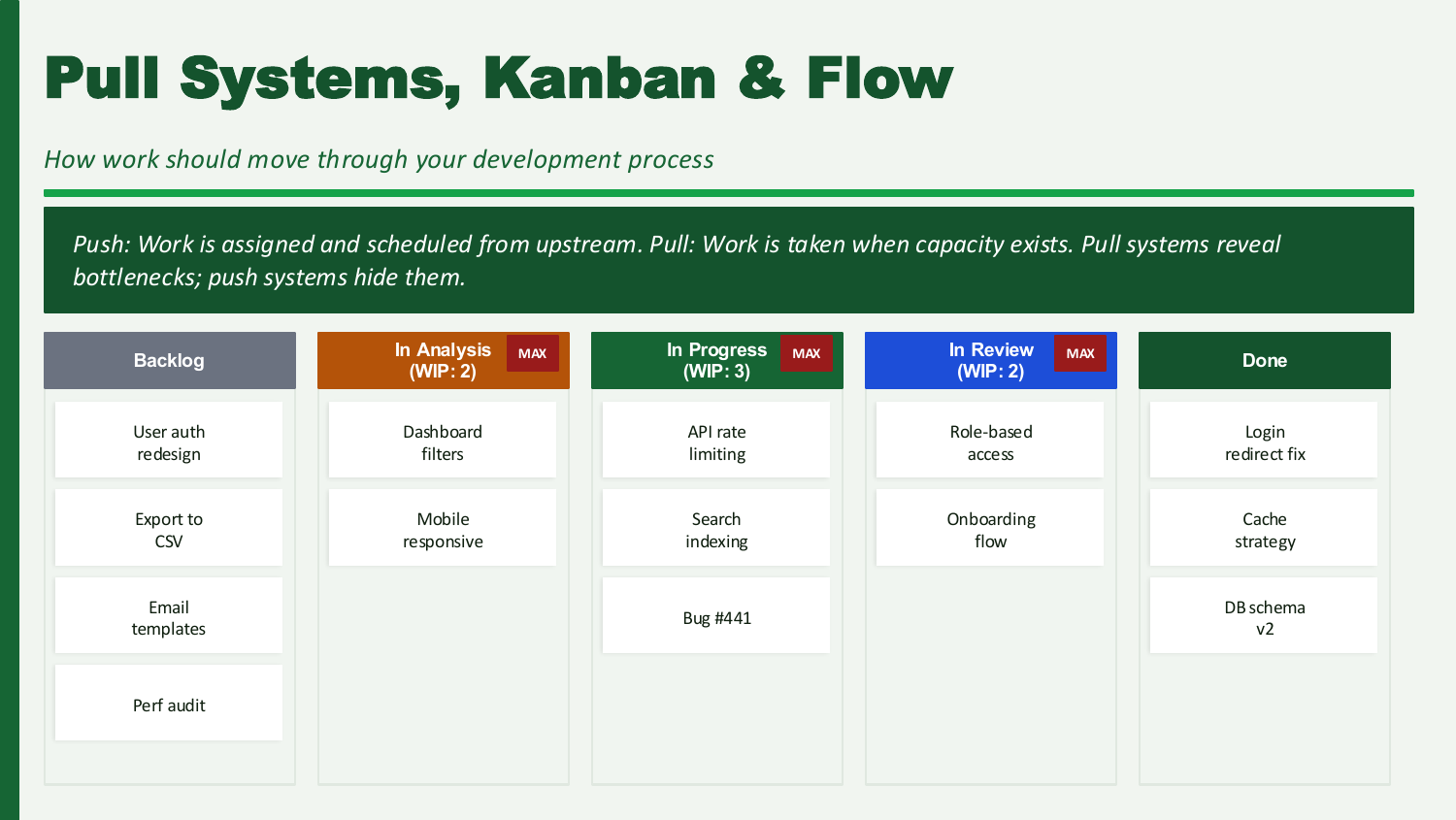
Push vs Pull
| System | How work enters | Effect |
|---|
| Push | Work is assigned and scheduled from upstream — team receives work whether ready or not | Bottlenecks are hidden; WIP accumulates silently; team appears busy but throughput stalls |
| Pull | Work is taken by the team when capacity exists — nothing starts until a slot opens | Bottlenecks become immediately visible as columns fill to their WIP limit |
Important: "Pull systems reveal bottlenecks; push systems hide them." This is why WIP limits are the primary Lean/Kanban mechanism.
Core Principles
| Principle | Detail |
|---|
| WIP Limits | Cap on how many items can be in progress simultaneously — highlights bottlenecks and improves flow velocity |
| Continuous Delivery | Items flow to Done as they are completed, not at Sprint end — no fixed cadence |
| Pull System | Work is pulled by capacity, not pushed by schedule |
| Visualise Work | The board makes blocked items, bottlenecks, and team capacity immediately visible |
Kanban vs Scrum
| Dimension | Kanban | Scrum |
|---|
| Cadence | Continuous flow; no fixed iterations | Fixed Sprints (2–4 weeks) |
| Changes | Can happen anytime | Locked during a Sprint |
| Roles | No prescribed roles | PO, ScrumMaster, Dev Team |
| Ceremonies | None required | Sprint Planning, Daily Scrum, Review, Retrospective |
| WIP | Explicitly limited via WIP limit | Implicitly limited by Sprint scope |
| Output metric | Lead time / Throughput | Velocity (story points/Sprint) |
When to Use Kanban
- Maintenance Mode — ongoing support where requests arrive continuously
- Focus on Flow — minimising lead time is more important than delivering planned features
- Continuous Delivery — need to ship items as they complete rather than waiting for a Sprint end
- Bottleneck visibility — team wants to identify and fix process constraints
Important: Strategic Selection: Kanban → Primary Constraint = Bottleneck Removal. (Waterfall → Fixed Requirements; Agile/Scrum → Evolving Requirements; RAD → Extreme Speed; Spiral → High Risk)
10 — RAD Teams
Cross-Functional Teams
| Property | Detail |
|---|
| Diverse Skills | Mix of dev, design, QA, and business expertise |
| Shared Goals | Team owns delivery end-to-end, not by phase |
| Flat Hierarchy | Direct communication, minimal approval chains |
| Autonomous | Empowered to make decisions within scope |
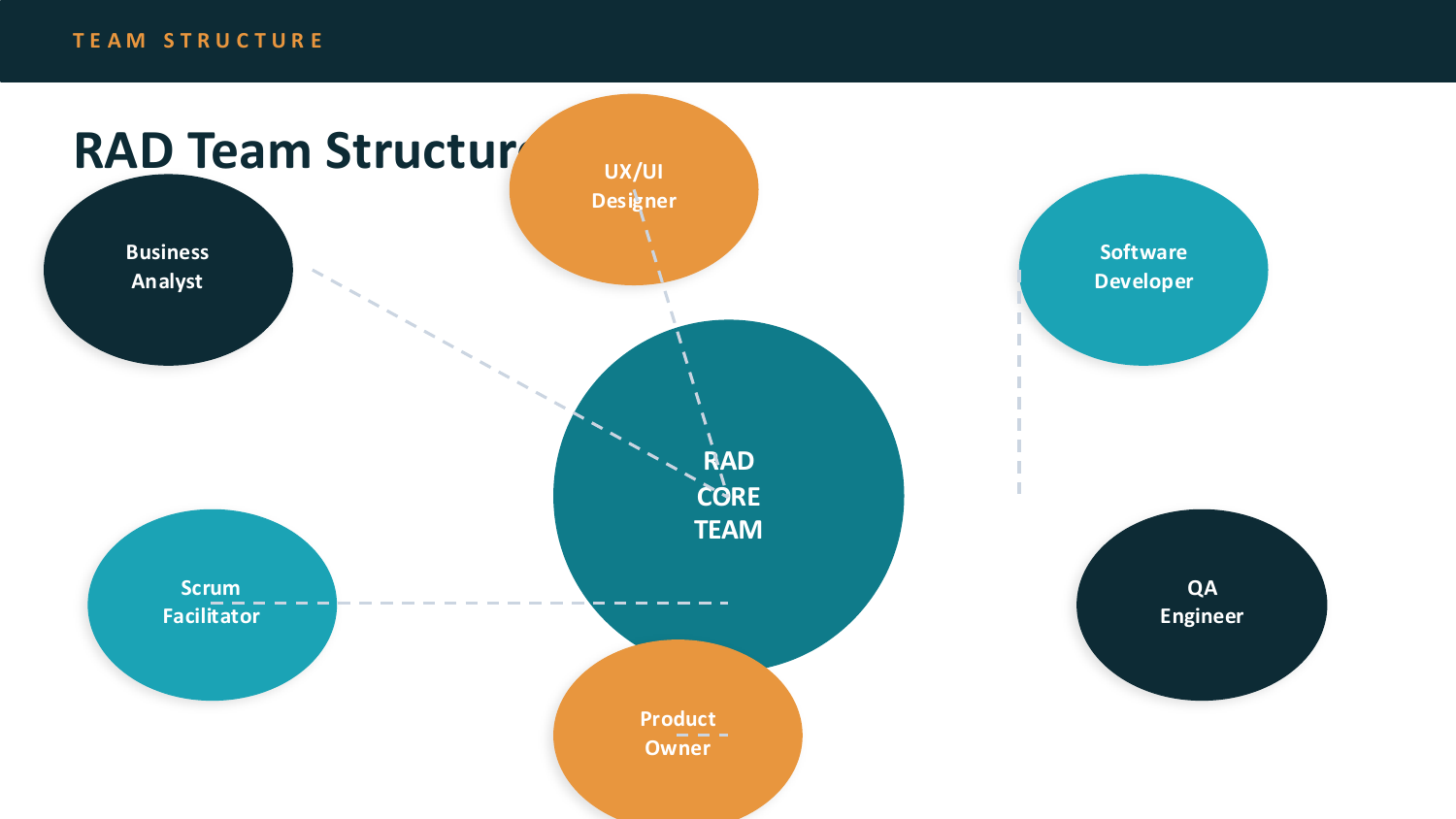
RAD Team Structure — Six Roles
| Role | Responsibility |
|---|
| Product Owner | Owns the vision; prioritises backlog; accepts deliverables. Bridge between business and team |
| RAD Facilitator | Manages timelines; removes blockers; protects team from scope creep and external distractions |
| Developers | Full-stack or specialised; build rapidly using reusable components and modern frameworks |
| UX/UI Designers | Create prototypes; conduct user research; translate user feedback into design iterations |
| QA Engineers | Embedded testers who validate continuously (not just at end); write acceptance criteria with PO |
| Business Analyst | Translates business requirements into user stories; maintains alignment between stakeholders and team |
Important: RAD Facilitator ≠ Project Manager. The RAD Facilitator protects the timebox and removes blockers — they do not direct tasks. This parallels the ScrumMaster role.
Management Principles
| Traditional | RAD |
|---|
| Top-down directives | Servant leadership — managers remove obstacles, not direct tasks |
| Phase-gate reviews | Continuous feedback |
| Fixed scope | Flexible scope; time-box discipline protects boundaries |
| Milestone tracking | Velocity tracking; transparent communication via daily standups + visible backlogs |
Sourcing Strategies
| Strategy | Pro | Con |
|---|
| Internal Secondment | Low cost, high context | Availability conflicts |
| External Contracting | On-demand expertise | Higher cost, onboarding time |
| Hybrid Sourcing (most common) | Flexible, cost-effective | Coordination overhead |
| Outsourced Teams | Fast ramp-up | Alignment risks, IP concerns |
T-Shaped Professional — Skill Requirements
| Skill Type | Detail |
|---|
| Technical Skills | Coding, testing, DevOps, prototyping tools, version control |
| Domain Knowledge | Understanding of the business domain, user workflows, and system constraints |
| Communication | Active listening, stakeholder management, technical writing, presentation |
| Adaptability | Comfort with ambiguity, rapid context switching, learning on-the-fly |
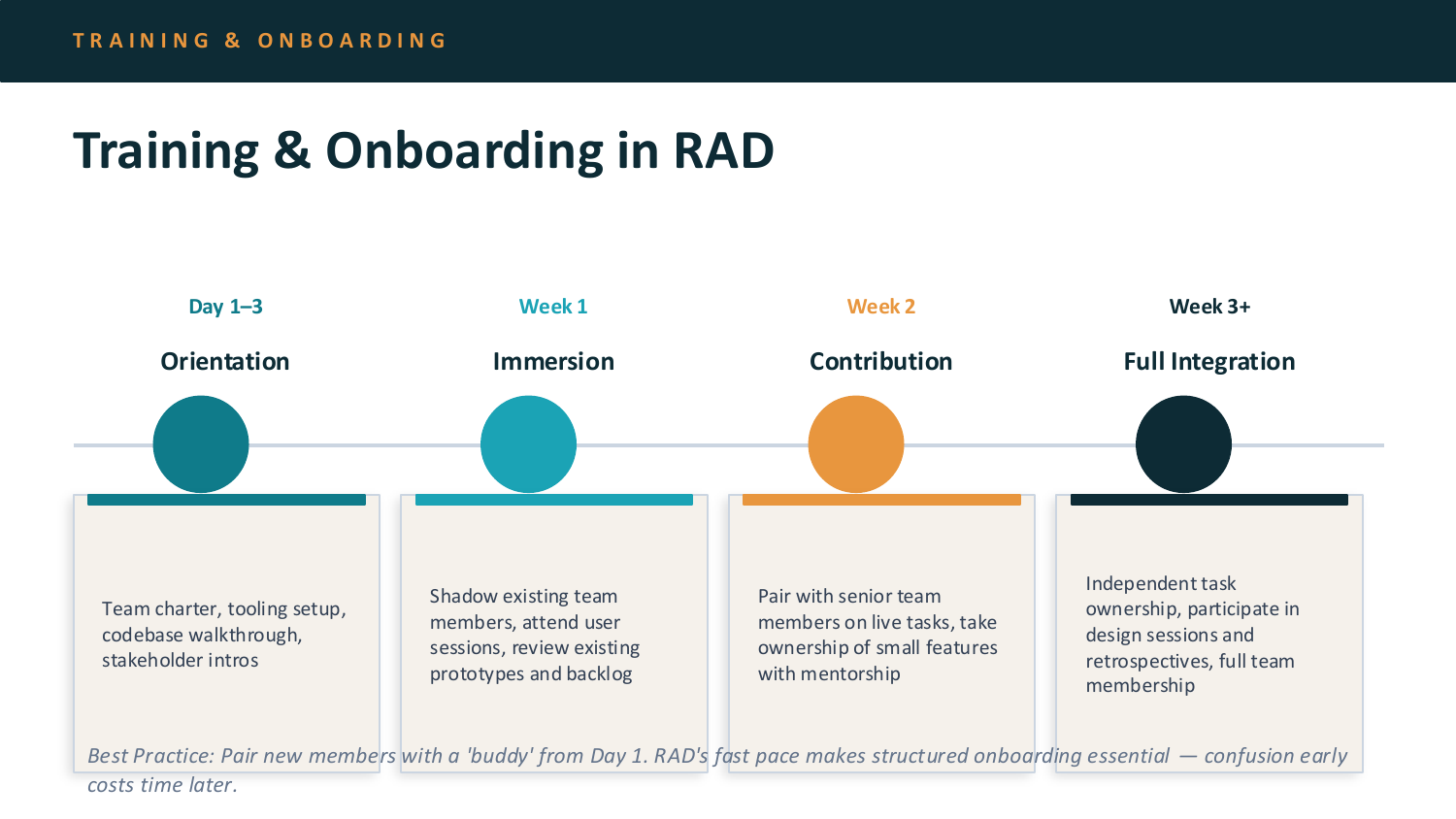
Training & Onboarding (4 Stages)
| Stage | Timing | Activities |
|---|
| Orientation | Day 1–3 | Team charter, tooling setup, codebase walkthrough, stakeholder intros |
| Immersion | Week 1 | Shadow existing team members, attend user sessions, review prototypes and backlog |
| Contribution | Week 2 | Pair with senior members on live tasks, take ownership of small features with mentorship |
| Full Integration | Week 3+ | Independent task ownership, participate in design sessions and retrospectives |
Knowledge Transfer Practices
| Practice | How It Transfers Knowledge |
|---|
| Pair Programming | Code written in pairs — both developers understand the implementation |
| Code Reviews | Every PR reviewed by at least one other; review comments are knowledge transfer artifacts |
| Wiki / Living Docs | Lightweight docs in sprint — focus on decisions made and why, not just what was built |
| Demo Sessions | Weekly demos open to entire team — everyone explains what they built |
| Retrospectives | Structured exchange of what worked, what didn't, what to carry forward |
| Rotation Policy | Regularly rotate team members across features and modules to distribute knowledge |
Work Tracking Metrics
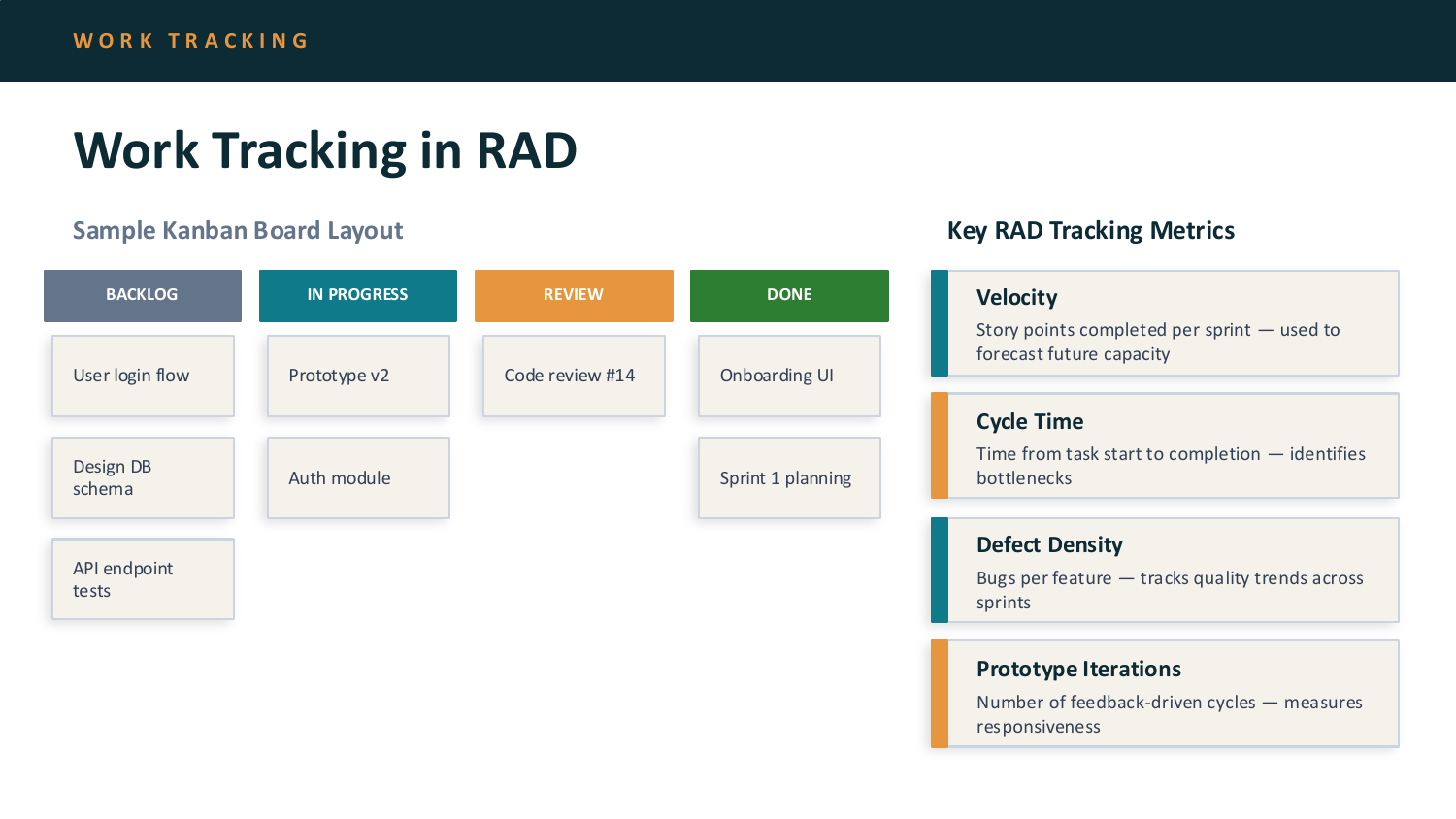
RAD Kanban boards use four columns: Backlog → In Progress → Review → Done.
| Metric | Definition | Purpose |
|---|
| Velocity | Story points completed per sprint | Forecast future capacity |
| Cycle Time | Time from task start to completion | Identify bottlenecks |
| Defect Density | Bugs per feature | Track quality trends across sprints |
| Prototype Iterations | Number of feedback-driven cycles | Measure responsiveness to user input |
Participatory Design (PD) — 3 Techniques
| Technique | Description |
|---|
| Co-Design Workshops | Users sketch interfaces, create paper prototypes, and prioritise features alongside the design team. Held at sprint start |
| Contextual Inquiry | Developers and designers observe users in their actual work environment — reveals tacit needs no interview would surface |
| Prototype Walkthroughs | Users walk through clickable prototypes while thinking aloud; team observes silently and notes friction points |
User-Centered Design (UCD)
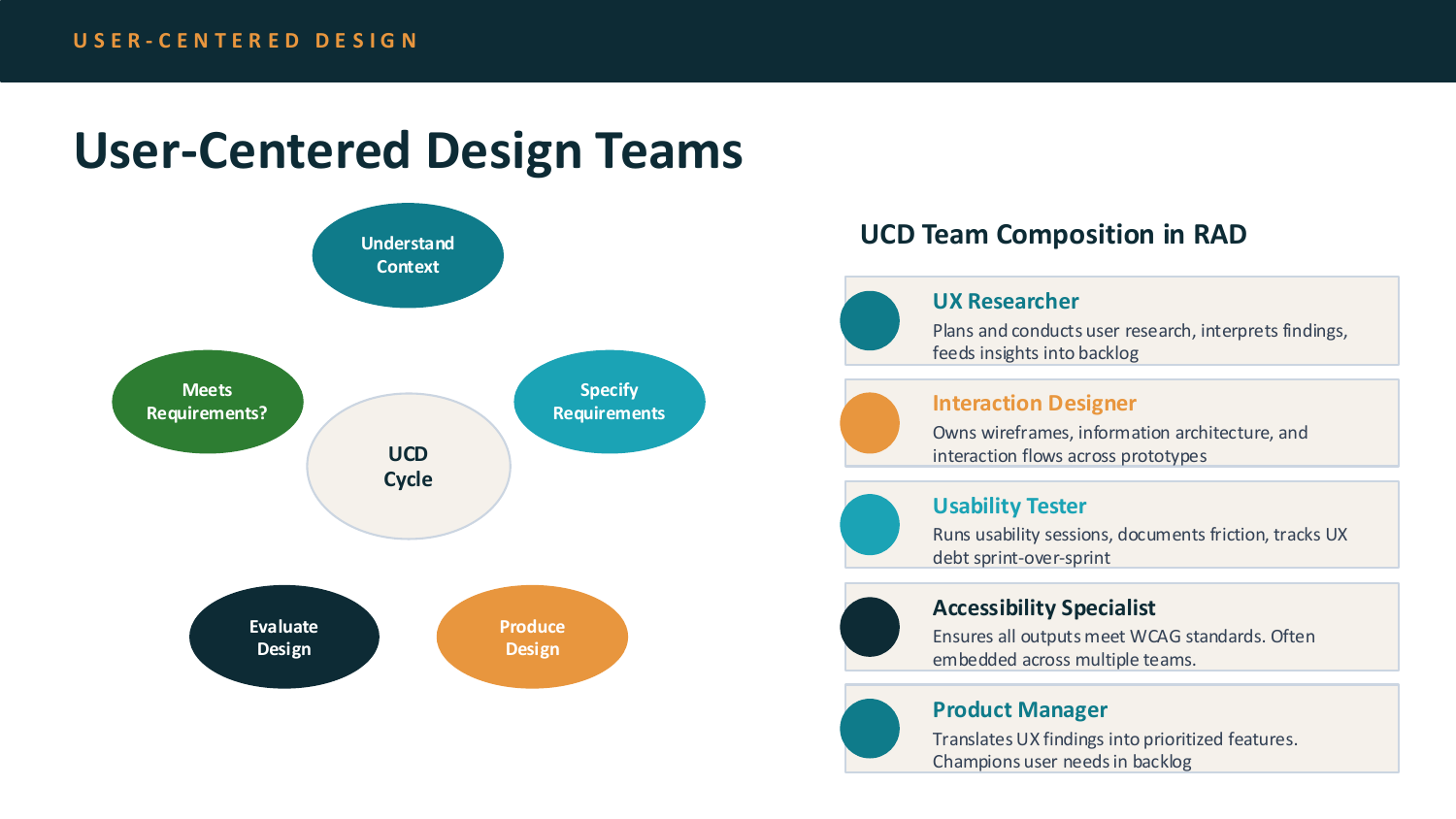
UCD Cycle: Understand Context → Specify Requirements → Produce Design → Evaluate Design → (Meets Requirements? → done or back to Understand)
| UCD Role | Responsibility |
|---|
| UX Researcher | Plans and conducts user research; interprets findings; feeds insights into backlog |
| Interaction Designer | Owns wireframes, information architecture, and interaction flows |
| Usability Tester | Runs usability sessions; documents friction; tracks UX debt sprint-over-sprint |
| Accessibility Specialist | Ensures all outputs meet WCAG standards |
| Product Manager | Translates UX findings into prioritised features; champions user needs in backlog |
Project Management Tools
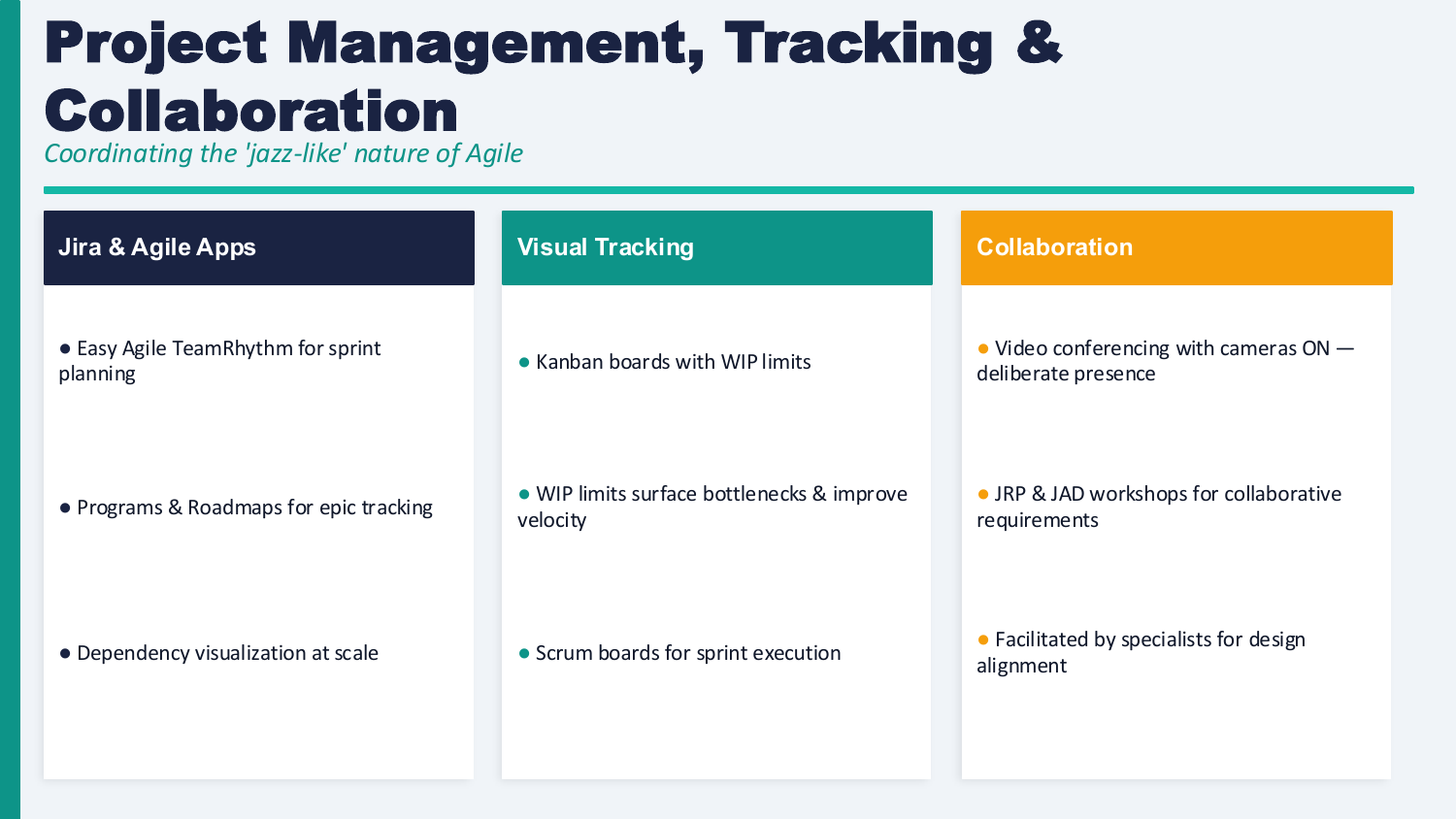
JRP & JAD Workshops
| JRP (Requirements) | JAD (Design) |
|---|
| Focus | Requirements gathering | Application design |
| Goal | Agree on scope and what the system must do | Agree on how the system will work |
| Who attends | Business stakeholders + analysts | Business + developers + designers |
| Output | Requirements document / user stories | Wireframes, data models, workflow designs |
| RAD value | Replaces weeks of back-and-forth with a 1–3 day workshop | Gets design decisions made with all parties in the room |
Important: JRP and JAD are time-compression techniques — they collapse requirements and design cycles from weeks of email chains into structured days of facilitated workshop.
12 — Low-Code / No-Code Prototyping
Important: "The Prototype IS the Product" — platforms like Quickbase and Caspio ship with built-in databases, reporting engines, and admin tools, making the prototype-to-production transition seamless.
Low-Code / No-Code Platforms
| Feature | Detail |
|---|
| Built-in database | No schema design or ORM wiring — storage is instant |
| Reporting engine | Charts, dashboards, and exports generated from data out of the box |
| Admin tools | User management, permissions, and configuration without custom code |
| Prototype-to-production | The prototype built in the platform is the production system — no throw-away work |
| Platform | Category | Strength |
|---|
| Quickbase | No-code | Business application builder; DB + reporting + admin built in |
| Caspio | Low-code | Web database apps; built-in workflows and API connections |
| Bubble | No-code | Full-stack web app builder; logic, DB, and UI in one |
| Webflow | No-code | Front-end/CMS; design-to-production web publishing |
User-Driven Prototyping
| Principle | Detail |
|---|
| Iterative with client | Show early → get feedback → refine → repeat |
| Requirements emerge | Users discover what they want by interacting with a working model, not by reading specs |
| Reduces rework | Misunderstandings caught at prototype stage cost far less than at system-test stage |
Prototype Fidelity
| Low-Fidelity | High-Fidelity |
|---|
| What it is | Sketches, paper prototypes, rough wireframes | Interactive, near-production mockup |
| Purpose | Early concept validation — test the idea cheaply | Stakeholder sign-off — validate look, feel, and flow |
| When used | Sprint start / discovery phase | Pre-production / UAT stage |
| Cost to change | Very cheap — sketches are disposable | Higher — polished prototypes take time to rebuild |
| Tools | Paper, Balsamiq, Figma Lo-Fi | Figma Hi-Fi, Webflow, Framer, low-code platforms |
Important: Low-fi first, high-fi later. The mistake is building high-fi prototypes before the concept is validated — wasted effort if the idea changes.
Ajax for Web Prototyping
| Aspect | Detail |
|---|
| Mechanism | Browser sends small data requests in the background; only relevant parts of the page update |
| User experience | Feels like a native app — instant feedback, no "white flash" between actions |
| Examples | Search-as-you-type, live form validation, dynamic dashboards |
13 — Product Management
Software Product Management governs a product from its inception to the market or customer delivery, in order to maximise revenue. Product management sits at the intersection of Customer, Technology, and Business.
Important: "Fall in love with the problem — not the product." The PM's job is to understand what customers need, not to advocate for a particular solution.
The Product Manager Role
| Responsibility | Detail |
|---|
| Reach product-market fit | Helps the product achieve and grow product-market fit by focusing on business needs |
| Manage the roadmap | Communicates with stakeholders to align the product roadmap with company goals |
| Cross-functional knowledge | Must know business models, product design, product marketing, and product development |
| Wears different hats | Acts as UX designer, product marketer, Business Analyst, and Data scientist as needed |
Understanding the Customer
Job Story format: "When [Situation] I want to [Motivation] so I can [Expected Outcome]"
| Step | Activity |
|---|
| Understand | Interviews, surveys, observations of customer behaviour |
| Model | Create end user personas |
| Document | Record customer feedback |
| Analyse | Understand jobs to be done; know competitor solutions; identify market fit; find what's missing |
User Persona — 6 Components
| Component | Content |
|---|
| Demographic Information | Age, gender, occupation, education, income |
| Behaviours | How the user interacts with products, purchasing habits, online behaviour |
| Goals | What the user hopes to achieve by using the product/service |
| Needs | The user's requirements and expectations from the product/service |
| Challenges | Obstacles or pain points in achieving their goals |
| Preferences | Preferred features, design, communication channels |
PM vs Project Manager vs Product Owner
Important: Three roles commonly confused in exams — know the distinctions precisely.
| Dimension | Product Manager | Project Manager | Product Owner |
|---|
| Focus | Strategic — product vision, business objectives, market | Tactical — organisation and resourcing for each initiative | Tactical — converts PM strategy into actionable tasks |
| Responsibilities | Researching, setting product vision, maintaining product roadmap | Breaking down initiatives, planning timelines, allocating resources | Working with cross-functional teams; sprint backlog management |
| Time horizon | Long-term product success | Project duration | Sprint-by-sprint delivery |
Product Life Cycle (5 Stages)
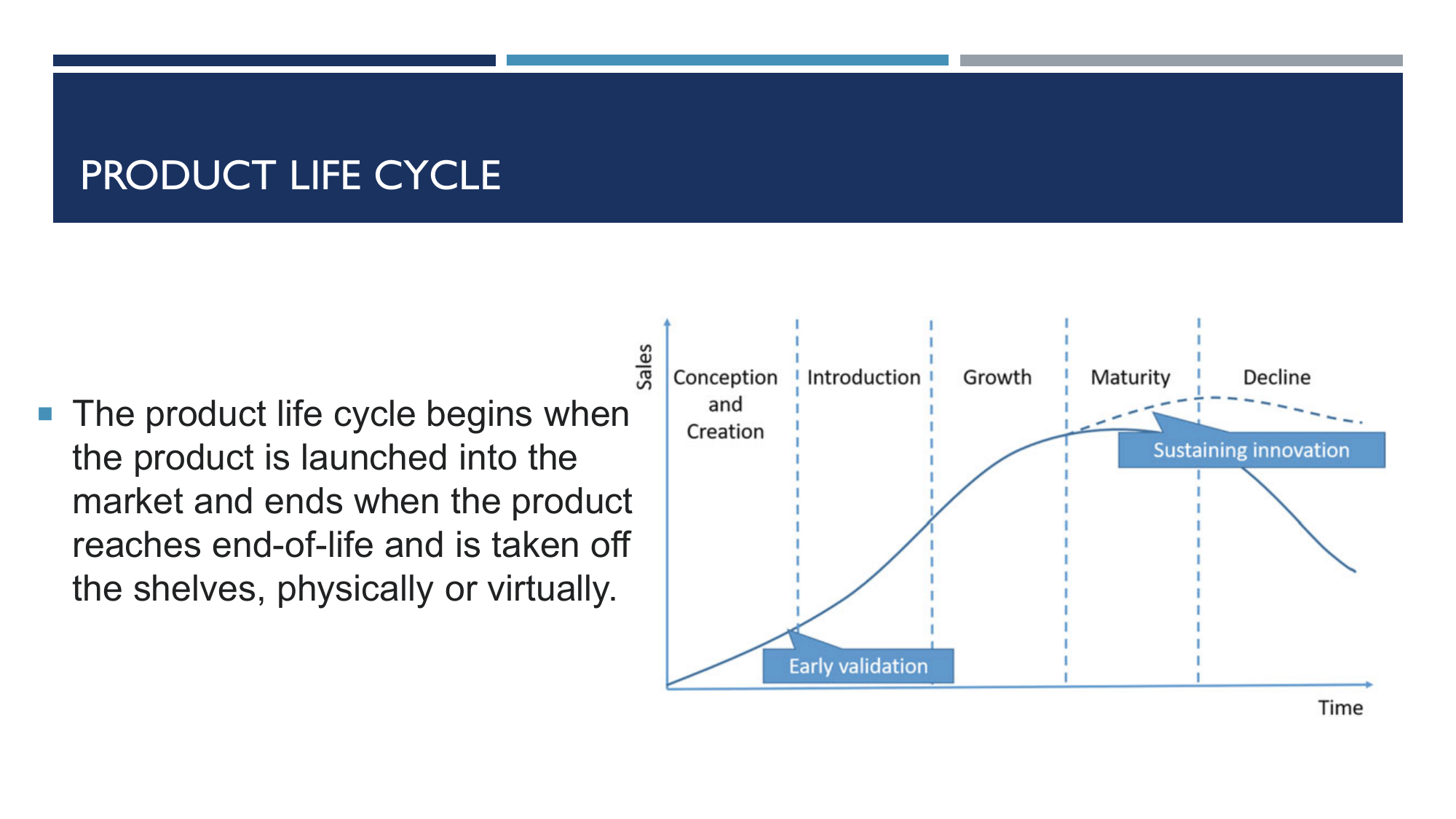
| Stage | Key Activity |
|---|
| Conception and Creation | Idea to initial build |
| Introduction | Launch — Early validation critical here |
| Growth | Rapid sales increase |
| Maturity | Peak sales — Sustaining innovation required to maintain position |
| Decline | Sales fall — product is retired or repositioned |
Important: "Sustaining innovation" at Maturity extends the lifecycle — failing to innovate here leads to Nokia-style decline (Nokia was largest cell phone maker in 1998 but collapsed due to hardware focus, resistance to Android, and overconfidence in brand value).
Product Development (6 Stages)
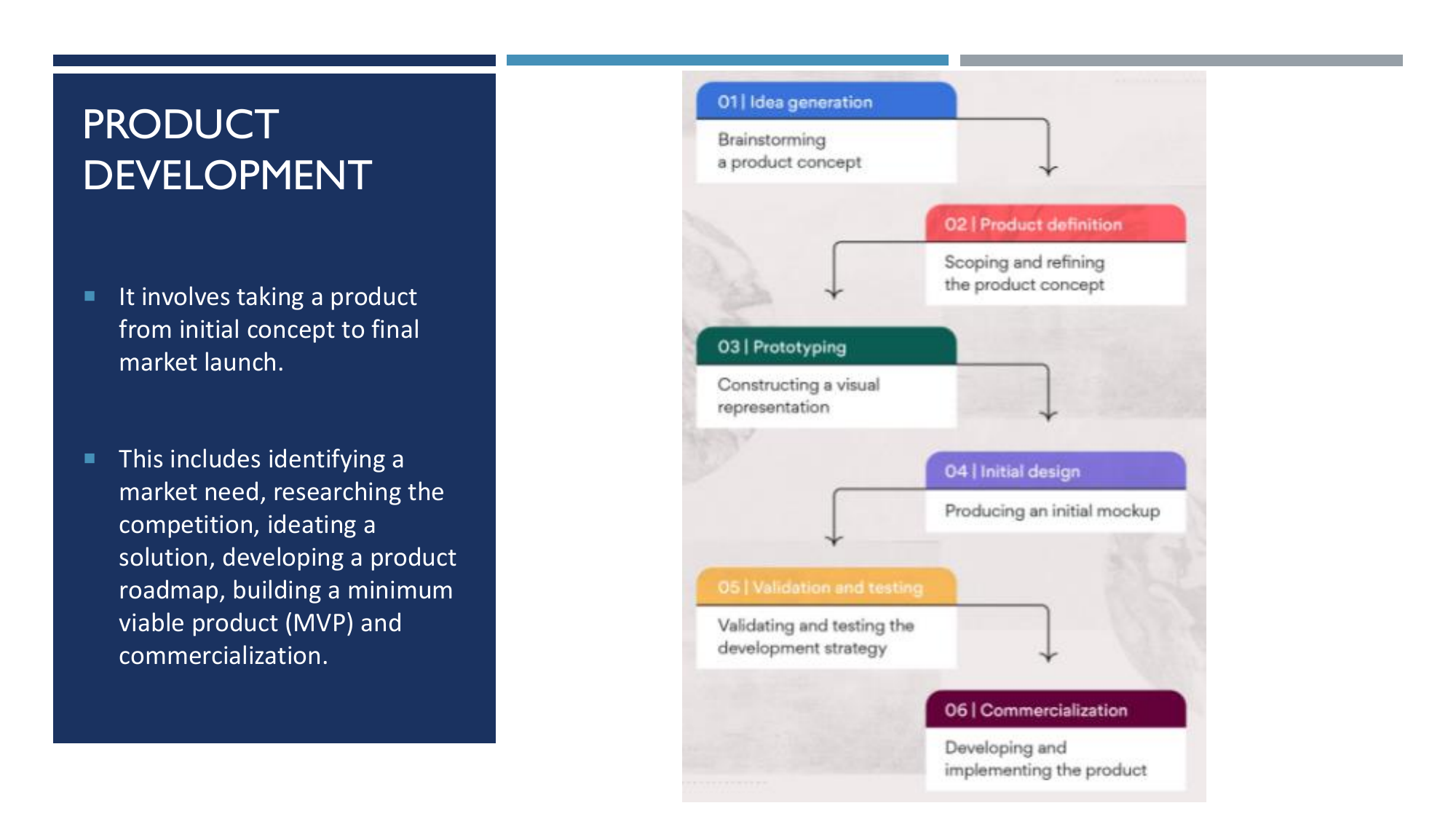
| Stage | Activity |
|---|
| 01 Idea Generation | Brainstorming; SWOT analysis; target market analysis; customer needs, pricing, and market research |
| 02 Product Definition | Scoping and refining the product concept; define value propositions, marketing strategies, success metrics |
| 03 Prototyping | Constructing a visual representation — from drawings to computer-rendered high-level prototypes |
| 04 Initial Design | Producing an initial mockup; stakeholders collaborate; designed for target audience; may take several iterations |
| 05 Validation and Testing | Validating and testing the development strategy; testing required across dev, marketing, and every product part |
| 06 Commercialisation | Developing and implementing the product; launching with planned commercialisation strategies |
Minimum Viable Product (MVP)
| Property | Detail |
|---|
| Definition | A version of a product with just enough features to be usable by early customers who can then provide feedback for future development |
| MVP ≠ Prototype | Prototype = internal sample used to explain a concept. MVP = fully functioning version released publicly |
| MVP ≠ Draft | MVP is not a plan or draft — it is ready to go to market |
| Company | Their MVP |
|---|
| Amazon | Online bookstore only (early 1990s) |
| Facebook | "Thefacebook" — launched across 4 universities to connect campus friends |
| Airbnb | Simple room-exchanging platform |
Important: MVPs are released publicly to receive market feedback and pivot in the right direction — unlike prototypes which are used internally.
14 — SE Ethics and Legal Compliance
"Ethics is not philosophy; it is a structural requirement for system viability."
Professional Ethics
| Layer | Body | Scope |
|---|
| ACM/IEEE 1999 Code of Ethics | International professional standard | Committing to public health, safety, and welfare as the primary obligation — above client or employer interests when they conflict |
| IEEE | Institute of Electrical and Electronics Engineers | Defines, advances, and regulates professional engineering standards globally |
| SLASSCOM | Sri Lanka Association for Software & Services Companies | Local professional body — same mandate at national level |
Standardisation: ISO 27000 Series
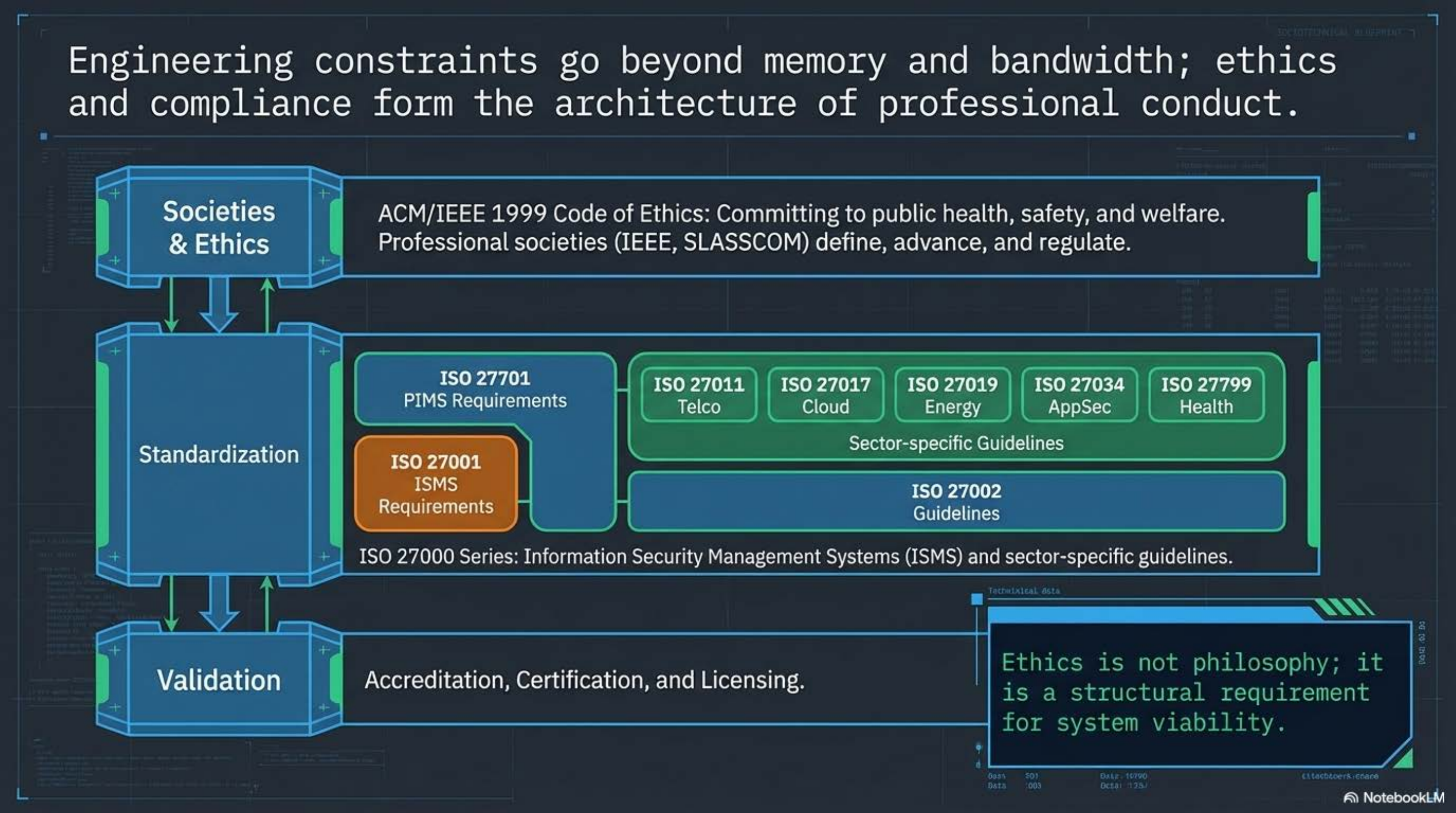
| Standard | Name | Purpose |
|---|
| ISO 27001 | ISMS Requirements | Core — the certifiable standard; defines requirements for establishing, implementing, maintaining, and improving an ISMS |
| ISO 27002 | Guidelines | Implementation guidance for ISO 27001 controls |
| ISO 27701 | PIMS Requirements | Privacy Information Management System — extends 27001 for personal data |
| ISO 27011 | Telco | Sector-specific guidelines for telecommunications |
| ISO 27017 | Cloud | Sector-specific guidelines for cloud services |
| ISO 27019 | Energy | Sector-specific guidelines for energy industry |
| ISO 27034 | AppSec | Application security guidance |
| ISO 27799 | Health | Sector-specific guidelines for healthcare |
The Legal Attack Surface
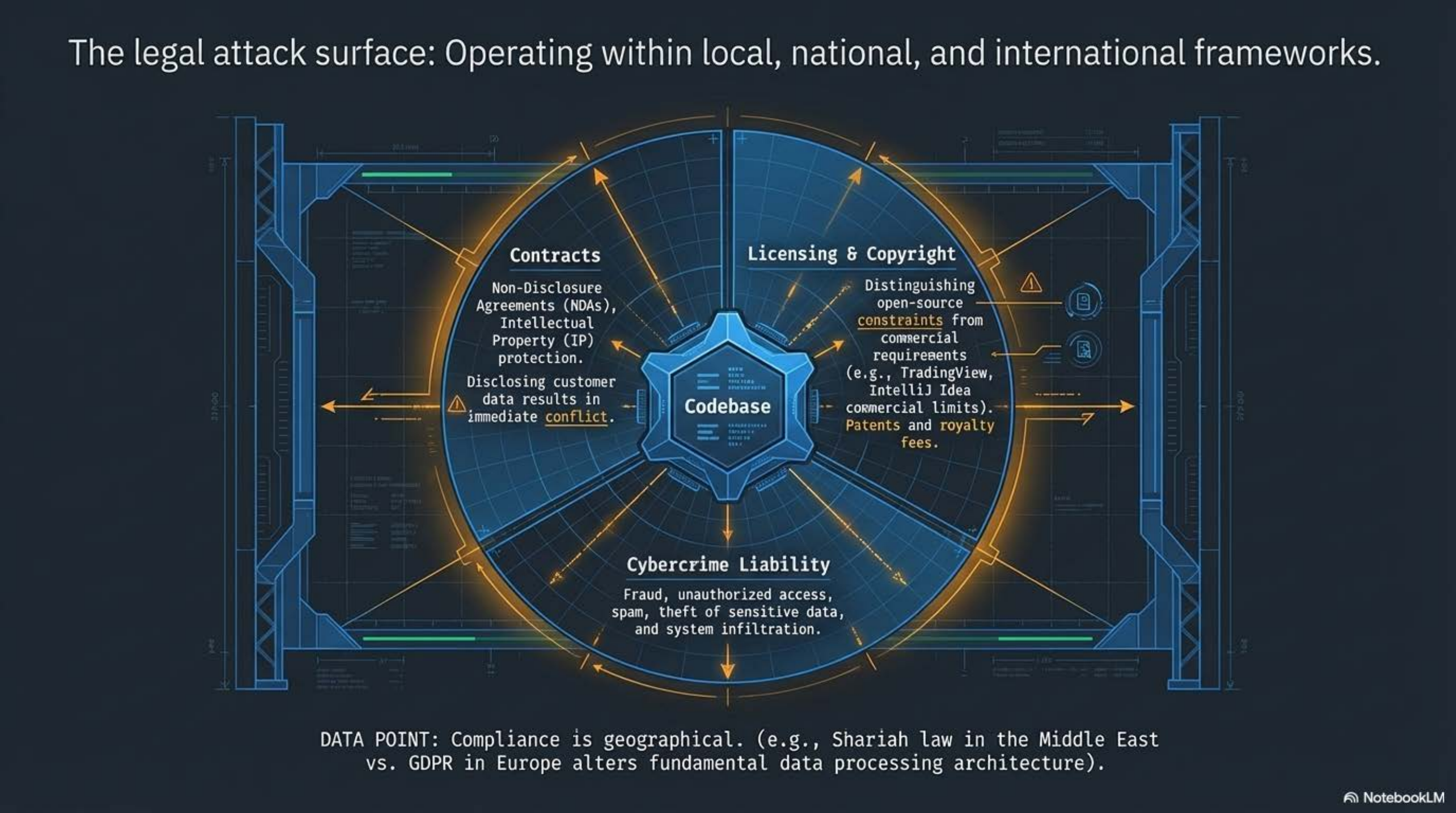
| Legal Area | What it covers | Key Risks |
|---|
| Contracts | NDAs, Intellectual Property (IP) protection | Disclosing customer data = immediate legal conflict; IP leakage through code sharing |
| Licensing & Copyright | Open-source constraints vs. commercial requirements | Confusing open-source licences with commercial freedom; Patent infringement and royalty fees |
| Cybercrime Liability | Fraud, unauthorised access, spam, theft of sensitive data | Engineers can be held liable for systems they build if security is negligent |
Important: Compliance is geographical. Shariah law in the Middle East vs GDPR in Europe alters fundamental data processing architecture — not just policies. Building for a global market means designing for the most restrictive jurisdiction.
Case Study: British Airways — Failure of Privacy by Design
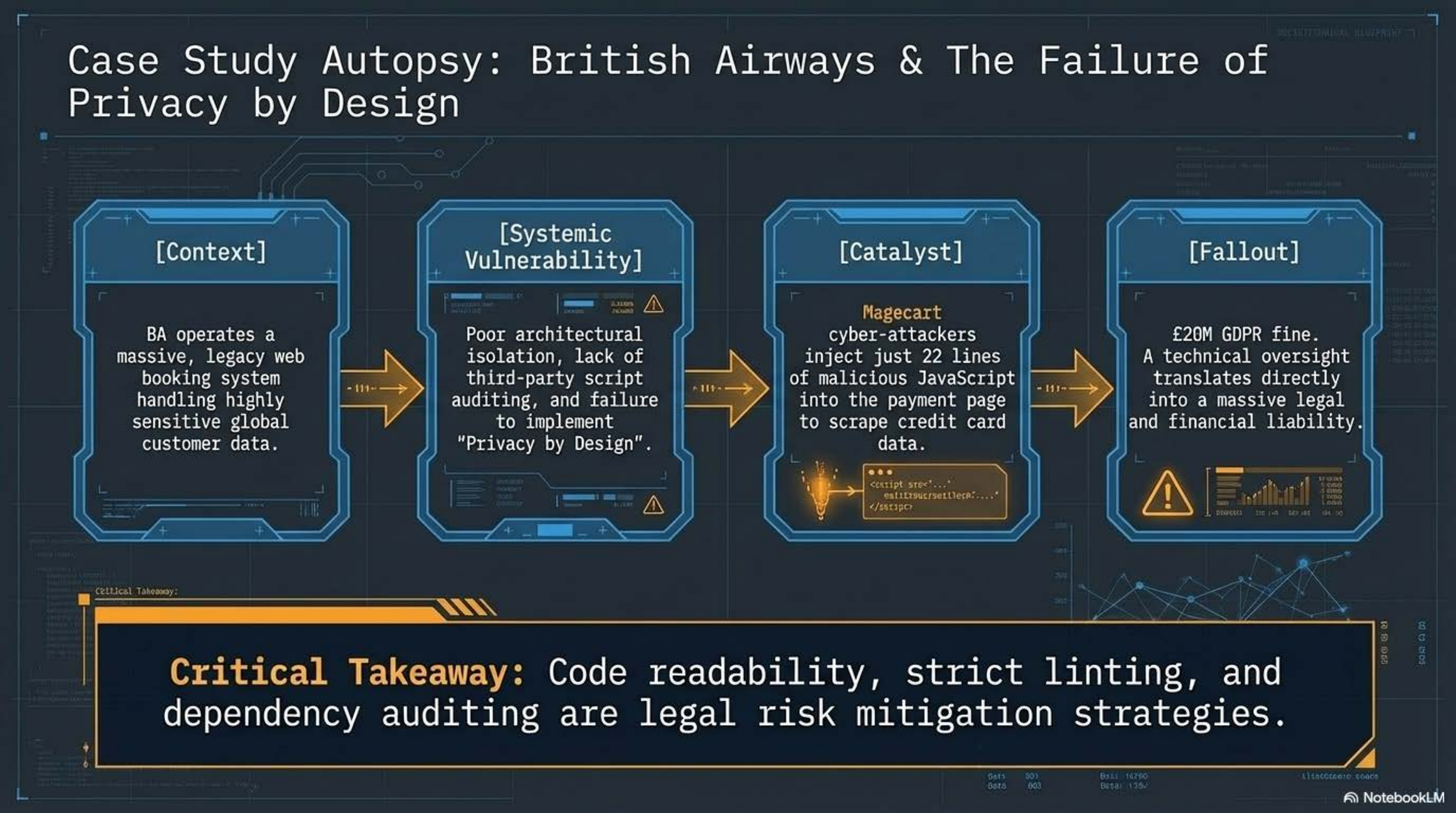
| Stage | Detail |
|---|
| Context | BA operates a massive, legacy web booking system handling highly sensitive global customer data |
| Systemic Vulnerability | Poor architectural isolation; lack of third-party script auditing; failure to implement "Privacy by Design" |
| Catalyst | Magecart cyber-attackers inject 22 lines of malicious JavaScript into the payment page to scrape credit card data |
| Fallout | £20M GDPR fine. A technical oversight translates directly into a massive legal and financial liability |
Critical Takeaway: Code readability, strict linting, and dependency auditing are legal risk mitigation strategies — not just engineering hygiene. Unaudited third-party scripts are a legal attack surface.
Privacy by Design — the architectural principle BA violated: privacy protections must be built into the system architecture from the start, not added as a post-hoc layer.
15 — SOLID Principles
"Architectural integrity requires principles that prevent technical debt from compounding."
The Five SOLID Principles
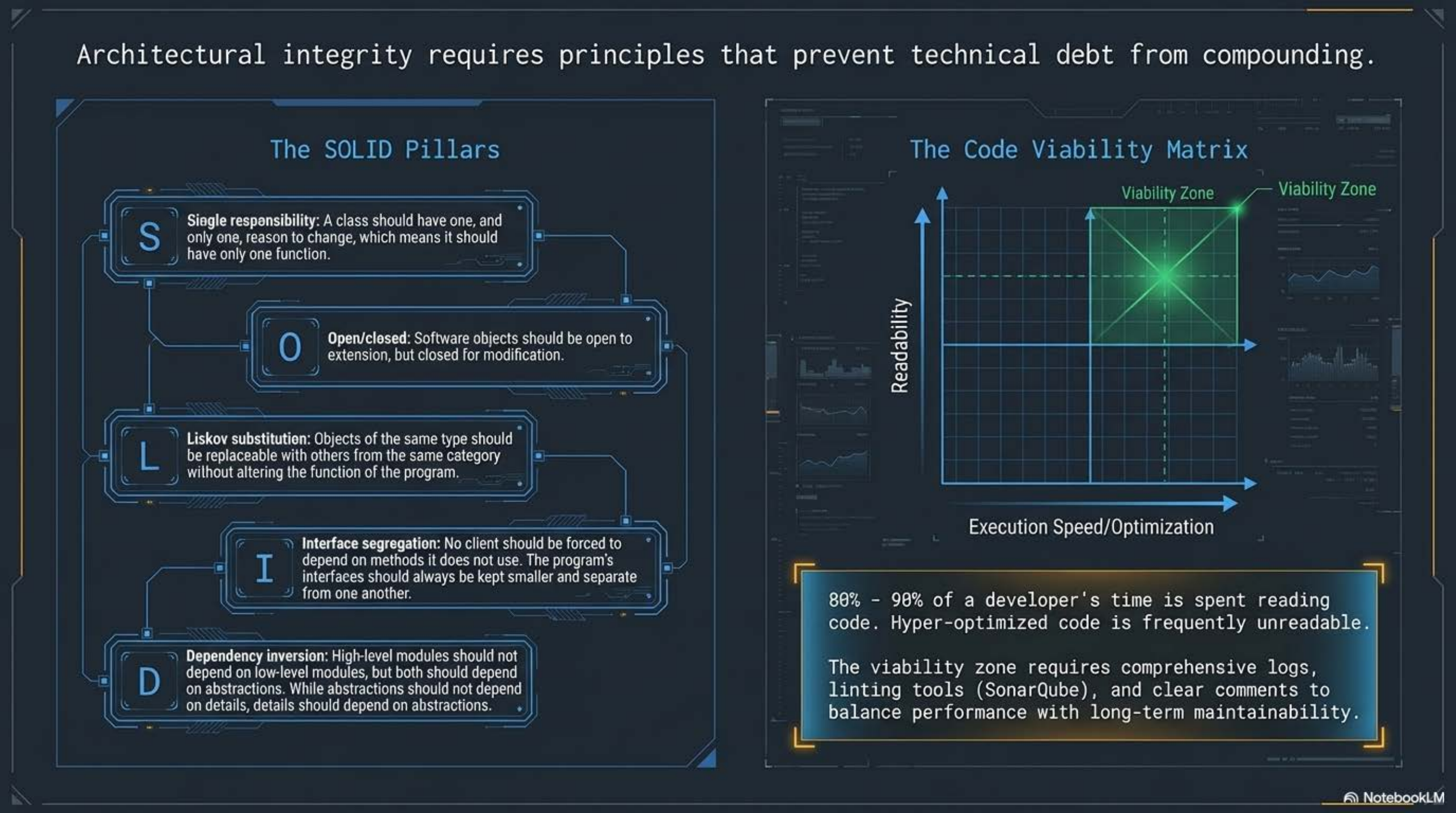
| Letter | Principle | Definition |
|---|
| S | Single Responsibility | A class should have one, and only one, reason to change. It should perform only one function. |
| O | Open/Closed | Software objects should be open for extension, but closed for modification. Add behaviour by extending, not by changing existing code. |
| L | Liskov Substitution | Objects of the same type should be replaceable with others from the same category without altering the function of the program. Subclasses must honour the contract of their parent class. |
| I | Interface Segregation | No client should be forced to depend on methods it does not use. Interfaces should be kept small and separate — many specific interfaces are better than one general-purpose interface. |
| D | Dependency Inversion | High-level modules should not depend on low-level modules — both should depend on abstractions. Abstractions should not depend on details; details should depend on abstractions. |
The Code Viability Matrix
80–90% of a developer's time is spent reading code, not writing it. Hyper-optimised code is frequently unreadable, creating a long-term maintenance liability.
| Zone | Readability | Execution Speed | Result |
|---|
| Viability Zone | High | High | Sustainable production code |
| Fast but Fragile | Low | High | Unreadable, unmaintainable — technical debt accumulates |
| Readable but Slow | High | Low | Cannot scale — performance becomes a bottleneck |
| Danger Zone | Low | Low | Both unmaintainable and slow — replace immediately |
Reaching the Viability Zone requires: Comprehensive logs · Linting tools (SonarQube) · Clear comments where intent is non-obvious · Balancing performance with long-term maintainability
The CI/CD Guardrail Funnel
Automated gate sequence — only verified, secure code reaches production:
- ES Lint / TS Lint — Syntax and style enforcement; catches errors before execution
- Static Code Analysers (SonarQube) — Code metrics: complexity, duplication, coverage, security hotspots
- Automated Unit Tests — Regression protection; every commit verified against the test suite
Case Study: Knight Capital Group — $460M Code Regression
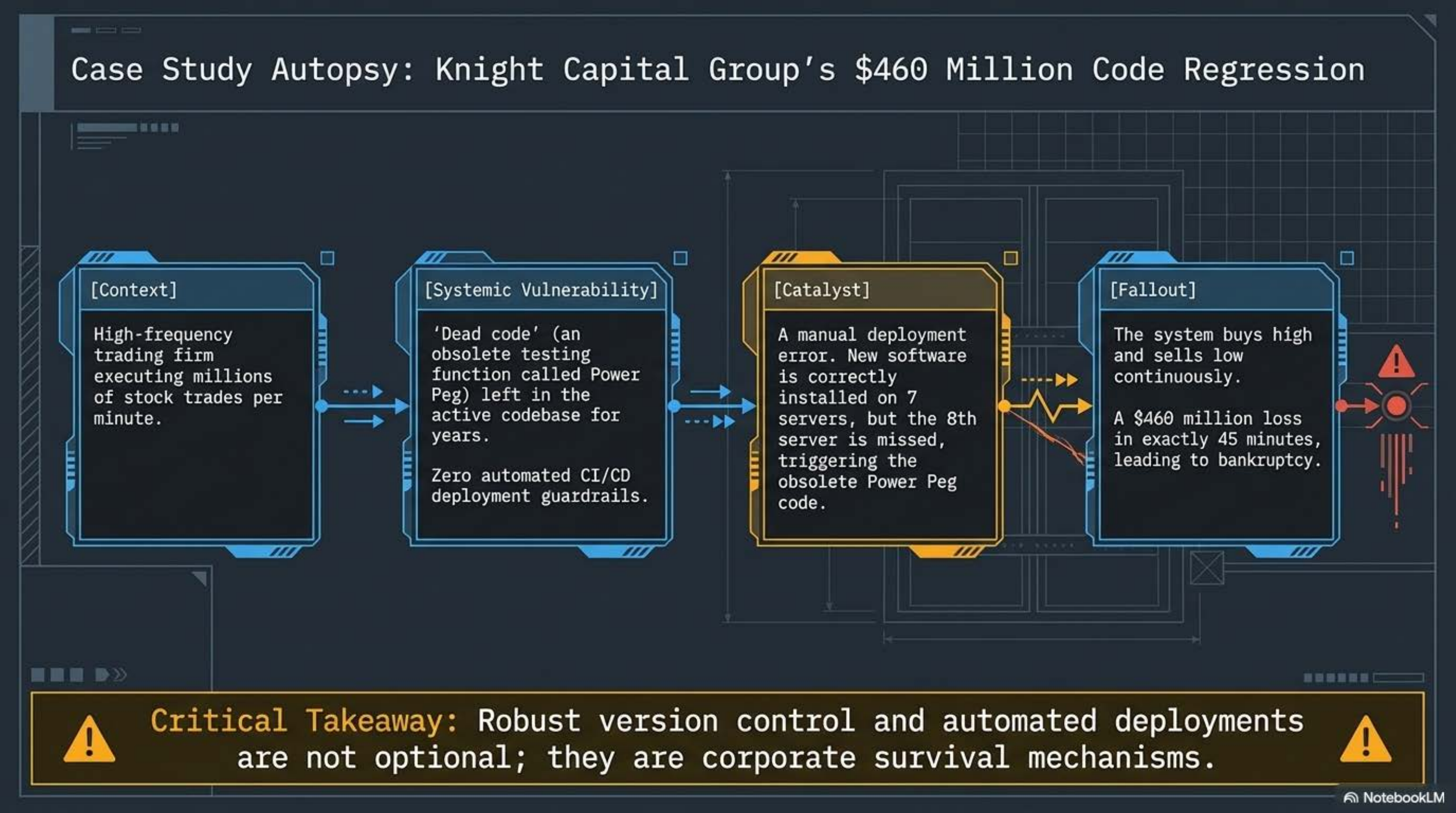
| Stage | Detail |
|---|
| Context | High-frequency trading firm executing millions of stock trades per minute |
| Systemic Vulnerability | 'Dead code' — an obsolete testing function called "Power Peg" left in the active codebase for years. Zero automated CI/CD deployment guardrails |
| Catalyst | Manual deployment error: new software correctly installed on 7 servers, but the 8th server missed — triggering the obsolete Power Peg function |
| Fallout | System buys high and sells low continuously. $460 million loss in exactly 45 minutes, leading to bankruptcy |
Critical Takeaway: Robust version control and automated deployments are not optional — they are corporate survival mechanisms. Dead code + manual deployments + zero CI/CD guardrails = existential risk.
SOLID violations present: Single Responsibility violated — Power Peg testing code lived in the production module. No automated gate to catch stale code before deployment.
16 — Professional Engineering Practices
The Dynamic Tension Web
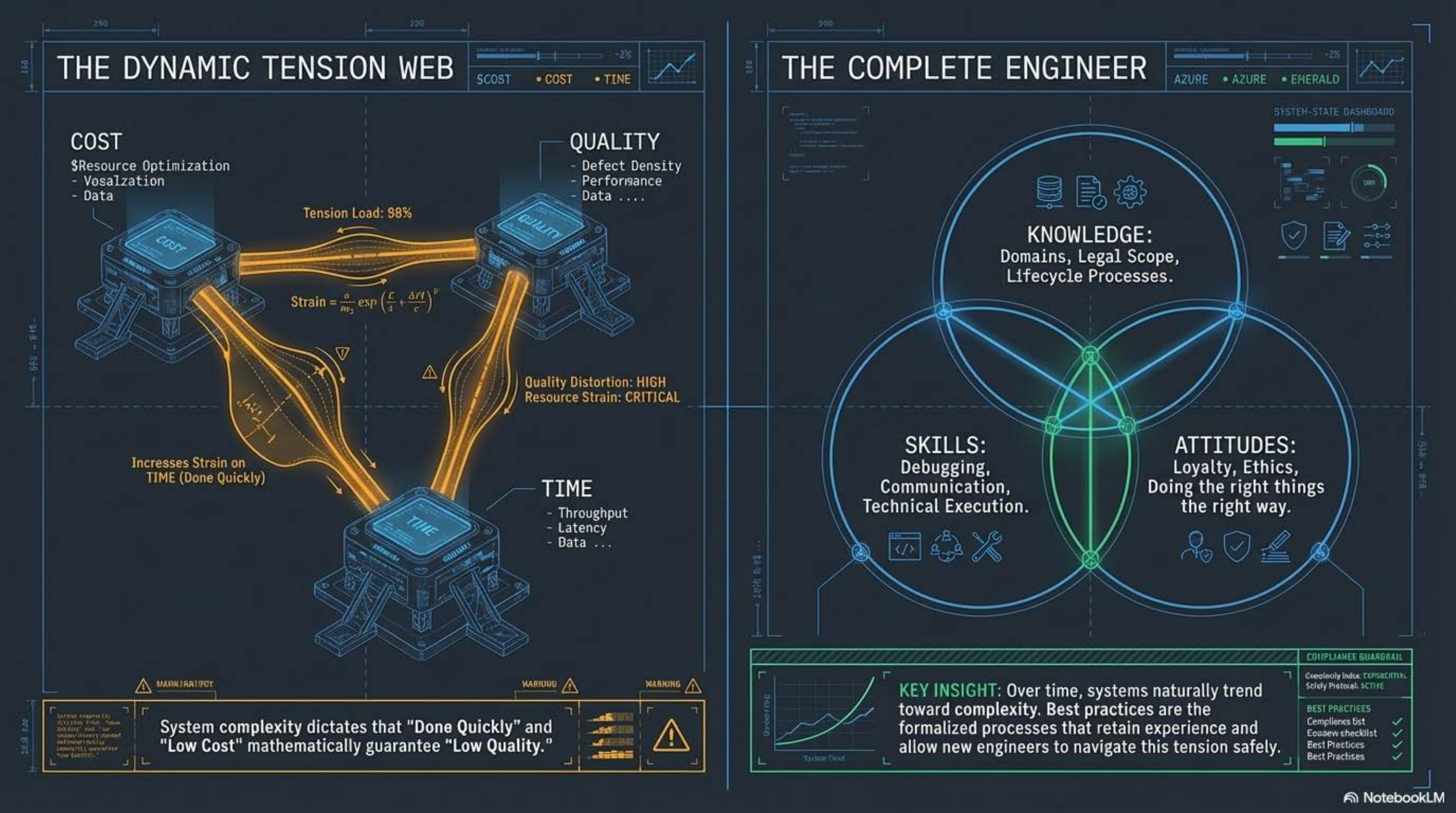
| Force | Measured by | The constraint |
|---|
| Cost | Resource optimisation, compute spend | Reducing cost increases strain on time and quality |
| Quality | Defect density, performance, reliability | High quality requires time and money |
| Time | Throughput, latency, delivery speed | Speed pressure degrades quality and raises cost |
Important: "System complexity dictates that 'Done Quickly' and 'Low Cost' mathematically guarantee 'Low Quality.'" — The triangle cannot be optimised in all three corners simultaneously.
The Complete Engineer
| Domain | Components |
|---|
| Knowledge | Domains, legal scope, lifecycle processes — knowing what applies where |
| Skills | Debugging, communication, technical execution — being able to apply that knowledge |
| Attitudes | Loyalty, ethics, doing the right things the right way — choosing to apply it correctly |
Site Reliability Engineering (SRE)
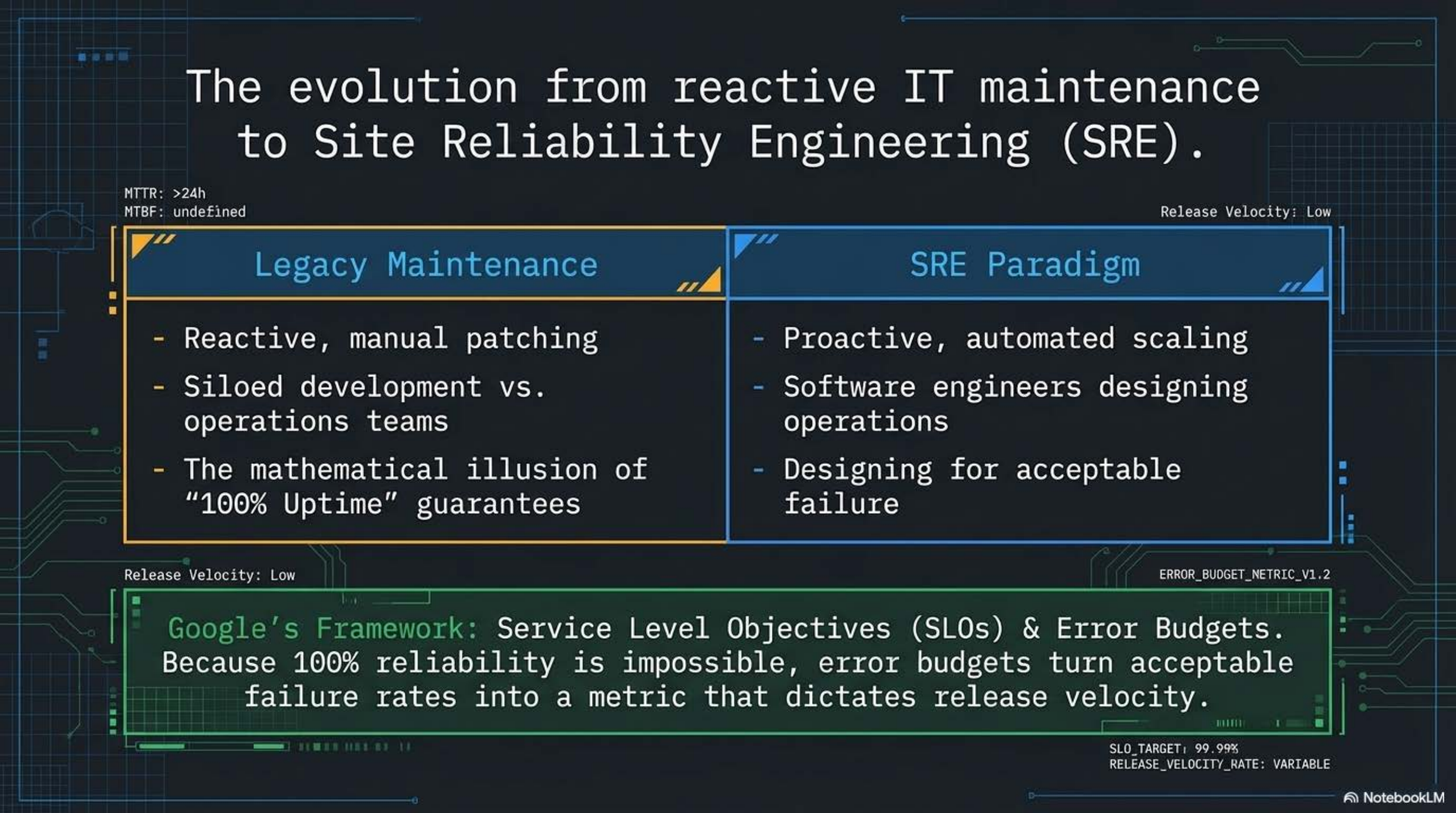
| Dimension | Legacy Maintenance | SRE Paradigm |
|---|
| Approach | Reactive, manual patching | Proactive, automated scaling |
| Team structure | Siloed development vs. operations | Software engineers designing operations |
| Reliability target | Mathematical illusion of "100% uptime" | Designing for acceptable failure |
| MTTR | >24 hours | Target: <30 minutes |
SLOs and Error Budgets
- Service Level Objectives (SLOs): The agreed reliability target (e.g., 99.99% uptime). SLOs define acceptable reliability rather than pretending failure can be eliminated.
- Error Budget: The allowed failure margin (100% minus the SLO). If SLO = 99.99%, error budget = 0.01% downtime per period.
- When the budget is full: deploy freely. When the budget is exhausted: freeze deployments and focus on stability.
Important: SLOs + Error Budgets resolve the fundamental ops tension: engineering teams want to ship fast; ops teams want stability. The error budget gives both teams a shared objective metric to negotiate against.
Green Software Engineering
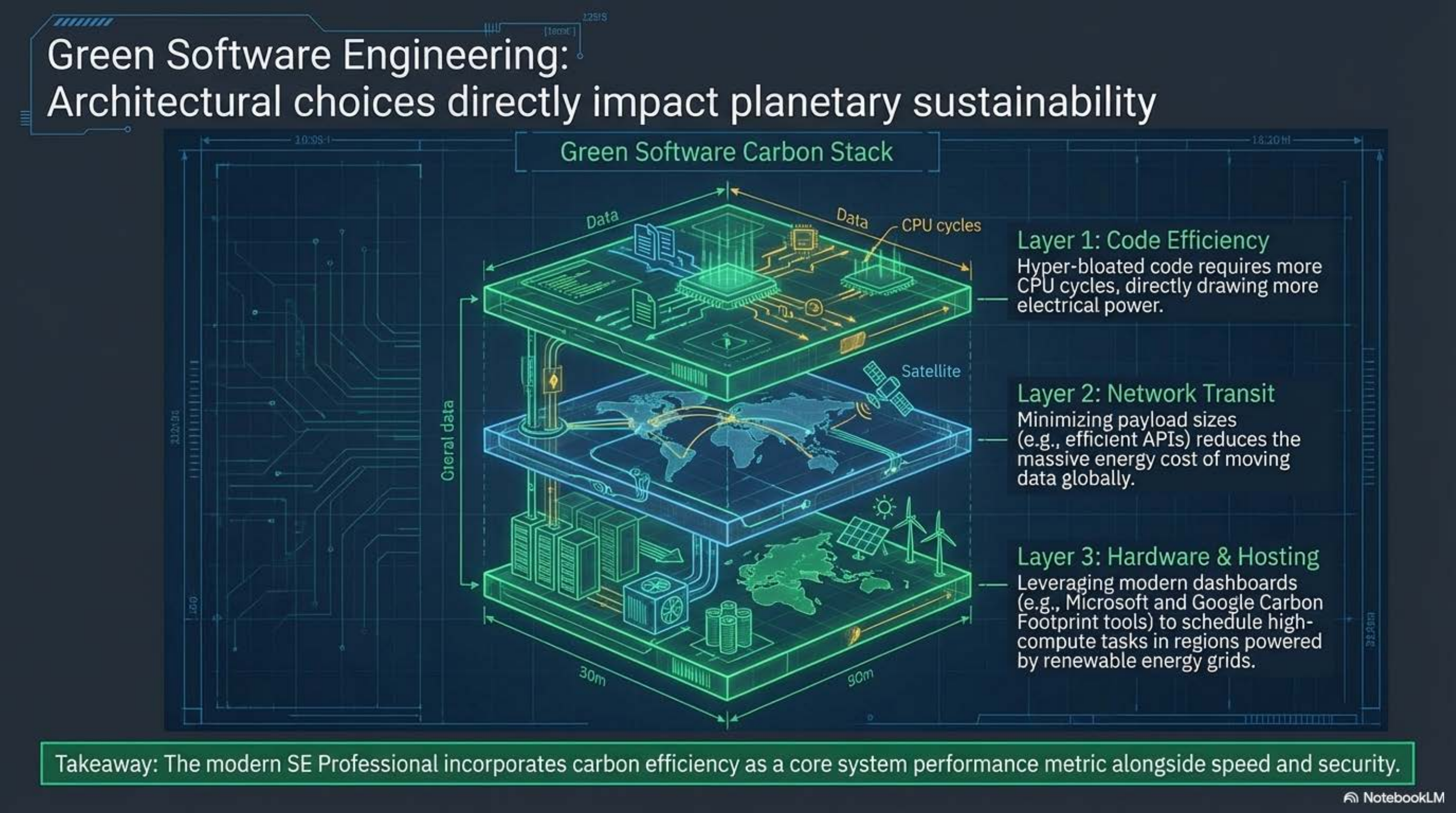
The Green Software Carbon Stack has three layers:
| Layer | Focus | How to reduce carbon impact |
|---|
| Layer 1: Code Efficiency | CPU cycles | Hyper-bloated code draws more electrical power. Efficient algorithms and clean code directly reduce energy consumption |
| Layer 2: Network Transit | Data movement | Minimising payload sizes (efficient APIs, compression, caching) reduces the massive energy cost of moving data globally |
| Layer 3: Hardware & Hosting | Infrastructure | Use carbon footprint tools to schedule high-compute tasks in regions powered by renewable energy grids |
Groupthink and Intellectual Honesty
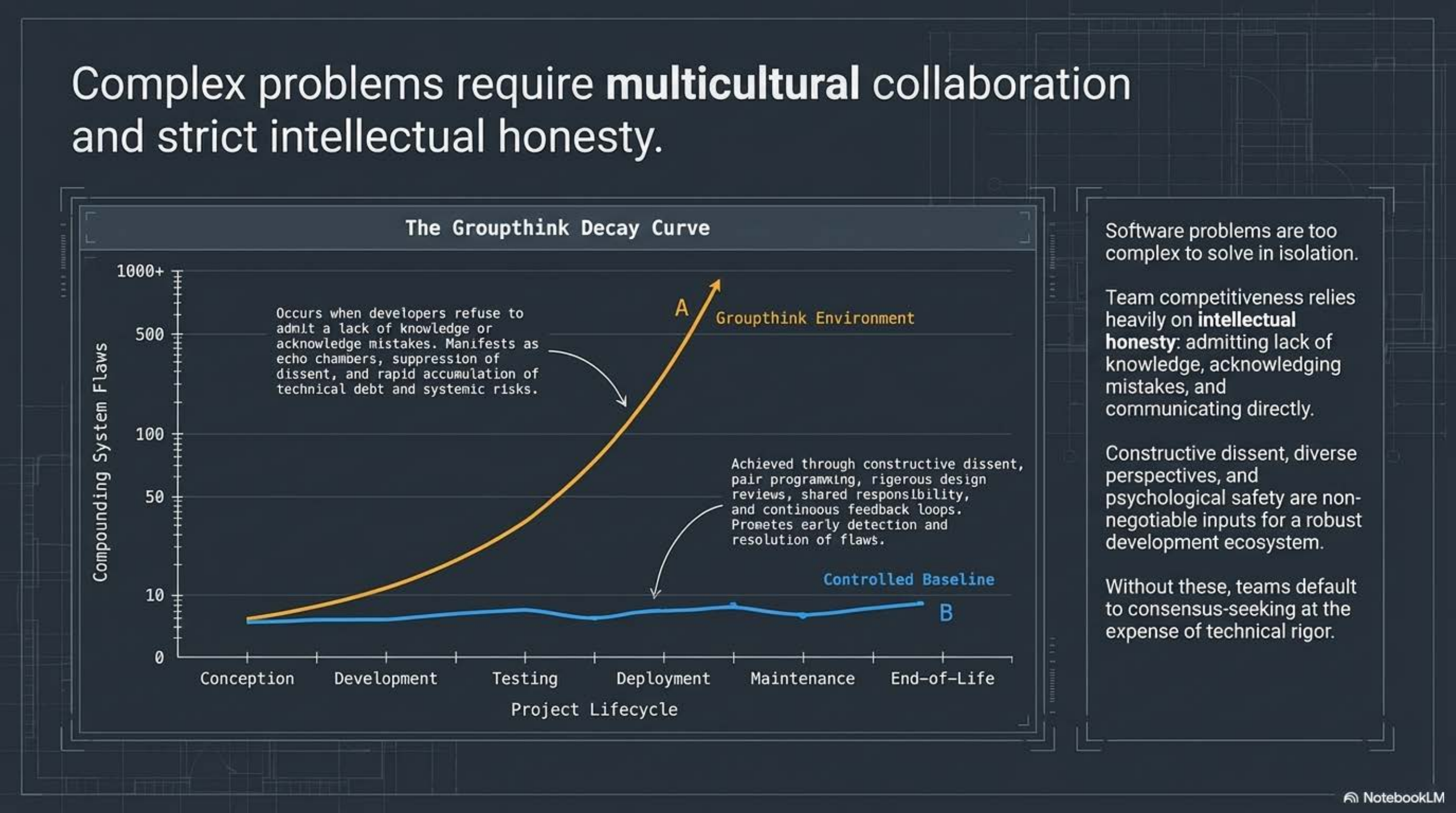
The Groupthink Decay Curve — Compounding System Flaws over the Project Lifecycle:
- Curve A (Groupthink Environment): Developers refuse to admit mistakes. Echo chambers suppress dissent. Flaws compound from ~5 → 1000+ by End-of-Life.
- Curve B (Controlled Baseline): Achieved through constructive dissent, pair programming, rigorous reviews, shared responsibility, and continuous feedback. Flaws stay flat at ~5–10.
| Required input | Why |
|---|
| Intellectual honesty | Admitting lack of knowledge and acknowledging mistakes prevents small issues from compounding |
| Constructive dissent | Diverse perspectives catch what consensus misses |
| Psychological safety | Without it, teams default to consensus-seeking at the expense of technical rigour |
| Direct communication | Indirection (passing info through layers) introduces delay and distortion |
Stakeholder Management
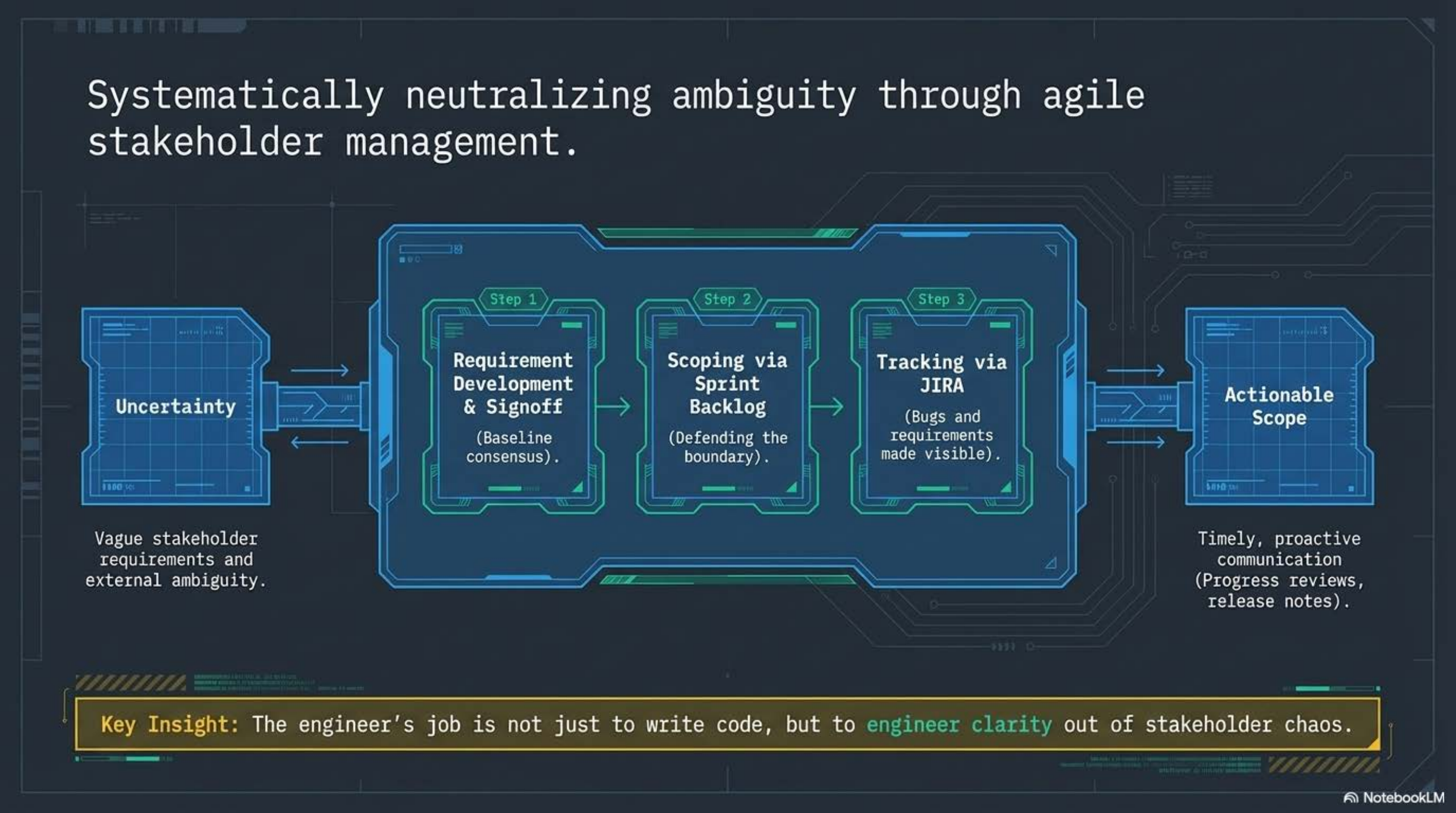
| Step | Action | Output |
|---|
| 1. Requirement Development & Signoff | Establish baseline consensus with stakeholders — document what is agreed and get formal sign-off | Baseline requirements document |
| 2. Scoping via Sprint Backlog | Translate requirements into the sprint backlog — defend the boundary against scope creep | Bounded sprint scope |
| 3. Tracking via JIRA | Make bugs and requirements visible — track progress transparently | Actionable, visible progress |
The Modern Sociotechnical Ecosystem
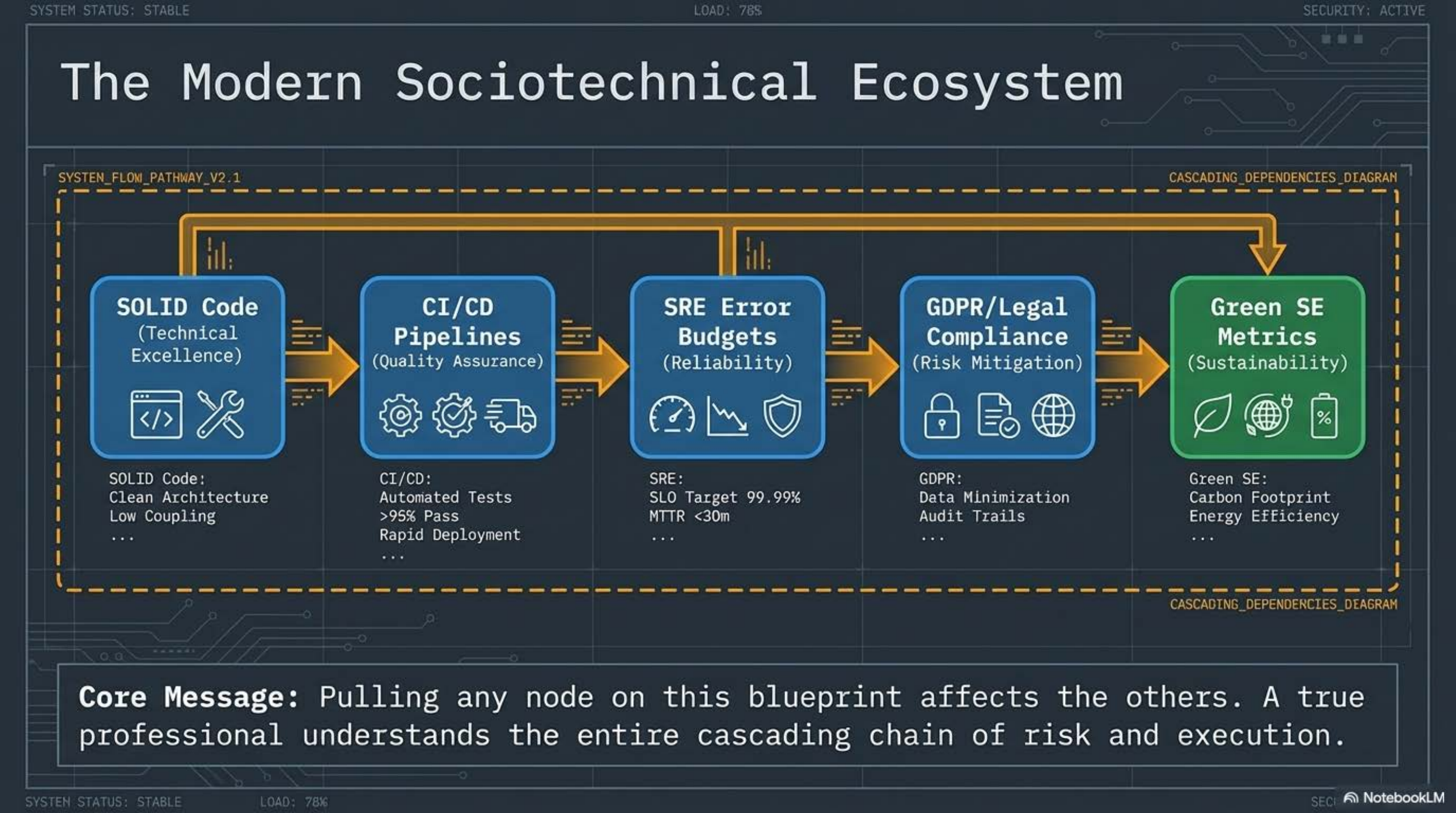
A complete professional practice chains five nodes — each one enabling the next:
| Node | Domain | Key Metrics |
|---|
| SOLID Code | Technical Excellence | Clean architecture, low coupling |
| CI/CD Pipelines | Quality Assurance | Automated tests >95% pass, rapid deployment |
| SRE Error Budgets | Reliability | SLO target 99.99%, MTTR <30 minutes |
| GDPR / Legal Compliance | Risk Mitigation | Data minimisation, audit trails |
| Green SE Metrics | Sustainability | Carbon footprint, energy efficiency |
Important: "Pulling any node on this blueprint affects the others. A true professional understands the entire cascading chain of risk and execution."
17 — Lean Software Development
Origins
| Milestone | Detail |
|---|
| 1950s — TPS | Post-war Japan: Toyota couldn't afford excess inventory, defective parts, or idle workers. Necessity created the Toyota Production System (TPS). Quote: "Build only what is needed, when it is needed, in the amount needed." |
| 1988 — 'Lean' Named | MIT researchers coined "Lean" studying global car manufacturing. Toyota produced cars with half the defects and half the space of Western factories |
| 2003 — Software Adaptation | Mary & Tom Poppendieck published Lean Software Development: An Agile Toolkit — inventory = partially done work, defects = bugs, motion = handoffs |
The 7 Lean Principles
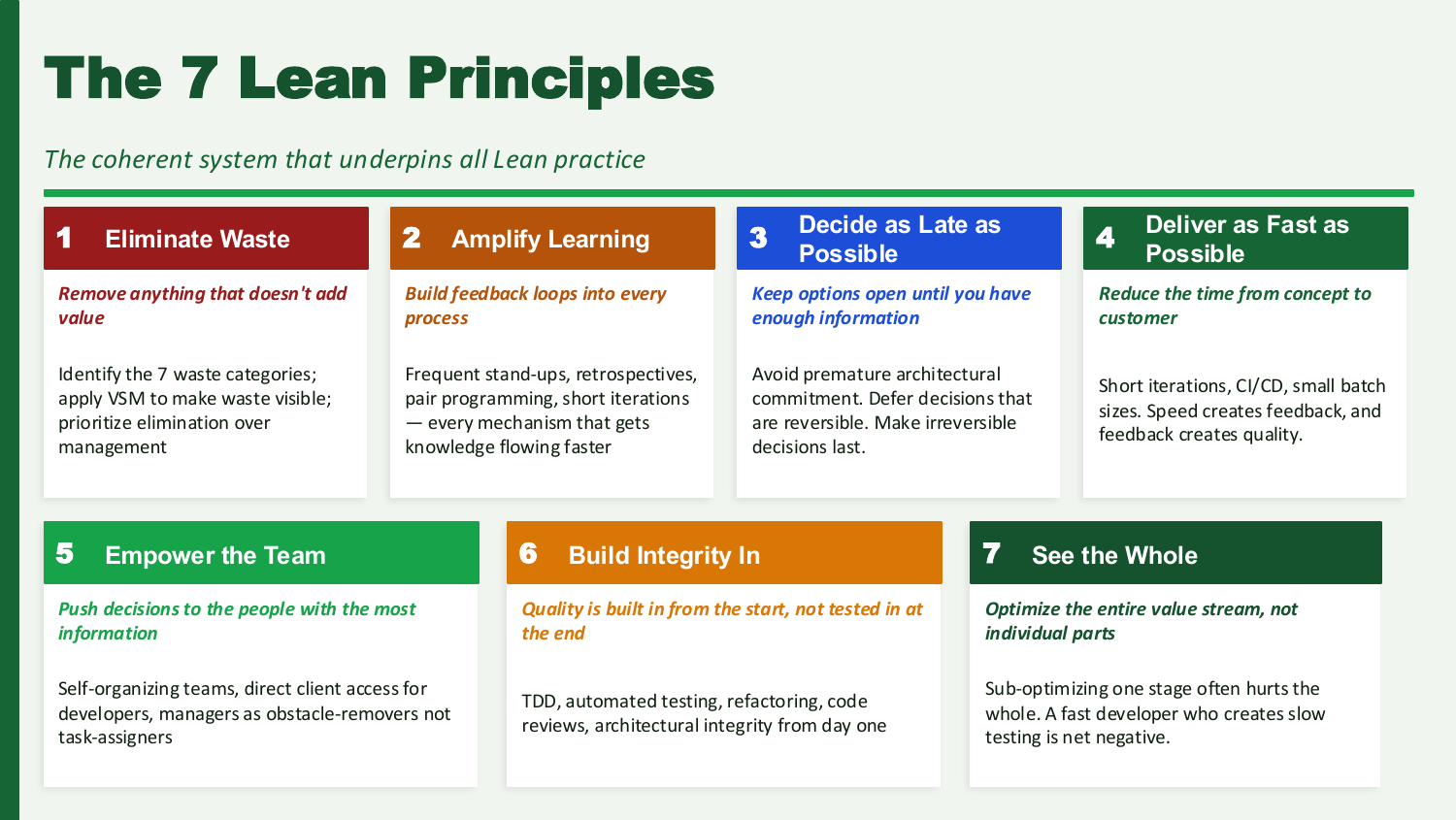
| # | Principle | Core Idea | In Practice |
|---|
| 1 | Eliminate Waste | Remove anything that doesn't add value | Identify the 7 waste categories; apply VSM to make waste visible |
| 2 | Amplify Learning | Build feedback loops into every process | Frequent stand-ups, retrospectives, pair programming, short iterations |
| 3 | Decide as Late as Possible | Keep options open until you have enough information | Avoid premature architectural commitment; defer reversible decisions |
| 4 | Deliver as Fast as Possible | Reduce time from concept to customer | Short iterations, CI/CD, small batch sizes |
| 5 | Empower the Team | Push decisions to the people with the most information | Self-organising teams; managers as obstacle-removers, not task-assigners |
| 6 | Build Integrity In | Quality is built in from the start, not tested at the end | TDD, automated testing, refactoring, code reviews |
| 7 | See the Whole | Optimise the entire value stream, not individual parts | Sub-optimising one stage often hurts the whole — a fast developer who creates slow testing is net negative |
Important: Principle 7 (See the Whole) is the most commonly violated in practice — and the root cause of the "Local Optimization" anti-pattern. Improvements only count when they reduce end-to-end lead time.
The 7 Wastes in Software
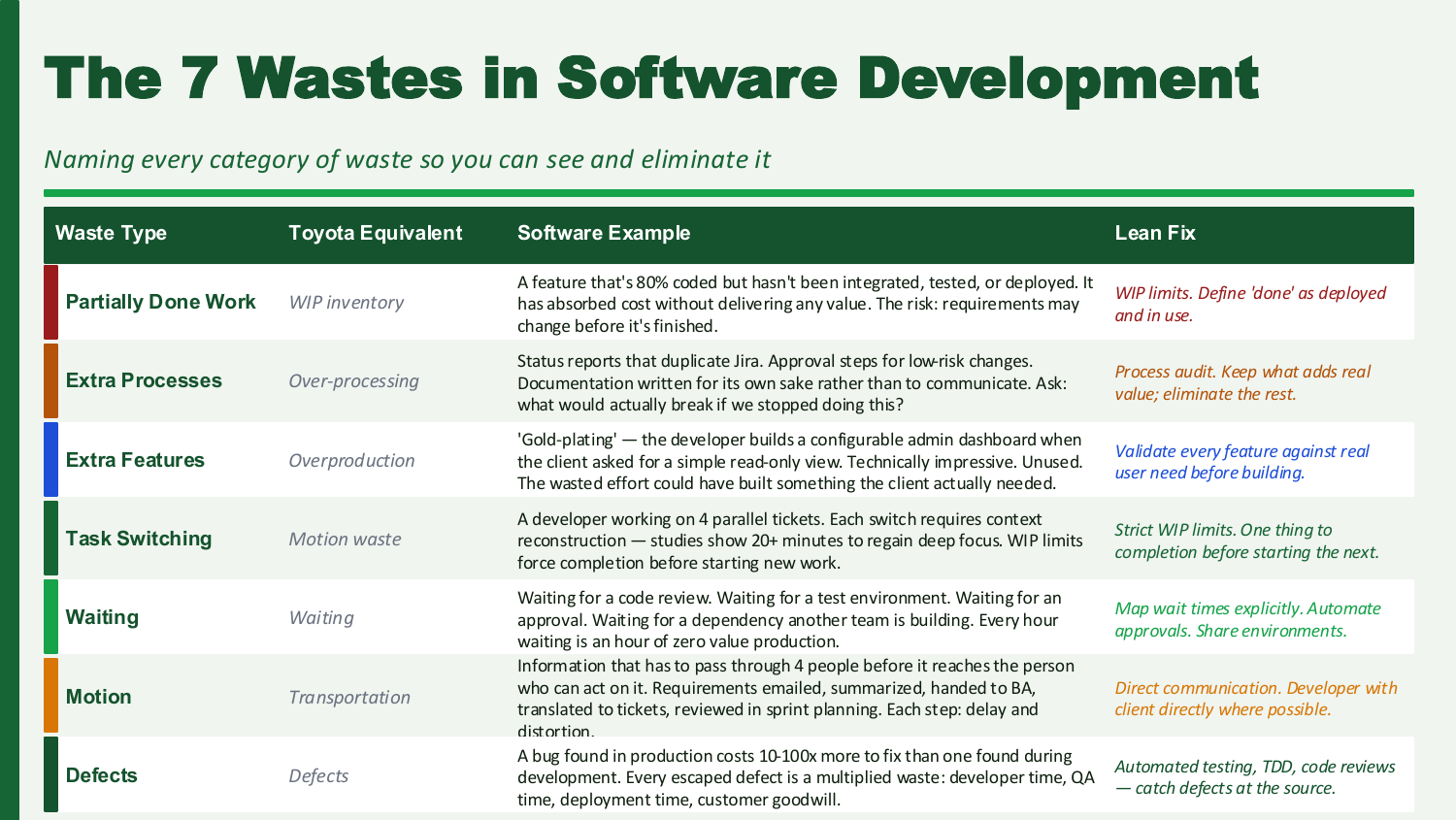
| Waste | Toyota Equivalent | Software Example | Lean Fix |
|---|
| Partially Done Work | WIP inventory | Feature 80% coded but not integrated, tested, or deployed — absorbs cost, delivers nothing | WIP limits. Define 'done' as deployed and in use |
| Extra Processes | Over-processing | Status reports duplicating Jira. Approval steps for low-risk changes | Process audit — keep what adds real value; eliminate the rest |
| Extra Features | Overproduction | 'Gold-plating' — configurable admin dashboard when client asked for a simple read-only view | Validate every feature against real user need before building |
| Task Switching | Motion waste | Developer on 4 parallel tickets. Each switch requires 20+ minutes to regain deep focus | Strict WIP limits. One thing to completion before starting the next |
| Waiting | Waiting | Waiting for code review, test environment, approval, a dependency another team is building | Map wait times explicitly. Automate approvals. Share environments |
| Motion | Transportation | Information through 4 people before reaching who can act — each step = delay and distortion | Direct communication. Developer with client directly where possible |
| Defects | Defects | A bug found in production costs 10–100× more to fix than during development | Automated testing, TDD, code reviews — catch defects at the source |
Important: Defect escape rate target: <5% of defects should reach production. Rising escape rate = quality gates weakening.
Kaizen: Continuous Improvement (PDCA Cycle)
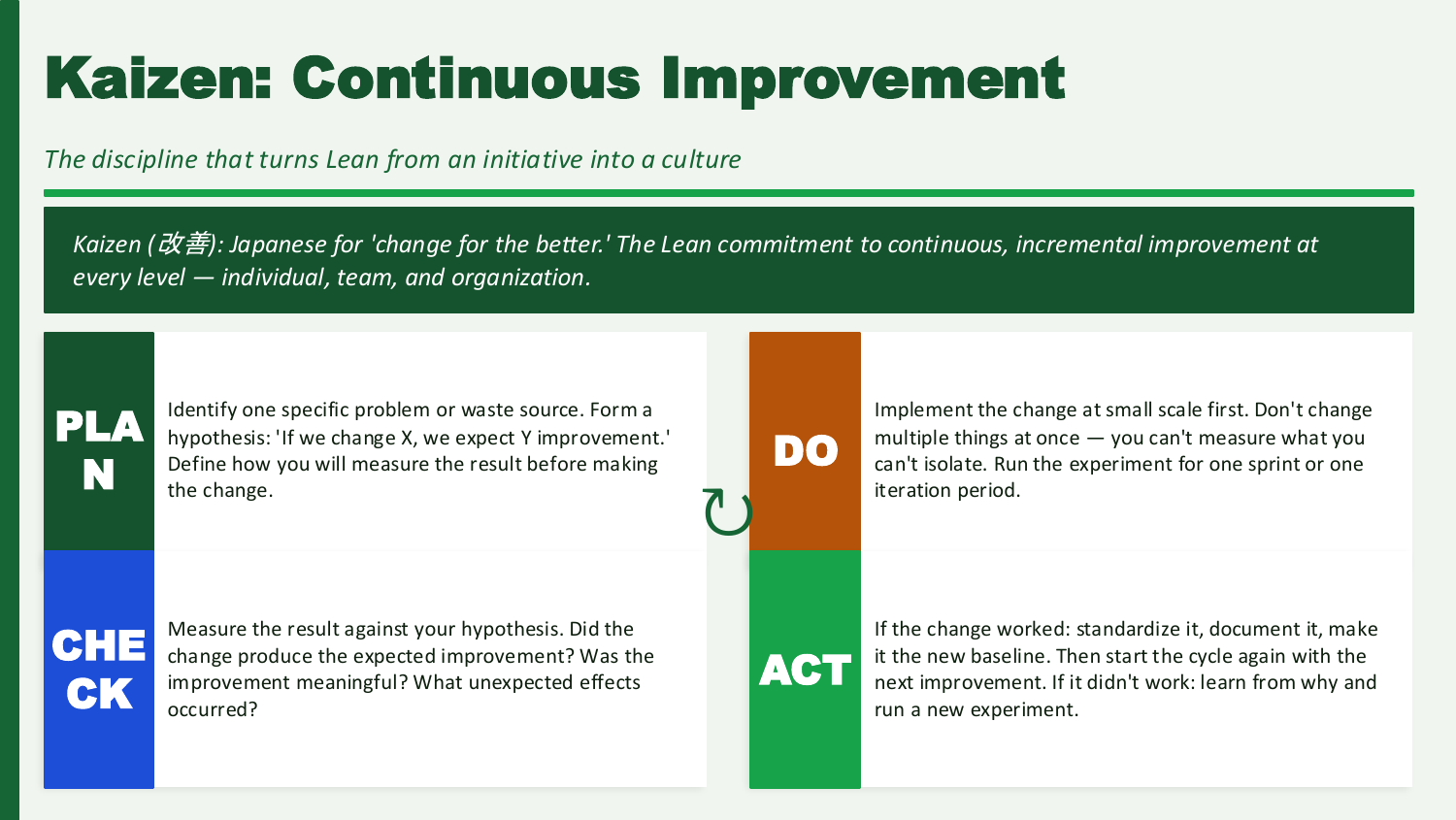
| Step | Action | Key Rule |
|---|
| PLAN | Identify one specific problem. Form a measurable hypothesis: "If we change X, we expect Y improvement." Define measurement method before making the change | One problem at a time. Hypothesis must be measurable |
| DO | Implement the change at small scale first — one sprint or one iteration period | Don't change multiple things at once — you can't measure what you can't isolate |
| CHECK | Measure the result against your hypothesis. Did the change produce the expected improvement? | Compare against the hypothesis, not against feelings |
| ACT | If it worked: standardise, document, make it the new baseline, then start again. If not: learn and run a new experiment | Kaizen never stops — the next improvement always exists |
Lean Anti-Patterns
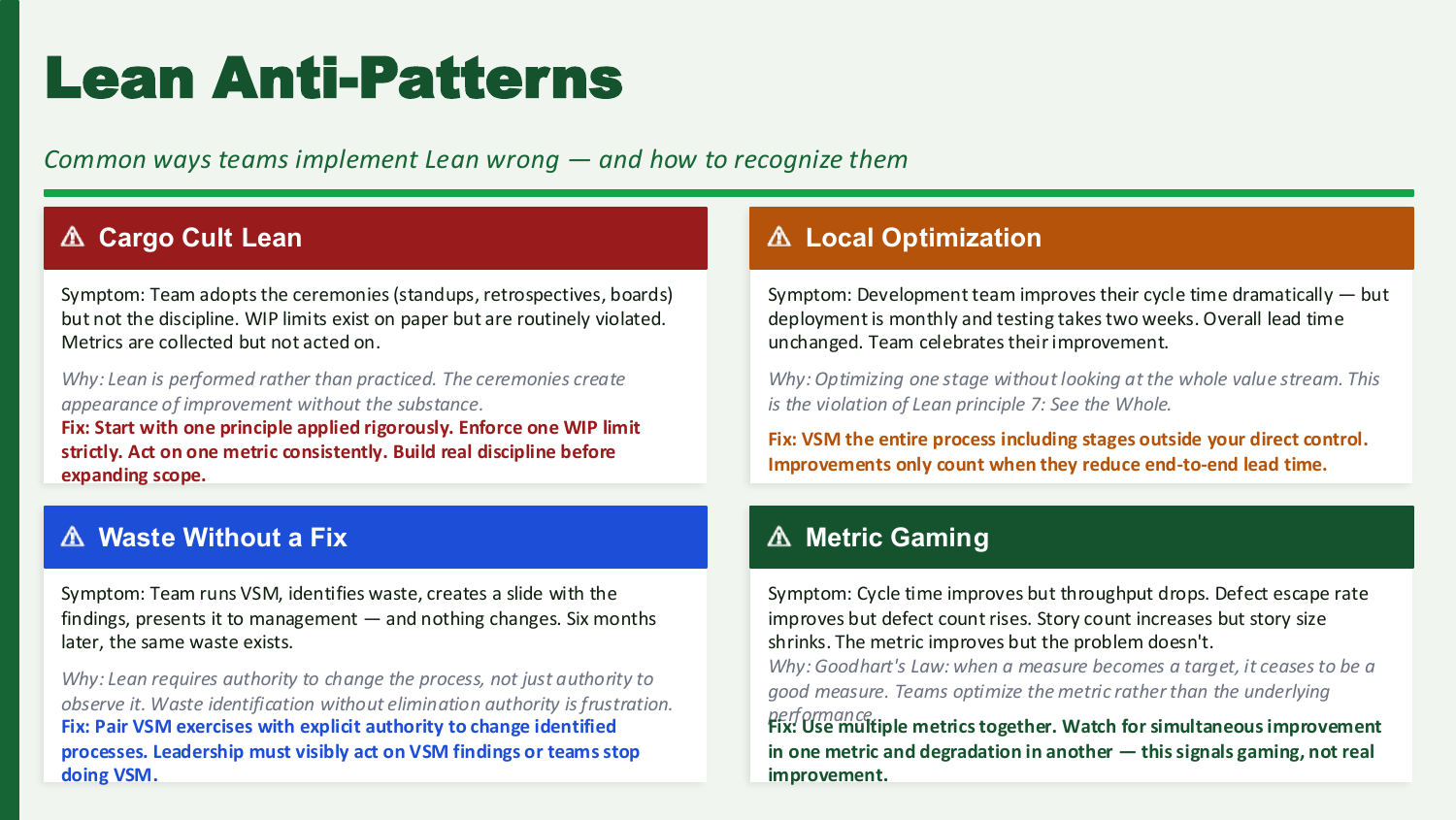
| Anti-Pattern | Symptom | Fix |
|---|
| Cargo Cult Lean | Team adopts ceremonies (standups, boards) but not discipline. WIP limits on paper, routinely violated. Metrics collected, not acted on | Start with one principle applied rigorously. Enforce one WIP limit strictly. Act on one metric consistently |
| Local Optimization | Dev team improves cycle time, but deployment is monthly and testing takes two weeks. Overall lead time unchanged | VSM the entire process including stages outside your direct control. Improvements only count when they reduce end-to-end lead time |
| Waste Without a Fix | Team runs VSM, identifies waste, presents to management — nothing changes. Six months later, same waste exists | Pair VSM exercises with explicit authority to change identified processes. Leadership must visibly act on findings |
| Metric Gaming (Goodhart's Law) | Cycle time improves but throughput drops. Defect escape rate improves but defect count rises | Use multiple metrics together. Simultaneous improvement in one metric and degradation in another = gaming, not real improvement |
Lean in Practice — Worked Example (54% Lead Time Reduction)
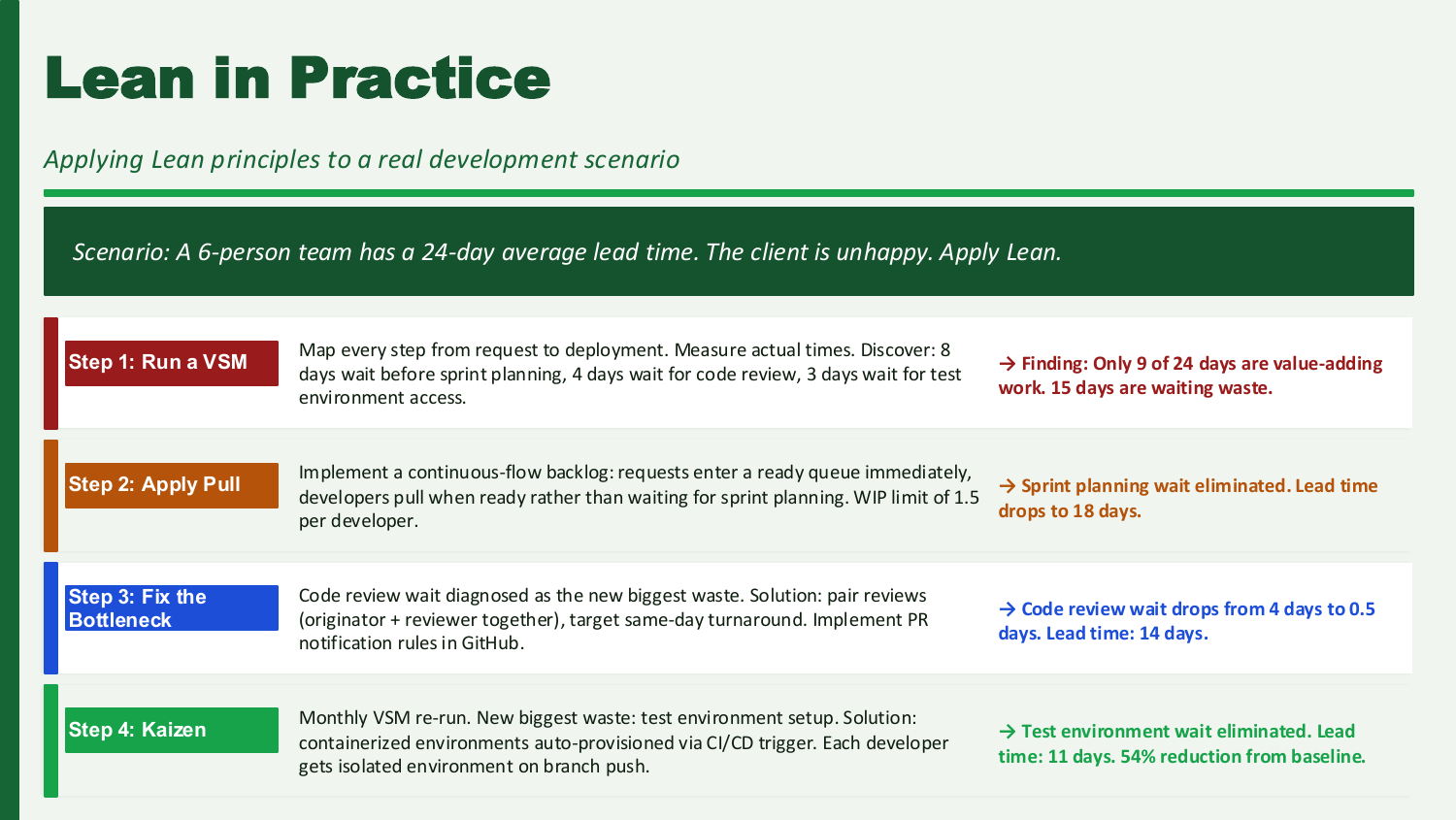
| Step | Action | Result |
|---|
| 1. Run a VSM | Map every step request→deployment. Discover: 8 days wait before sprint planning, 4 days code review wait, 3 days test environment wait. Only 9 of 24 days are value-adding (38%) | Baseline: 24 days |
| 2. Apply Pull | Implement continuous-flow backlog; requests enter ready queue immediately; developers pull when ready. WIP limit of 1.5 per developer | 18 days |
| 3. Fix the Bottleneck | Code review wait is new biggest waste. Solution: pair reviews (originator + reviewer together), same-day turnaround target, PR notification rules | 14 days |
| 4. Kaizen | Monthly VSM re-run. Biggest waste: test environment setup. Solution: containerised environments auto-provisioned via CI/CD trigger | 11 days (54% reduction) |
18 — Value Stream Mapping (VSM)
A Value Stream Map (VSM) traces every step from customer request to working software — measuring time spent in value-adding work versus time spent waiting. It makes invisible waste visible so you can eliminate it.
"69% of development time is typically non-value-adding. VSM is the diagnostic tool that forces honest measurement of where time actually goes."
The VSM Pipeline — Typical Example
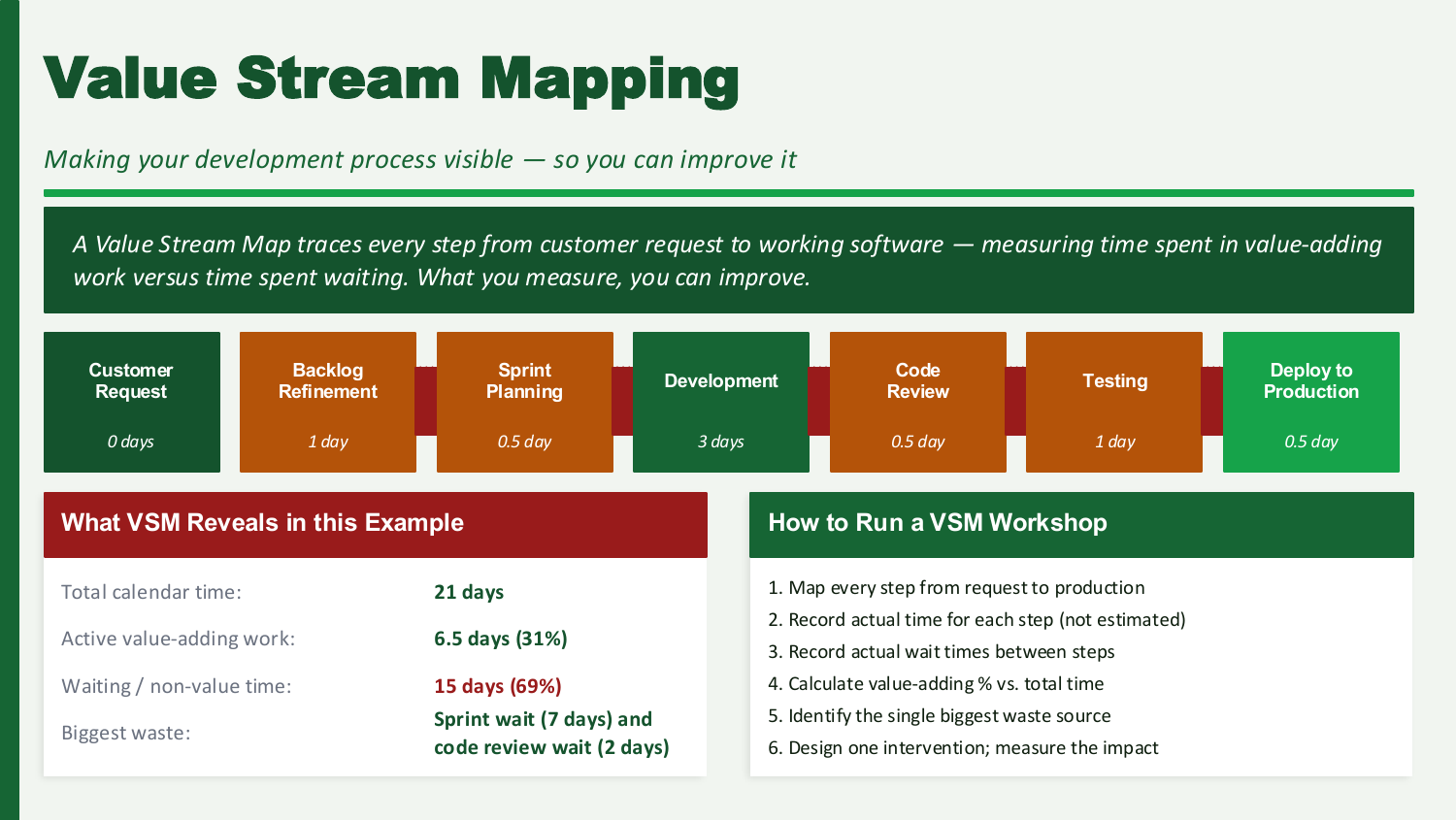
| Step | Active Time |
|---|
| Backlog Refinement | 1 day |
| Sprint Planning | 0.5 day |
| Development | 3 days |
| Code Review | 0.5 day |
| Testing | 1 day |
| Deploy to Production | 0.5 day |
| Metric | Value |
|---|
| Total calendar time | 21 days |
| Active value-adding work | 6.5 days (31%) |
| Waiting / non-value time | 15 days (69%) |
| Biggest waste | Sprint wait (7 days) + code review wait (2 days) |
Important: The gap between total calendar time and active work time is your waste target. In this example, 69% of time is pure queue. Fix the queue, not the code.
How to Run a VSM Workshop (6 Steps)
- Map every step from customer request to production deployment
- Record actual time for each step — not estimated, not planned; actual measured time
- Record actual wait times between each step (queue time before each stage)
- Calculate value-adding % vs. total time — this is your efficiency ratio
- Identify the single biggest waste source — the one queue or delay that dominates
- Design one intervention; measure the impact — one change at a time so you can attribute the result
The 6 Lean Metrics
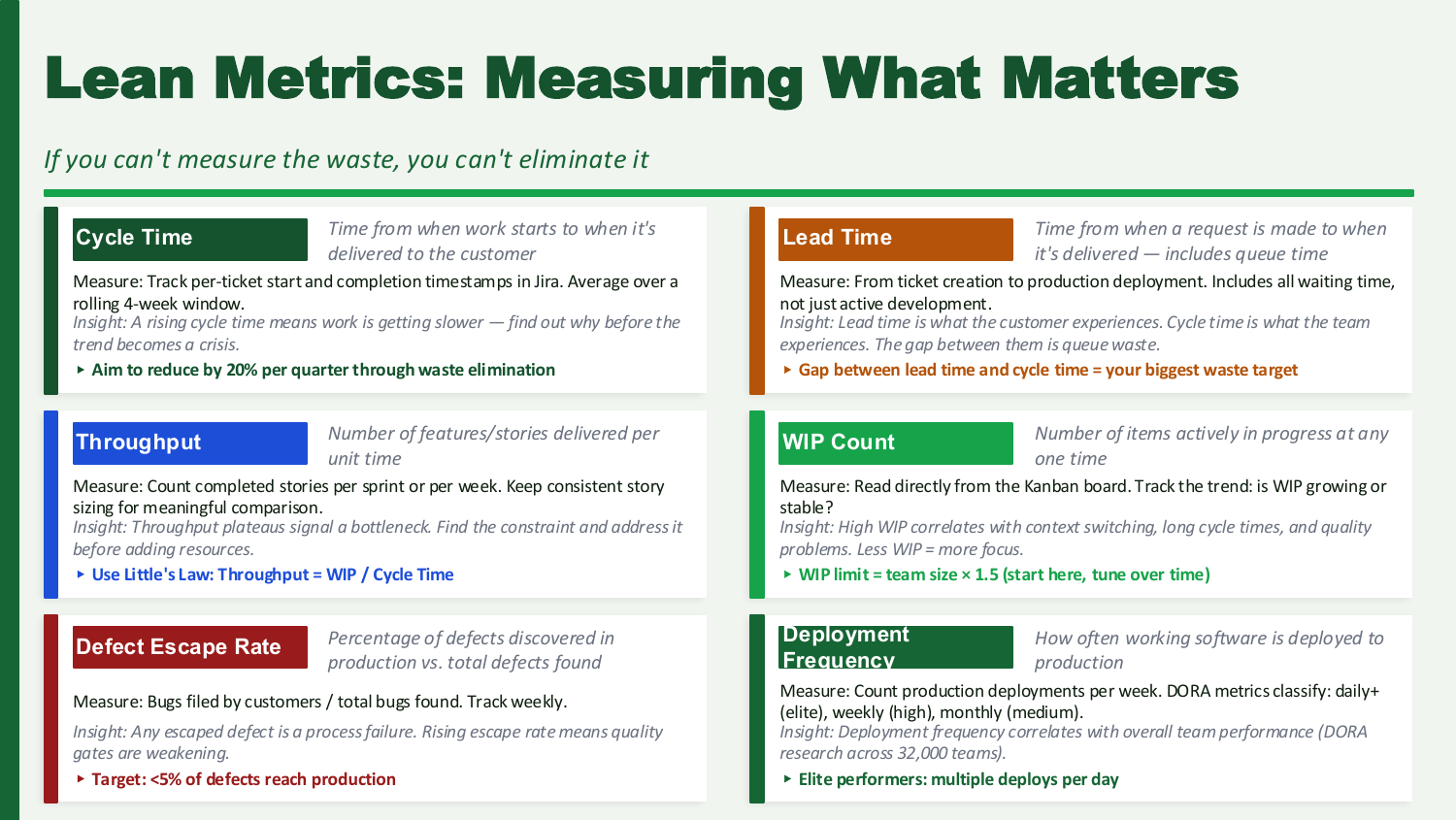
| Metric | Definition | Key Insight / Formula |
|---|
| Cycle Time | Time from when work starts to when it's delivered | A rising cycle time means work is getting slower. Aim to reduce 20% per quarter |
| Lead Time | Time from when a request is made to when it's delivered — includes queue time | Lead time = what the customer experiences. Gap between Lead Time and Cycle Time = your biggest waste target |
| Throughput | Number of features/stories delivered per unit time | Throughput plateaus signal a bottleneck. Little's Law: Throughput = WIP ÷ Cycle Time |
| WIP Count | Number of items actively in progress at any one time | High WIP correlates with context switching and long cycle times. Starting WIP limit = team size × 1.5 |
| Defect Escape Rate | Percentage of defects discovered in production vs. total defects found | Any escaped defect is a process failure. Target: <5% of defects reach production |
| Deployment Frequency | How often working software is deployed to production | DORA classification: daily+ = Elite, weekly = High, monthly = Medium. Elite performers: multiple deploys per day |
Important: Use metrics as a system, not in isolation. Goodhart's Law: when a measure becomes a target, it ceases to be a good measure. Simultaneous improvement in one metric and degradation in another = gaming.
19 — GenAI in RAD
"Speed is no longer the constraint — judgment is." — GenAI has removed the speed barrier. What matters now is knowing when to use these tools, how to review their output critically, and when to slow down and think.
What GenAI Changes
| GenAI Capability | Impact on RAD |
|---|
| Natural language → working code | Specification and initial implementation collapse into one step |
| AI-assisted across the entire SDLC | Every phase — design, code, test, review, document — has AI acceleration |
| Prototyping in hours, not days | The RAD 60–90 day cycle compresses further; inner iterations shrink to hours |
The GenAI Development Loop (6 Stages)
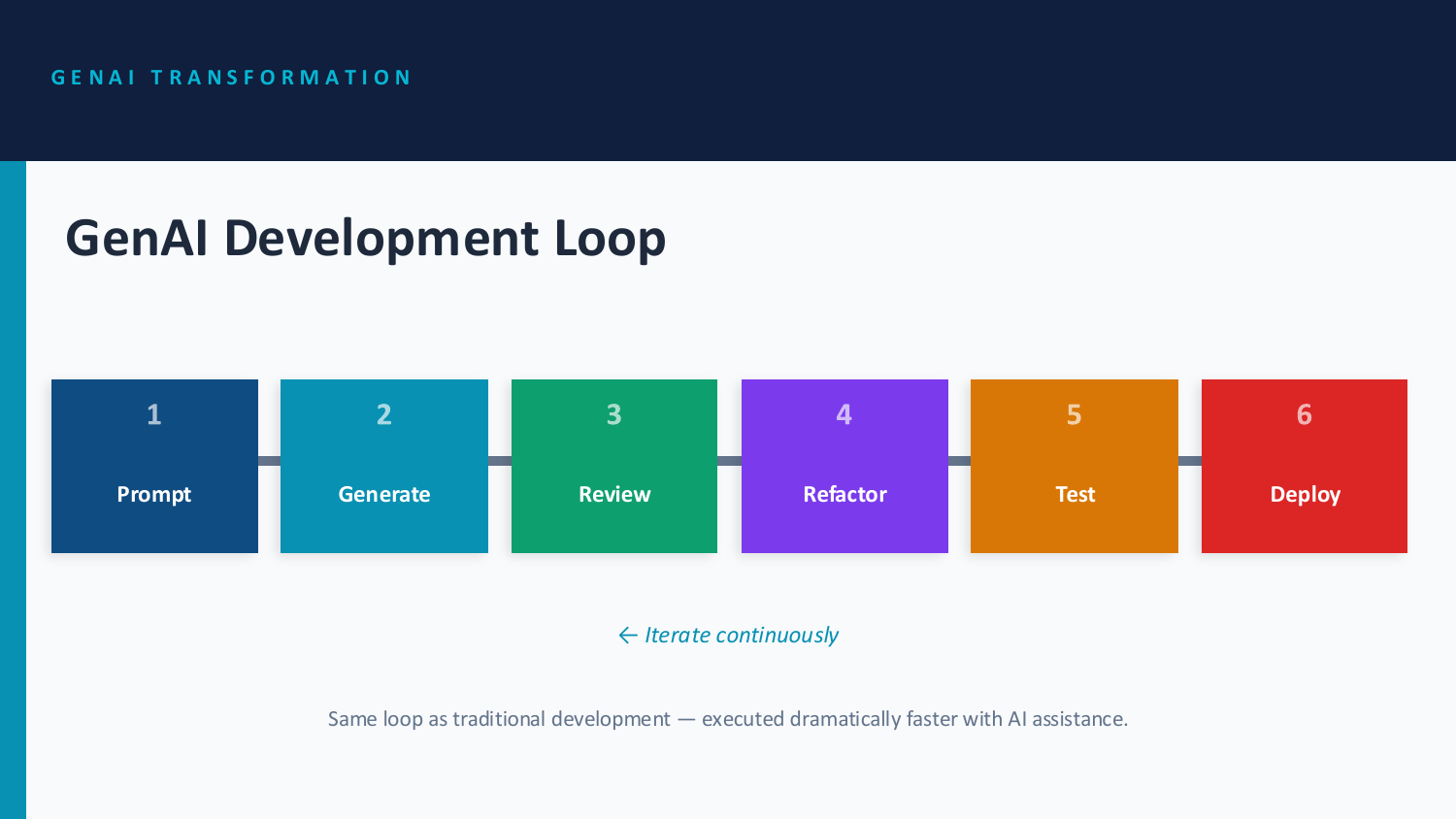
| Stage | What happens |
|---|
| 1. Prompt | Developer writes a plain-English description of the feature — no formal spec needed |
| 2. Generate | AI produces a working implementation in seconds, covering the core logic |
| 3. Review | Developer reads the generated code critically — checking correctness, security, and fit |
| 4. Refactor | Developer restructures and adapts the generated code to integrate with the existing codebase |
| 5. Test | Automated tests run immediately; feedback loop closes in minutes, not days |
| 6. Deploy | Tested, reviewed code goes through the deployment pipeline |
Important: The GenAI loop is the same as traditional development. The difference is speed: Prompt replaces hours of spec work; Generate replaces days of coding.
Traditional RAD vs GenAI RAD
| Attribute | Traditional RAD | GenAI RAD |
|---|
| Primary Tools | CASE tools & IDE | AI copilots & LLMs |
| Team Size | SWAT teams (6–10) | Small teams (2–4) |
| Cycle Time | Days to weeks | Hours to days |
| Prototyping | Manual mockups | AI-generated in minutes |
| Code Review | Peer review | AI-assisted + human oversight |
How Roles Are Shifting
| Traditional Role | GenAI Role | What changes |
|---|
| Developer | AI Orchestrator | Directs, validates, and integrates AI-generated code rather than writing everything manually |
| QA Engineer | Automation Designer | Designs AI-powered test strategies and pipelines rather than writing individual test cases |
| Business Analyst | Prompt Engineer | Translates requirements into precise AI instructions that generate the right output |
| Designer | AI UX Specialist | Integrates AI capabilities into user-centered workflows; governs AI-generated UI components |
Important: Human oversight is the constant across all role shifts. Roles move up the abstraction ladder — from doing to directing — but remain accountable for the output.
Risks of GenAI in Development
| Risk | Description | Mitigation |
|---|
| Hallucinated Code | AI generates plausible-looking code that is logically wrong or subtly broken | Always review — never ship unreviewed generated code |
| Security Risks | Vulnerabilities slip through when AI output isn't carefully audited | Security audit every generated file; treat AI output as untrusted until reviewed |
| Over-Reliance | Foundational skills erode when engineers stop thinking critically and delegate too much | Maintain core engineering practice; use AI as accelerator, not replacement |
| Hard Debugging | When AI-generated code fails, tracing the root cause can be significantly more complex | Review code before merging so you understand it; keep generated functions small |
Strategic Methodology Mapping
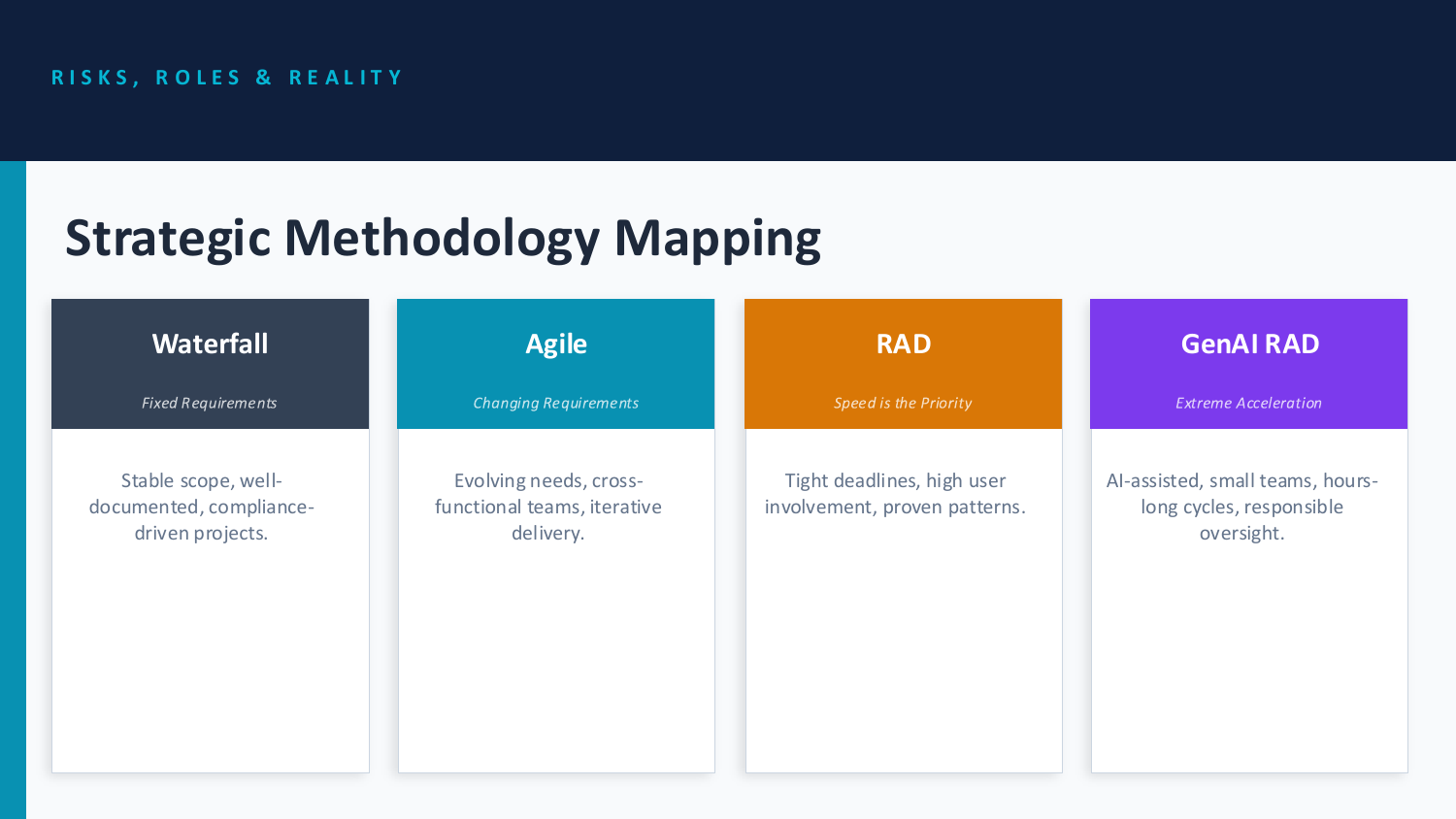
| Methodology | Context | When to use |
|---|
| Waterfall | Fixed Requirements | Stable scope, well-documented, compliance-driven projects |
| Agile | Changing Requirements | Evolving needs, cross-functional teams, iterative delivery |
| RAD | Speed is the Priority | Tight deadlines, high user involvement, proven patterns |
| GenAI RAD | Extreme Acceleration | AI-assisted, small teams (2–4), hours-long cycles, responsible oversight |
20 — Revenue Models and Software Licensing
Revenue Model vs Revenue Stream
| Term | Definition |
|---|
| Revenue Model | The strategy of managing a company's revenue streams and the resources required for each |
| Revenue Stream | A company's single source of revenue — a company can have zero or many revenue streams |
Four Revenue Models
| Model | Description | Examples |
|---|
| Transaction-based | Revenue generated by directly selling an item or service to a customer | Microsoft, Apple, Samsung |
| Advertisement-based | Revenue from selling ad space; used by high-traffic websites/apps/marketplaces | Google, YouTube, Facebook |
| Commission-based | A commission charged on transactions between buyers and sellers | Airbnb, Uber, Booking.com |
| Donation-based / Pay-what-you-want | Product/service is free; revenue generated from voluntary donations | Wikipedia, open-source projects |
Transaction-Based Sub-types (5)
| Sub-type | Description | Examples |
|---|
| Licensing / One-time purchase | Sell software by license; one payment for perpetual use | Microsoft Windows, Apache Server, video games |
| Subscription / Recurring payment | User pays monthly or annual fee for continued access | Netflix, Spotify, Adobe products |
| Pay-per-use | Charge for computing resources, memory, or time actually consumed | Amazon Web Services, Google Cloud Platform |
| Freemium / Upselling | Main product is free; charge for additional functions, services, or extensions | Skype, Dropbox, Evernote |
| Hybrid pricing | A mixture of more than one pricing model | Mailchimp, AWS higher tiers, Salesforce |
Important: Know the 5 transaction sub-types with examples. Freemium ≠ free: core is free, premium features are paid.
Software Licensing
Definition: A contract between the entity that created and supplied an application (or underlying source code) and its end user. Protects IP, provides legally binding definitions for distribution and use, spells out installation rights, warranties, liabilities, and IP protections.
License Categories — Ordered by Restrictiveness
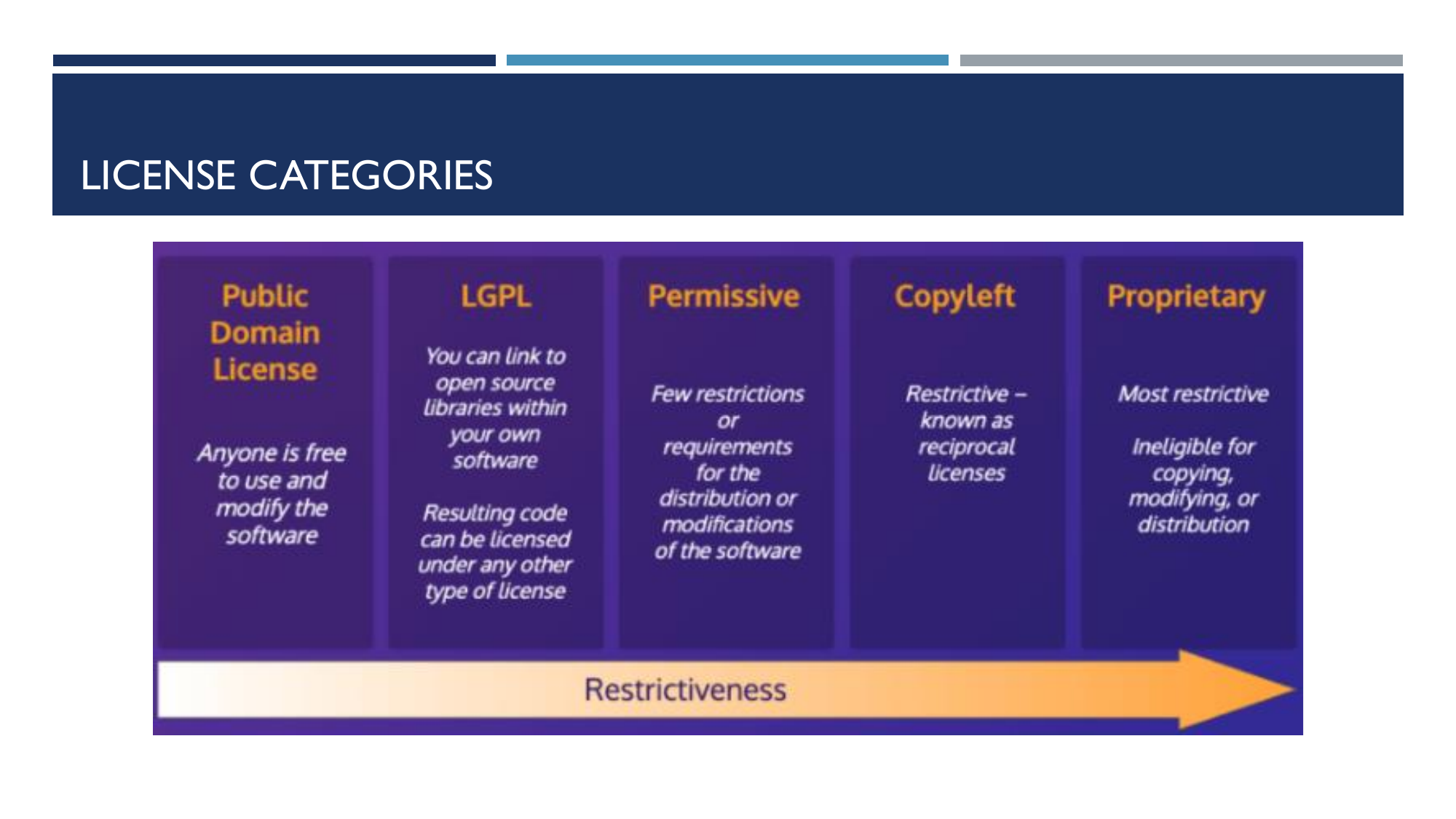
From least restrictive → most restrictive:
| License | Restrictiveness | Description | Examples |
|---|
| Public Domain | None | No legal, copyright, or editing restrictions. Free to use, modify, distribute, or sell without any restrictions | SQLite, ImageJ, SHA-3 |
| LGPL | Very low | Allows linking to open-source libraries within proprietary software. Resulting code can be licensed under any other type | VLC, 7zip |
| Permissive | Low | Few restrictions on distribution or modifications. Most common open-source license type. Variants: Apache, BSD, MIT | Apache, BSD, MIT licensed projects |
| Copyleft | Medium | Modified/distributed code must carry the same license (reciprocal). If original is "personal use only", derivative must also be "personal use only" | Linux kernel, OBS, GIMP |
| Proprietary | Most restrictive | Software ineligible for copying, modifying, or distribution. Protects developer/owner from unauthorized use | Spotify, Windows |
Copyleft vs Proprietary (Key Distinction)
| Copyleft | Proprietary |
|---|
| Can modify? | Yes — but derivative must carry same license | No |
| Can distribute? | Yes — under same license terms | No |
| Example | Linux kernel (GPL) — can modify but must release as GPL | Windows — cannot copy, modify, or distribute |
Important: The restrictiveness spectrum is: Public Domain → LGPL → Permissive → Copyleft → Proprietary. The most common exam confusion is between Copyleft (reciprocal — derivative inherits the license) and Proprietary (no copying/modifying at all).